
The Complete Guide to ChatGPT Ads for Marketers: How to Measure, Optimize, and Scale AI-Native Advertising Campaigns in 2026
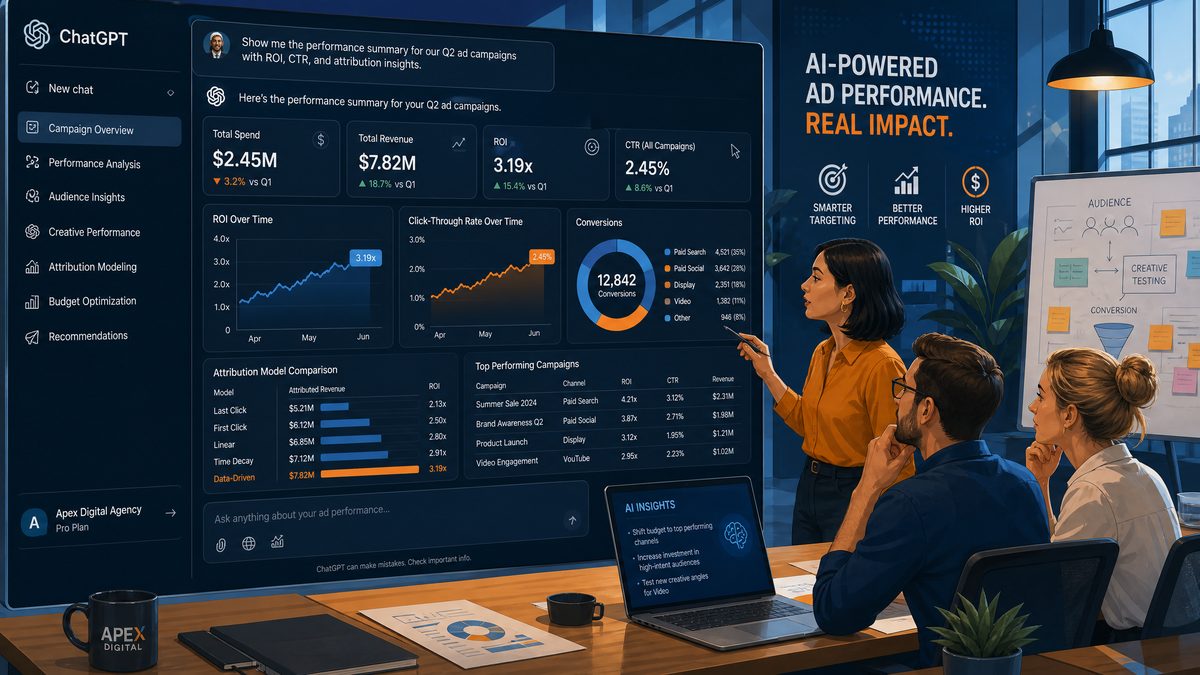
The Complete Guide to ChatGPT Ads for Marketers: How to Measure, Optimize, and Scale AI-Native Advertising Campaigns in 2026
When OpenAI quietly began rolling out sponsored results inside ChatGPT in late 2025, most marketing teams filed it under “interesting development, monitor closely.” By Q2 2026, that posture has become untenable. ChatGPT now processes more than 2 billion queries per day, and the platform’s advertising surface — spanning sponsored answers, product recommendation carousels, and contextual service placements — has evolved into a legitimate performance channel that enterprise brands can no longer afford to treat as experimental.
The integration of CallRail’s call-tracking infrastructure with ChatGPT’s ad platform, announced in May 2026, marked a turning point. For the first time, marketers can close the attribution loop between a conversational AI recommendation and an offline phone conversion — the same measurement standard that made paid search defensible to CFOs for two decades. That development, combined with OpenAI’s expanding self-serve ad console and its new campaign objective framework, means the playbook for ChatGPT advertising is finally mature enough to document systematically.
This guide is written for performance marketers, growth leads, and digital advertising directors who need to move beyond “we’re testing ChatGPT ads” and into a repeatable, measurable, scalable program. We’ll cover how the ad formats work, how attribution is structured in 2026, how to set up proper measurement infrastructure, and the optimization levers that actually move the needle — with specific examples, benchmark data, and configuration details throughout.
Understanding the ChatGPT Advertising Ecosystem in 2026
How ChatGPT Ads Actually Work
ChatGPT’s advertising model is fundamentally different from search advertising, social advertising, or display. The key distinction is that ads are injected into a conversational context — they appear as part of a response, not as a banner alongside content. This creates both the channel’s greatest opportunity and its most significant measurement challenge.
When a user asks ChatGPT “What’s the best project management software for a 50-person engineering team?”, the model generates a response that may include organic recommendations alongside sponsored placements. Sponsored results are labeled with a discrete “Sponsored” tag and are formatted to match the conversational tone of the surrounding answer. A sponsored result might read: “Many teams your size use Linear or Jira, but [Brand Name] has built specific features for engineering teams managing sprint cycles at scale — they offer a 30-day free trial.” The placement feels native to the conversation because it is native to the conversation.
OpenAI’s ad auction operates on a relevance-weighted CPM model with a cost-per-click billing option for direct-response campaigns. Advertisers bid on intent categories rather than keywords — a deliberate design choice that reflects how the model interprets queries rather than how users type them. The intent category taxonomy currently includes 47 top-level categories and more than 800 subcategories, with granularity comparable to Google’s audience segment library.
The Four Core Ad Formats
As of June 2026, ChatGPT’s advertising console supports four distinct placement formats, each with different performance characteristics and appropriate use cases:
1. Conversational Sponsored Answers
The flagship format. A sponsored text response integrated into ChatGPT’s answer to a relevant query. Advertisers provide a brand brief, key messages, and a call-to-action URL. OpenAI’s ad system generates the actual response text dynamically, ensuring it matches the conversational register of the surrounding content. Advertisers can review and approve generated copy templates before campaigns go live, and they can specify tone guardrails. This format performs best for consideration-stage campaigns where the goal is to shift a user’s mental shortlist.
2. Product Recommendation Cards
A structured card format that appears when users ask product-comparison or shopping-intent queries. Cards include a product image, headline, price (optional), key features (up to three bullet points), and a CTA button. This format is available to e-commerce and SaaS advertisers and integrates with product catalogs via a feed similar to Google Shopping’s structure. Average click-through rates on product recommendation cards are running 3.2–4.8% for well-matched intent categories, according to OpenAI’s Q1 2026 advertiser benchmarks.
3. Service Placement Links
A lighter-weight format designed for service businesses — agencies, consultancies, local businesses, and professional services. When a user asks a question that implies they may need professional help (“How do I set up a 401k for my small business?”), a service placement link appears as a discrete recommendation with a short descriptor and a URL. This format is particularly effective for high-intent, high-value service queries where the user is at or near a decision point.
4. Deep Research Sponsorships
The newest format, launched in March 2026. When users invoke ChatGPT’s Deep Research mode for extended analytical tasks, advertisers can sponsor specific sections of the research output — for example, a financial services firm sponsoring the “financing options” section of a research report on buying commercial real estate. This format carries the highest CPMs (often $45–$120 per thousand impressions) but also the highest engagement quality, as users are in a high-attention, high-intent research mode.
The Intent Category Framework
Understanding how OpenAI’s intent categorization works is essential for campaign setup. Unlike keyword bidding, where you control the exact trigger terms, intent category bidding means you’re targeting a model’s interpretation of what a user is trying to accomplish. This is both more powerful and more unpredictable than keyword targeting.
The intent category hierarchy works at three levels:
- Domain: The broad subject area (e.g., “Business Software,” “Financial Services,” “Home Services”)
- Intent Type: The user’s goal within that domain (e.g., “Evaluate Options,” “Get a Quote,” “Learn How To,” “Find a Provider”)
- Specificity Signal: Indicators of how far along the decision journey the user appears to be (“Exploratory,” “Comparative,” “Decision-Ready”)
Best-performing campaigns in 2026 are targeting the intersection of a specific domain, a “Comparative” or “Decision-Ready” intent type, and a specificity signal that indicates the user has already done some research. Broad “Exploratory” targeting tends to produce high impression volume but poor conversion efficiency.
Attribution Architecture: Closing the Loop on ChatGPT Ad Performance
Why ChatGPT Attribution Is Structurally Different
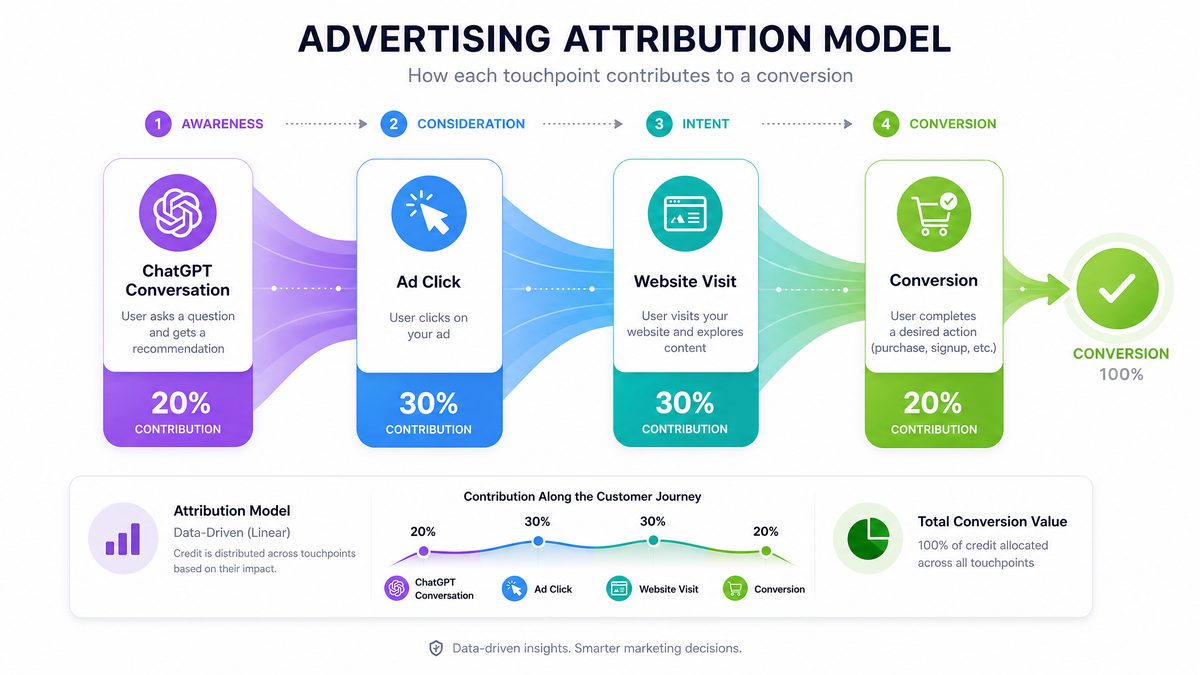
The attribution challenge with ChatGPT ads is not simply a matter of adding a new channel to your existing stack. The conversational nature of the platform creates attribution dynamics that don’t exist in search or social. Consider a user journey that looks like this: the user asks ChatGPT about project management tools, sees a sponsored mention of your product, doesn’t click, later Googles your brand name, converts through a paid search ad. In a last-click model, paid search gets full credit. In a data-driven model, the ChatGPT exposure may get partial credit — or none, if your measurement infrastructure doesn’t capture the exposure event.
OpenAI has addressed part of this problem through its Ad Attribution API, launched in January 2026. The API provides three types of signals: click events (when a user clicks a sponsored result), engagement events (when a user asks a follow-up question about a sponsored brand), and exposure events (when a sponsored result is rendered in a response). Exposure events are the most novel — this is essentially view-through attribution at the conversational level, and it requires careful handling to avoid over-crediting the channel.
The CallRail Integration: What It Actually Does
The CallRail integration announced in May 2026 solves a specific but critical problem: connecting ChatGPT ad exposures and clicks to phone call conversions. This matters enormously for industries where phone calls are the primary conversion mechanism — home services, healthcare, legal, financial services, automotive, and B2B with inside sales teams.
Here’s how the integration works technically:
- When a user clicks a ChatGPT ad that leads to a landing page, CallRail’s dynamic number insertion (DNI) system assigns a unique tracking phone number to that session, tagged with the ChatGPT campaign and ad group data passed through UTM parameters or the ChatGPT Ad Attribution API.
- When the user calls that number, CallRail records the call, captures duration and outcome data (if you’ve configured call scoring), and fires a conversion event back to the ChatGPT ad console via the Attribution API.
- For view-through attribution (where the user saw a sponsored result but didn’t click, then later called), CallRail’s Visitor Timeline feature can associate a subsequent site visit — identified through CallRail’s tracking script — with a prior ChatGPT exposure event if the user’s session data allows it.
- CallRail’s Conversation Intelligence layer can automatically score calls as “qualified lead,” “appointment booked,” or “not a fit” using AI transcription, feeding higher-quality conversion signals back into the ChatGPT ad optimization engine.
For enterprise advertisers running high call volume, this integration effectively gives ChatGPT ads the same measurement infrastructure that has made Google Local Services Ads and paid search defensible in call-heavy verticals.
For a deeper exploration of related enterprise AI strategies, our comprehensive guide on 10 Battle-Tested Prompts for marketers in 2026 provides detailed implementation frameworks and practical workflows that complement the approaches discussed in this article.
The practical implication is that you can now optimize ChatGPT campaigns toward qualified call conversions rather than just clicks or form fills — a significant upgrade in signal quality for the ad platform’s machine learning.
Building a Full-Funnel Attribution Model for ChatGPT Ads
For most enterprise advertisers, the right attribution approach for ChatGPT ads in 2026 is a hybrid model that combines platform-native attribution with your existing multi-touch attribution (MTA) or media mix modeling (MMM) infrastructure. Here’s a recommended framework:
Layer 1: Platform-Native Attribution (ChatGPT Ad Console)
Use OpenAI’s native attribution for campaign-level optimization decisions. The platform’s attribution window defaults to 7-day click, 1-day view, which is reasonable for most direct-response campaigns. For brand awareness and consideration campaigns, extend the view-through window to 14 or 30 days. Configure conversion events in the ChatGPT ad console for: purchase, lead form submission, phone call (via CallRail), free trial signup, and demo request — whatever your primary conversion actions are.
Layer 2: UTM Parameter Framework
Every ChatGPT ad should pass consistent UTM parameters to your analytics platform. Recommended structure:
utm_source=chatgpt
utm_medium=sponsored_answer | product_card | service_link | deep_research
utm_campaign=[campaign_name]
utm_content=[ad_group_name]
utm_term=[intent_category_slug]
This structure allows you to segment ChatGPT traffic cleanly in GA4, your CDP, or your BI tool, and to distinguish between the four ad formats — which have meaningfully different user behaviors and conversion rates.
Layer 3: Server-Side Conversion API
For high-value conversions (purchases, enterprise leads, booked appointments), implement the ChatGPT Conversions API (CAPI) in addition to client-side pixel tracking. CAPI sends conversion data server-to-server, bypassing browser privacy restrictions and ad blockers. In testing by several enterprise advertisers in Q1 2026, CAPI implementation improved measured conversion volume by 18–34% compared to pixel-only tracking — not because there were more conversions, but because more conversions were being attributed to the channel that drove them.
Layer 4: Media Mix Modeling Integration
For brands spending $500K+ per year on ChatGPT ads, integrate the channel into your MMM. ChatGPT ad spend and impression data can be exported via the Reporting API and fed into your MMM as a separate channel variable. Early MMM analyses from Q1 2026 are showing ChatGPT ads with halo effects on branded search volume — a finding consistent with the channel’s role in the consideration stage of the purchase journey.
Attribution Benchmarks by Vertical
| Vertical | Primary Conversion Type | Recommended Attribution Window | Avg. Click-to-Conversion Rate | Key Attribution Tool |
|---|---|---|---|---|
| B2B SaaS | Demo request / Free trial | 14-day click, 7-day view | 4.2% | CAPI + CRM integration |
| E-commerce | Purchase | 7-day click, 1-day view | 2.8% | CAPI + GA4 |
| Home Services | Phone call / Quote request | 3-day click, 1-day view | 6.1% | CallRail + CAPI |
| Healthcare | Appointment booking | 7-day click, 3-day view | 5.4% | CallRail + CAPI |
| Financial Services | Application start / Call | 14-day click, 7-day view | 3.7% | CallRail + CAPI |
| Legal | Consultation request / Call | 7-day click, 3-day view | 7.2% | CallRail + CAPI |
Campaign Setup: A Systematic Approach to ChatGPT Ad Configuration
Account Structure Best Practices
The account structure conventions that work well in Google Ads and Meta Ads translate imperfectly to ChatGPT’s platform. The fundamental difference is that you’re organizing around intent categories rather than keywords or audience segments. Recommended account structure:
- Campaign level: Organize by funnel stage (Awareness, Consideration, Decision) or by product line for large catalogs. Each campaign should have a single primary objective — don’t mix brand awareness and lead generation in the same campaign.
- Ad group level: Organize by intent domain and intent type combination. For example: “Business Software — Evaluate Options” and “Business Software — Decision Ready” should be separate ad groups, because the appropriate ad copy, landing page, and bid strategy differ significantly between them.
- Ad level: For Conversational Sponsored Answers, create 3–5 brand brief variations per ad group, testing different value propositions, proof points, and CTAs. The platform will dynamically generate copy from your brief, but the brief’s content directly shapes output quality.
Writing Effective Brand Briefs for Conversational Ads
The brand brief is the most important input for Conversational Sponsored Answer campaigns. Unlike writing ad copy for search or social, you’re not writing the final ad text — you’re writing instructions that guide the model’s generation of ad text. This requires a different skill set.
A high-performing brand brief includes six components:
- Core value proposition (1–2 sentences): What your product or service does and why it’s better. Be specific. “We help engineering teams ship 40% faster by eliminating sprint planning overhead” outperforms “We’re a leading project management solution.”
- Target user descriptor: Who the ideal user is, in plain language. “Engineering managers at companies with 20–200 developers who are frustrated with Jira’s complexity.” This helps the model calibrate the response’s technical level and frame of reference.
- Key proof points (3–5 bullets): Specific, verifiable claims. Customer logos, usage statistics, awards, pricing transparency. “Used by engineering teams at Stripe, Figma, and Notion” is better than “trusted by thousands of companies.”
- Tone guardrails: How the brand should sound. “Direct and confident, not salesy. Use technical language appropriate for senior engineers. Avoid superlatives.”
- Objection handling: The one or two most common reasons prospects don’t convert, and how to address them. “If the user seems concerned about migration complexity, mention our white-glove onboarding team.”
- Call to action: The specific action you want the user to take, with the landing page URL. Be precise about what happens when they click — “Start a free 30-day trial, no credit card required” sets clearer expectations than “Learn more.”
Bid Strategy Selection
ChatGPT’s ad console offers four bid strategies, and selection has significant performance implications:
Target CPA (tCPA)
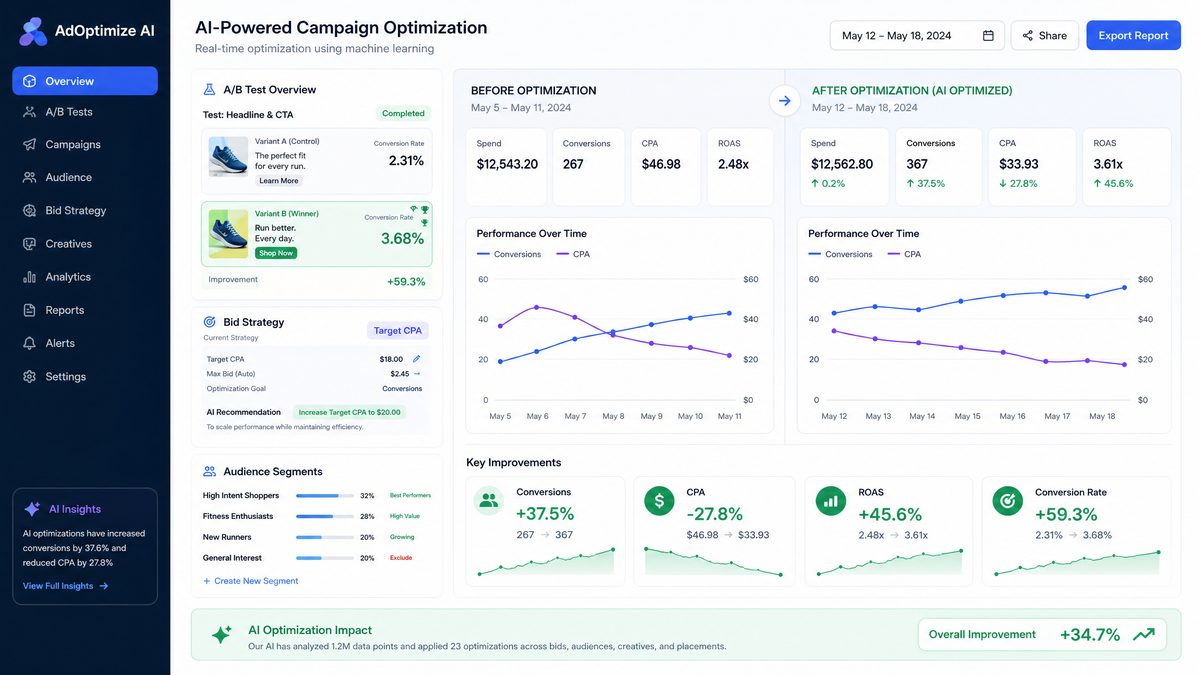
The recommended strategy for direct-response campaigns with established conversion history. Requires at least 30–50 conversions in the past 30 days to function effectively. Set your target CPA at 10–20% above your actual target initially to give the algorithm room to learn, then tighten over 4–6 weeks as the model accumulates data.
Target ROAS (tROAS)
Best for e-commerce advertisers with product catalog campaigns. Requires revenue values passed with conversion events. Works well when average order values vary significantly across product categories — the algorithm learns to prioritize impressions for higher-value queries.
Maximize Conversions
Appropriate for new campaigns without conversion history, or for campaigns in low-volume intent categories where tCPA can’t accumulate enough data. Set a maximum CPM cap to prevent runaway spend during the learning phase.
Manual CPM
Useful for brand awareness campaigns where impression delivery is the primary goal, or for advertisers who want full control during initial testing. Not recommended for performance campaigns — the platform’s automated bidding consistently outperforms manual CPM for conversion objectives once the learning phase is complete.
Landing Page Requirements for ChatGPT Ad Traffic
ChatGPT ad traffic has a distinct behavioral profile compared to search or social traffic. Users arriving from a ChatGPT sponsored result have typically just read a conversational explanation of your product or service. They arrive with more context than a typical search click, but they’re also in a different cognitive mode — they’ve been in a conversational, exploratory mindset, not a transactional “I’m going to buy now” mindset.
Landing pages for ChatGPT ad traffic should be optimized for this profile:
- Lead with the specific claim made in the sponsored answer. If the ad mentioned your white-glove onboarding, the landing page should feature onboarding prominently. Message match between the sponsored answer and the landing page is more important here than in search, because the conversational context has already set specific expectations.
- Reduce friction aggressively. ChatGPT users are often mid-session — they’re in the middle of a research task. Long forms, mandatory phone number fields, and multi-step processes cause disproportionate drop-off. Aim for the minimum viable conversion action: email address, one-click trial signup, or a prominent phone number (with CallRail tracking).
- Include social proof specific to the query context. If your ad appeared in response to a question about “project management for remote teams,” your landing page should feature testimonials or case studies from remote teams — not generic enterprise logos.
- Page speed is non-negotiable. ChatGPT users are accustomed to instant responses. A landing page that takes more than 2 seconds to load loses a measurable percentage of ChatGPT-sourced traffic. Target sub-1.5 second LCP.
Optimization Strategies: What Actually Moves the Needle
The ChatGPT Ad Quality Score Framework
OpenAI uses a Quality Score analog — internally called “Relevance Score” — that affects both ad delivery and effective CPM. Unlike Google’s Quality Score, which is largely transparent, ChatGPT’s Relevance Score is a composite metric with limited visibility. However, based on advertiser reporting and OpenAI’s published documentation, the score is influenced by four primary factors:
- Intent match rate: How well the ad’s brand brief aligns with the queries in the targeted intent categories. Measured by the platform’s own relevance model.
- Engagement rate: The percentage of users who click, follow up with a question about the brand, or take the CTA action after seeing the sponsored result.
- Landing page quality: Assessed via a crawl of your landing page, evaluating content relevance, load speed, and user experience signals.
- Conversion signal quality: Whether your conversion tracking is properly implemented and sending clean signals. Campaigns with CAPI implemented consistently show better Relevance Scores than pixel-only campaigns, likely because the signal quality is higher.
A/B Testing Framework for ChatGPT Ads
Testing in ChatGPT’s ad platform requires a different cadence than search or social. Because the platform generates ad copy dynamically from your brand brief, you’re not A/B testing specific ad copy variations — you’re testing brand brief variations, intent category targeting variations, and landing page variations.
Recommended testing priority order:
Test 1: Intent Category Specificity
Run the same brand brief against broad intent categories vs. narrow, high-specificity intent categories. In most verticals, narrower targeting produces better conversion rates at higher CPMs, but the volume-efficiency tradeoff varies by category. Test with equal budgets for 2–3 weeks before drawing conclusions.
Test 2: Funnel Stage Targeting
Test “Exploratory” vs. “Comparative” vs. “Decision-Ready” specificity signals for your top intent categories. This is often the highest-leverage test available — Decision-Ready targeting typically converts at 2–4x the rate of Exploratory targeting, but at significantly higher CPMs. Calculate your effective CPA at each specificity level to determine the optimal mix.
Test 3: Brand Brief Value Proposition
Test different core value propositions in your brand brief. For a B2B SaaS product, this might mean testing a speed/efficiency value prop against a cost-reduction value prop against a compliance/risk-reduction value prop. Each appeals to different buyer personas who may be asking similar questions from different motivations.
Test 4: CTA Type and Offer
Test different calls to action: free trial vs. demo request vs. case study download vs. pricing page. In B2B, demo requests often convert to pipeline at higher rates than free trials despite lower click-through rates. In e-commerce, testing “Shop Now” vs. “See [X]% Off” vs. “Find Your Perfect [Product]” can produce meaningful conversion rate differences.
Test 5: Ad Format
If you’re eligible for multiple formats, test Conversational Sponsored Answers against Product Recommendation Cards for the same intent categories. The formats attract different user behaviors, and the “right” format varies by product type, price point, and purchase complexity.
Negative Intent Category Management
One of the most underutilized optimization levers in ChatGPT ads is negative intent category exclusions. Just as negative keywords in search prevent ads from showing on irrelevant queries, negative intent category exclusions prevent your ads from appearing in conversational contexts that are poor matches for your offer.
Common negative intent categories that enterprise advertisers should consider:
- “Learn How To” intent type for direct-response campaigns — users asking how to do something themselves are rarely in a buying mindset for a service that does it for them.
- “Academic Research” specificity signal — users writing papers or conducting academic research are not purchase-intent users.
- Competitor brand domains (if you’re not running a conquesting strategy) — appearing in responses about competitors when you haven’t designed your messaging for that context produces poor engagement.
- “Troubleshooting” intent type for acquisition campaigns — users troubleshooting existing products are not acquisition targets (though they may be retention targets for a different campaign).
Dayparting and Budget Pacing
ChatGPT usage patterns differ from search in important ways. Search volume spikes around commercial intent moments (lunch breaks, evenings for consumer, business hours for B2B). ChatGPT usage is more evenly distributed throughout the day, with notable spikes during “research sessions” — early morning (6–9 AM) and late evening (8–11 PM) for consumers, and mid-morning (9–11 AM) for B2B users.
For B2B campaigns, consider running at full budget during business hours (8 AM–6 PM in target time zones) and reducing to 30–40% budget outside those hours. Conversion rates for B2B demo requests are measurably lower for clicks that occur outside business hours, even when the conversion itself happens during business hours — the session intent is different.
For e-commerce and consumer campaigns, avoid aggressive dayparting unless your data shows clear patterns. The evening research sessions (8–11 PM) often produce strong conversion rates for considered purchases, as users are in a relaxed, exploratory mode with time to complete a purchase.
Scaling ChatGPT Ad Campaigns: From Test to Full Investment
The Scaling Framework
Scaling ChatGPT ad spend requires a different approach than scaling search or social. The platform’s inventory is constrained by the actual volume of relevant queries — you can’t simply increase your bid and get proportionally more impressions in a specific intent category. Scaling requires expanding your addressable inventory through one of four mechanisms:
Horizontal Scaling: Expand Intent Categories
Identify adjacent intent categories where your product or service is relevant but you haven’t yet been targeting. Use the ChatGPT Insights tool (available in the ad console under “Audience Intelligence”) to see which intent categories your existing converters were in before converting. This often reveals intent categories you wouldn’t have predicted — a project management tool might find high-converting traffic in “remote team communication” or “engineering hiring” intent categories, not just “project management software.”
Vertical Scaling: Increase Bid Competitiveness
In intent categories where you’re already converting efficiently, increase your tCPA target or maximum CPM to capture a higher share of available impressions. The platform’s auction dynamics mean that moderate bid increases (20–40%) often produce disproportionate impression share gains, as many competitors are bidding at floor prices. Monitor your impression share metric in the ad console — if you’re below 40% impression share in a high-converting category, there’s room to scale with bid increases.
Format Expansion: Add New Ad Formats
If you’re running Conversational Sponsored Answers only, adding Product Recommendation Cards or Service Placement Links in the same intent categories effectively doubles your inventory access without competing with your existing campaigns. Different users respond to different formats — some users are more likely to click a structured card than a conversational mention, and vice versa.
Geographic Expansion: New Markets
ChatGPT’s ad platform is available in 38 markets as of June 2026, with varying levels of inventory depth. English-language markets (US, UK, Canada, Australia) have the deepest inventory and most competitive auctions. German, French, Japanese, and Spanish-language markets have grown substantially in 2026 but remain less competitive, often with 30–60% lower CPMs than equivalent US intent categories. For brands with international operations, geographic expansion is often the highest-ROI scaling path.
Budget Allocation Across the Funnel
Based on performance data from enterprise advertisers across verticals, the following budget allocation framework has emerged as a starting point for full-funnel ChatGPT ad programs:
| Funnel Stage | Recommended Budget % | Primary Objective | Primary Format | Key Metric |
|---|---|---|---|---|
| Awareness | 15–20% | Brand recall, category association | Conversational Sponsored Answers | Impression share, brand lift |
| Consideration | 35–45% | Shortlist inclusion, engagement | Conversational Sponsored Answers, Deep Research Sponsorships | Engagement rate, follow-up question rate |
| Decision | 35–45% | Conversion, lead generation | Product Cards, Service Links, Conversational Answers | CPA, ROAS, qualified call rate |
| Retention/Upsell | 5–10% | Expansion revenue, churn prevention | Conversational Sponsored Answers | Expansion MRR, retention lift |
Integration with Existing Channel Mix
ChatGPT ads don’t exist in isolation — they interact with your existing paid search, paid social, and organic channels in ways that require deliberate management.
For a deeper exploration of related enterprise AI strategies, our comprehensive guide on Advanced Prompt Patterns for automation: Working Examples for Gemini 3.1 Pro and Cursor provides detailed implementation frameworks and practical workflows that complement the approaches discussed in this article.
Several integration patterns have emerged from enterprise advertisers who’ve been running ChatGPT ads for 6+ months:
The ChatGPT-to-Search Handoff
Many users who see a sponsored result in ChatGPT don’t click immediately — they finish their research session and later search for the brand directly. This creates a branded search volume lift that is attributable to ChatGPT ad exposure but captured by your paid search campaigns. Brands running ChatGPT ads consistently report 12–28% increases in branded search volume in markets where they’ve launched ChatGPT advertising. Configure your MMM to account for this spillover effect, and don’t reduce branded search budgets when you launch ChatGPT ads — you’ll need the capacity to capture the demand you’re generating.
The Retargeting Audience Seed
Users who click ChatGPT ads and visit your site can be added to retargeting audiences in Google Ads and Meta Ads, using the UTM parameters you’ve configured for ChatGPT traffic. These audiences have demonstrated high intent (they were researching in a conversational AI environment, saw your brand, and clicked) and typically convert at higher rates in retargeting than general site visitors. Build a “ChatGPT Clickers” retargeting segment and test it against your standard site visitor retargeting audiences.
Content Alignment with ChatGPT Organic
ChatGPT’s organic responses draw heavily on web content — your blog posts, product pages, and documentation. Advertisers who invest in content that aligns with the intent categories they’re targeting in paid campaigns see better Relevance Scores, because the model’s understanding of their brand is reinforced by the organic content it has indexed. This creates a virtuous cycle where paid and organic ChatGPT presence reinforce each other.
ROI Measurement and Reporting for ChatGPT Ads
Building a ChatGPT Ads Performance Dashboard
A complete ChatGPT ads performance dashboard should include four reporting layers, each answering different questions for different stakeholders:
Layer 1: Campaign Health (Daily)
For campaign managers. Metrics: impressions, clicks, CTR, CPM, CPC, conversions, CPA, conversion rate, Quality Score/Relevance Score, budget utilization. Alert thresholds: Relevance Score drops below 6/10, CPA exceeds target by 30%, impression share drops below 20% in key categories.
Layer 2: Funnel Performance (Weekly)
For growth and marketing leads. Metrics: leads by stage, lead-to-opportunity rate for ChatGPT-sourced leads, pipeline generated, average deal size from ChatGPT-sourced leads, call conversion rate (from CallRail), cost per qualified lead. Compare against other channels to assess relative efficiency.
Layer 3: Attribution Analysis (Monthly)
For marketing directors and CMOs. Metrics: ChatGPT ads contribution to total conversions across all attribution models (last-click, data-driven, first-click), branded search volume lift, cross-channel influence rate, MMM-attributed revenue contribution.
Layer 4: Business Impact (Quarterly)
For C-suite and board reporting. Metrics: revenue attributed to ChatGPT ads (using your MMM), customer acquisition cost from ChatGPT channel, LTV:CAC ratio for ChatGPT-acquired customers, market share indicators in targeted intent categories.
Benchmarking ChatGPT Ad Performance
One of the most common questions from enterprise advertisers is “how do our ChatGPT ad metrics compare to the market?” The following benchmarks are compiled from OpenAI’s Q1 2026 advertiser data and third-party agency reporting:
| Metric | Bottom Quartile | Median | Top Quartile |
|---|---|---|---|
| CTR (Conversational Answer) | 0.8% | 2.1% | 4.6% |
| CTR (Product Card) | 1.4% | 3.2% | 6.8% |
| CTR (Service Link) | 1.1% | 2.7% | 5.4% |
| Landing Page Conversion Rate | 1.2% | 3.4% | 7.8% |
| CPM (Consideration Intent) | $8 | $18 | $42 |
| CPM (Decision Intent) | $22 | $38 | $85 |
| Engagement Rate (Follow-up questions) | 0.3% | 1.1% | 3.2% |
| Relevance Score | 4.2/10 | 6.8/10 | 8.4/10 |
Calculating True ROI: Beyond Last-Click CPA
The most common mistake enterprise advertisers make when evaluating ChatGPT ads is applying last-click attribution and comparing the resulting CPA directly against search or social CPAs. This methodology systematically undervalues ChatGPT ads because of the channel’s role in the consideration stage — it influences decisions that convert through other channels.
A more accurate ROI calculation for ChatGPT ads uses a three-component model:
- Direct attributed revenue: Revenue from conversions where ChatGPT ads received credit in your data-driven attribution model. This is your baseline.
- Assisted conversion value: Revenue from conversions where ChatGPT ads appeared in the conversion path but didn’t receive last-click credit. Calculate this using your path analysis data in GA4 or your MTA platform. Apply a discount factor (typically 30–50%) to avoid double-counting with other channels.
- Branded search lift value: The incremental revenue generated by the increase in branded search volume attributable to ChatGPT ad exposure. Calculate by measuring branded search volume in test markets before and after ChatGPT ad launch, applying your branded search conversion rate and average order value.
When enterprise advertisers apply this three-component model, the effective ROAS of ChatGPT ad programs typically increases by 40–80% compared to last-click attribution — often moving a channel that looked marginal under last-click to clearly positive ROI under full-value attribution.
Compliance, Brand Safety, and Creative Governance
Brand Safety Controls
One of the legitimate concerns enterprise advertisers have about ChatGPT ads is brand safety — specifically, the risk that a dynamically generated sponsored answer might misrepresent your product, make unsubstantiated claims, or appear in a conversational context that’s inappropriate for your brand.
OpenAI has built several brand safety controls into the platform:
- Copy approval workflow: Before any dynamically generated ad copy goes live, you can review a sample of generated copy templates and flag any that don’t meet your brand standards. The platform will regenerate alternatives based on your feedback.
- Claim verification layer: The ad system cross-references claims in generated copy against your brand brief. If the system generates a claim that isn’t supported by your brief, it flags it for human review rather than publishing it.
- Context exclusion lists: You can specify topic categories where your ads should never appear, regardless of intent category match. Common enterprise exclusions include: political topics, health crisis discussions, legal disputes, and competitor brand mentions.
- Sensitive category opt-outs: For regulated industries (healthcare, financial services, legal), the platform has pre-built sensitive category frameworks that apply additional compliance guardrails to generated copy.
Regulatory Compliance Considerations
ChatGPT ads are subject to the same advertising regulations as other digital channels — FTC disclosure requirements, GDPR/CCPA data handling requirements, and vertical-specific regulations (HIPAA for healthcare, FINRA for financial services, etc.). Several compliance considerations are specific to the conversational AI context:
- Disclosure clarity: The FTC’s guidance on AI-generated advertising content requires clear disclosure that sponsored content is advertising. OpenAI’s “Sponsored” label meets this requirement, but advertisers should ensure their legal teams have reviewed the specific disclosure format for compliance in their jurisdiction.
- Data minimization in CAPI: When implementing the Conversions API, ensure you’re only sending the minimum necessary personal data to OpenAI’s servers. Hash all personal identifiers (email, phone) before transmission, and review your data processing agreement with OpenAI.
- Healthcare and financial services copy review: For regulated verticals, establish a human review workflow for all generated ad copy before it goes live, even if the platform’s automated review has approved it. Compliance risk in these verticals is too high to rely solely on automated guardrails.
The Future of ChatGPT Advertising: What’s Coming in Late 2026
Announced Platform Developments
OpenAI has publicly announced several advertising platform developments scheduled for H2 2026 that enterprise advertisers should be planning for now:
Voice Interface Advertising
ChatGPT’s voice interface (Advanced Voice Mode) is being integrated into the advertising platform. Voice-native ad formats will allow sponsored mentions within voice responses — a format with no direct precedent in digital advertising. OpenAI has committed to audio disclosure requirements (a distinct audio tone before sponsored content) and is working with the FTC on disclosure standards. Enterprise advertisers in home services, local services, and consumer categories should begin developing voice-optimized brand briefs now.
Agentic Task Advertising
As ChatGPT’s agentic capabilities expand — the ability to take actions on behalf of users, like booking appointments, making purchases, or completing research tasks — OpenAI is developing an “agentic commerce” advertising format. This would allow advertisers to sponsor specific actions: “When a user asks ChatGPT to book a hotel in Chicago, show [Brand]’s available inventory.” This format is in closed beta with a small number of travel and hospitality partners, with broader availability expected in Q4 2026.
Enhanced Audience Intelligence
OpenAI is expanding its Audience Intelligence tools to provide advertisers with aggregate (privacy-safe) data about the users engaging with their intent categories — demographic signals, behavioral patterns, and cross-category interest data. This will enable more sophisticated audience targeting and will make ChatGPT ads more competitive with Meta’s audience targeting capabilities for brand campaigns.
Strategic Implications for Enterprise Advertisers
The trajectory of ChatGPT advertising in 2026 points toward a future where conversational AI is a primary channel for consumer and B2B research and decision-making — not a supplementary tool. Brands that build measurement infrastructure, optimization expertise, and creative capabilities for this channel now will have meaningful advantages over competitors who wait until the channel is fully mature and competitive.
The most important strategic investments to make in the next 12 months are: first, measurement infrastructure (CAPI implementation, CallRail integration, MMM integration) — this is the foundation everything else depends on; second, brand brief development and testing — the quality of your brand brief is the primary creative lever in this channel, and developing institutional expertise in writing effective briefs is a durable competitive advantage; third, organizational alignment — ChatGPT ads sit at the intersection of paid media, content strategy, and brand marketing, and organizations that break down silos between these functions will optimize the channel more effectively than those that treat it as purely a performance marketing responsibility.
Quick-Start Checklist for Enterprise ChatGPT Ad Programs
For marketing teams ready to move from planning to execution, the following checklist covers the essential setup steps for a properly instrumented ChatGPT ad program:
Measurement Setup (Week 1–2)
- Implement ChatGPT Pixel on all landing pages and conversion pages
- Configure Conversions API (CAPI) for primary conversion events
- Set up UTM parameter framework and verify data flow into GA4/analytics platform
- Integrate CallRail with ChatGPT ad console (if phone calls are a primary conversion)
- Configure conversion events in ChatGPT ad console with appropriate attribution windows
- Create “ChatGPT Clickers” retargeting audience in Google Ads and Meta Ads
Campaign Setup (Week 2–3)
- Audit intent category taxonomy and identify top 10–15 target categories
- Build account structure: campaigns by funnel stage, ad groups by intent domain + intent type
- Write brand briefs for top 3–5 ad groups (minimum 3 brief variations per ad group)
- Configure negative intent category exclusions
- Set bid strategies: Maximize Conversions for new campaigns, tCPA for established campaigns
- Configure brand safety controls and copy approval workflow
Landing Page Optimization (Week 2–4)
- Audit existing landing pages for message match with ChatGPT ad brand briefs
- Optimize page speed (target <1.5s LCP)
- Implement minimal friction conversion forms
- Add context-specific social proof aligned with target intent categories
- Verify CallRail DNI is functioning on all ChatGPT-targeted landing pages
Reporting Setup (Week 3–4)
- Build campaign health dashboard (daily metrics)
- Configure automated alerts for key performance thresholds
- Set up weekly funnel performance report
- Establish baseline branded search volume for pre/post comparison
- Schedule monthly attribution analysis review
Access 40,000+ AI Prompts for ChatGPT, Claude & Codex — Free!
Subscribe to get instant access to our complete Notion Prompt Library — the largest curated collection of prompts for ChatGPT, Claude, OpenAI Codex, and other leading AI models. Optimized for real-world workflows across coding, research, content creation, and business.
Conclusion: ChatGPT Ads as a Mature Performance Channel
ChatGPT advertising has crossed the threshold from experimental to essential for enterprise brands in competitive categories. The combination of OpenAI’s expanding ad format portfolio, the CallRail integration closing the phone attribution loop, and the platform’s growing query volume means that the measurement, optimization, and scaling infrastructure that makes paid search defensible is now available for AI-native advertising.
The marketers who will win in this channel are not those who simply port their search or social playbooks into ChatGPT’s interface. They’re the ones who understand the conversational intent model that underlies the platform, who build measurement infrastructure that captures the channel’s full-funnel influence, and who invest in the creative capability — specifically, brand brief writing — that this format demands.
The fundamentals haven’t changed: match your message to your audience’s intent, measure what matters, optimize relentlessly, and scale what works. What has changed is the environment in which those fundamentals operate — and that environment is now conversational, AI-native, and growing faster than any advertising channel since the early days of paid search. The brands that take it seriously in 2026 will be the ones setting the benchmarks that everyone else is chasing in 2027.