
25 ChatGPT Prompts for Parents Managing Their Teen’s AI Usage: Screen Time, Digital Literacy, Homework Help Boundaries, and Online Safety Conversations
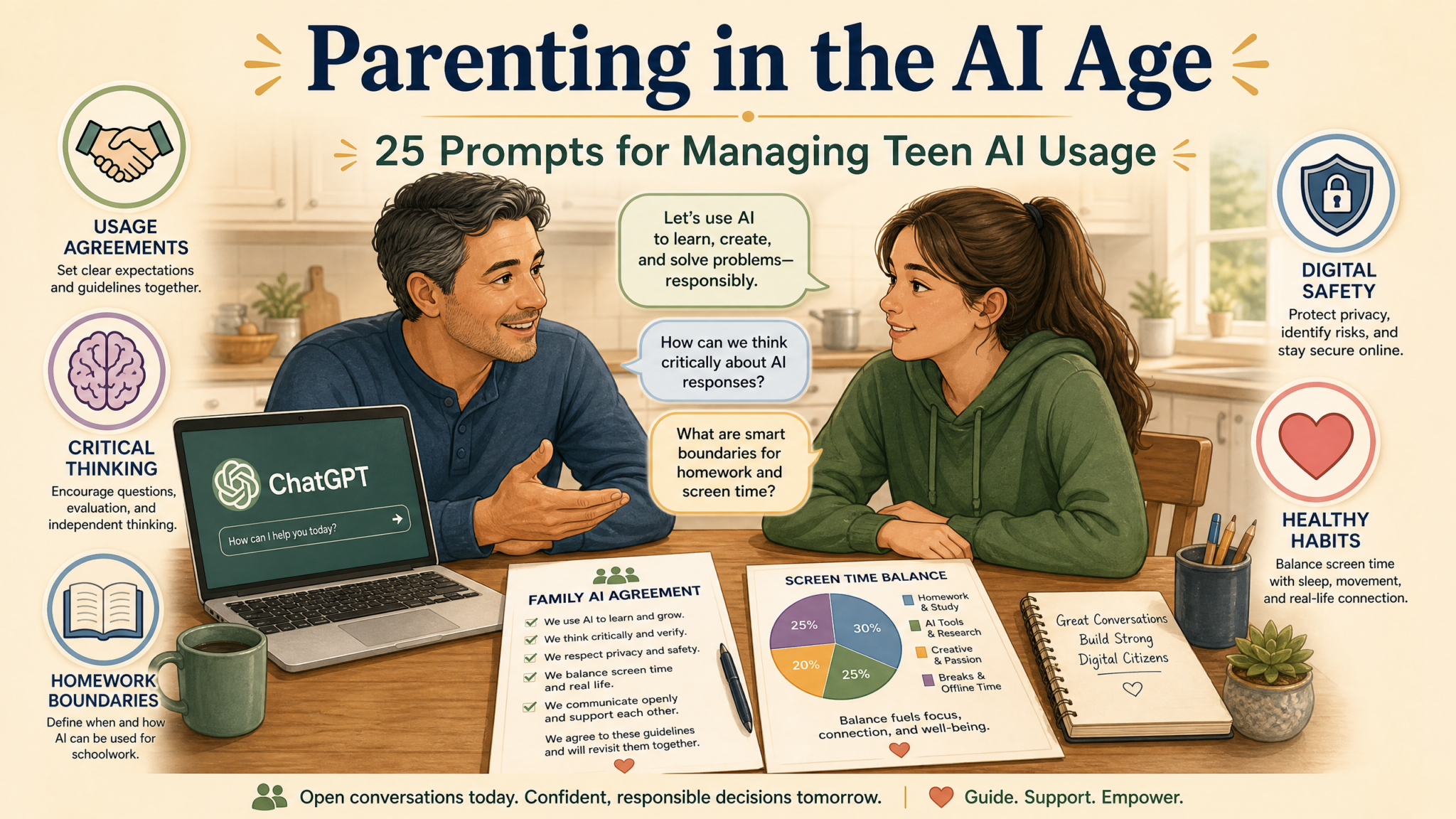
25 ChatGPT Prompts for Parents Managing Their Teen’s AI Usage: Screen Time, Digital Literacy, Homework Help Boundaries, and Online Safety Conversations
When OpenAI officially launches ChatGPT for Teens on August 18, 2026, millions of parents across the United States and globally will face an inflection point they have never encountered before. Unlike social media, gaming, or even smartphones — tools that parents could learn to monitor through parental controls and screen time dashboards — AI represents something fundamentally different: a technology that can write, think, reason, and respond in ways that are indistinguishable from a knowledgeable adult. A teenager with unrestricted, unguided access to an AI system is simultaneously empowered and at risk in ways that previous generations of parents never had to navigate. This is the parenting challenge of the 2020s.
The numbers tell a story that is both exciting and sobering. According to a 2025 Pew Research Center survey, 72% of teenagers aged 13–17 reported using AI chatbots for schoolwork at least once per month, while only 38% of their parents said they had discussed AI usage rules with their children. A separate Common Sense Media study found that adolescents who receive guided instruction on AI literacy demonstrate significantly higher critical thinking scores and are three times less likely to submit AI-generated content as their own work. The gap between teen AI adoption and parent-guided AI literacy is one of the most urgent digital parenting challenges of our era.
This is precisely why AI itself can be one of your most powerful tools as a parent. ChatGPT can help you draft agreements, prepare difficult conversations, design learning workflows, and think through scenarios you have not yet encountered. The 25 prompts in this masterclass are designed to help you use ChatGPT as a co-pilot in the very task of managing your teenager’s ChatGPT usage — a meta-approach that is entirely appropriate given the complexity of the challenge.
Each prompt in this guide has been written for parents who are not necessarily tech experts but who are thoughtful, engaged, and committed to raising digitally literate, ethically grounded teens. You will find prompts organized into five critical categories, each with deep context, conversation starters, and guidance on how to adapt the outputs you receive from ChatGPT to your unique family situation.
Why Parents Need AI Tools to Manage Teen AI Usage
Before diving into the prompts, it is worth understanding why ChatGPT’s official teen platform launch in August 2026 represents such a significant moment — and why a reactive, control-focused approach to teen AI usage is almost certainly going to backfire.
OpenAI’s ChatGPT for Teens is designed with specific safeguards for users aged 13–17, including more conservative content filters, enhanced data privacy protections, and usage monitoring features. This is meaningfully different from a teenager simply creating an adult account with a fake birthdate, which has been the reality for most teen AI users prior to 2026. The official teen platform legitimizes AI as part of adolescent digital life in the same way that education-focused app stores legitimized app usage in schools a decade earlier.
This legitimization creates both opportunity and obligation for parents. The opportunity is that conversations about AI are now socially sanctioned — your teenager’s school, their friends, and their future employers all expect AI fluency. The obligation is that you cannot simply block it. Attempting to prohibit AI usage entirely is no more effective than prohibiting smartphone use was in 2012. What works, as decades of digital parenting research have demonstrated, is guided, discussed, boundaried engagement combined with the development of intrinsic critical thinking skills.
Here is where ChatGPT becomes a remarkable resource for parents. You can use it to:
- Draft family AI agreements tailored to your teenager’s age, academic level, and maturity
- Prepare yourself with talking points before difficult conversations
- Generate age-appropriate exercises that help teens recognize AI limitations
- Create homework workflows that distinguish legitimate AI tutoring from academic dishonesty
- Model responsible AI usage to your teenager through your own transparent, thoughtful use
The prompts that follow are not magic scripts. They are starting points — frameworks that ChatGPT will expand and customize based on the details you provide about your family, your teenager’s age and school environment, and your own values and concerns. The more specific context you give ChatGPT in these prompts, the more useful and tailored the outputs will be.
ChatGPT for Teens Safety Features and Parental Controls Guide
Category 1: Setting Up AI Usage Agreements
Why AI Usage Agreements Matter
A family AI usage agreement is not a punishment document — it is a shared understanding. Research in adolescent psychology consistently shows that teenagers who participate in creating rules are significantly more likely to follow them. The act of negotiating an AI agreement with your teenager is itself a powerful exercise in digital literacy, because it requires both of you to think explicitly about values, consequences, and what “responsible use” actually means in practice.
The five prompts in this section will help you create, refine, implement, and maintain an AI agreement that grows with your teenager. Note that these agreements should be treated as living documents — the AI landscape in 2027 will look meaningfully different from the landscape in 2026, and your agreements should evolve accordingly.
Prompt 1: Creating the Family AI Contract
Parenting Context: This prompt generates a comprehensive draft AI agreement that you can then review and customize with your teenager. It is designed to be collaborative — you present it as a starting draft, not a decree.
You are a family therapist and digital literacy expert. Help me create a family AI usage agreement for my [13/15/17]-year-old teenager. Our family values include [academic honesty, privacy, real-world skill development, creativity]. My teenager uses AI primarily for [homework help, creative writing, general curiosity]. Please create a clear, age-appropriate agreement that covers: (1) approved uses of AI tools, (2) prohibited uses, (3) time and location boundaries, (4) privacy and data sharing rules, (5) consequences for violations, and (6) a process for reviewing the agreement together every three months. Make the language respectful and collaborative, not punitive. Format it as a document we can both sign.Conversation Starter: “I’ve been working on something I’d like your input on. I used ChatGPT to draft a starting point for how we want to handle AI in our family — but I want you to help me change whatever doesn’t feel right to you.”
Prompt 2: Defining Acceptable Use Across Different Contexts
Parenting Context: Acceptable AI use is not binary — it looks different for homework versus creative projects versus personal research. This prompt helps you think through the contextual nuance that most blanket rules miss.
I'm a parent creating AI usage guidelines for my teenager. Help me create a detailed breakdown of acceptable versus unacceptable AI use across these specific contexts: (1) school assignments — essay writing, math homework, research papers, (2) creative projects — music, art, storytelling, (3) learning new skills — coding, languages, instruments, (4) personal decisions — social situations, mental health questions, and (5) entertainment and leisure. For each context, explain WHY certain uses are problematic and provide specific examples my teenager can actually relate to. I want to teach principles, not just rules.Conversation Starter: “Let’s talk about the difference between using AI to help you think versus using AI so you don’t have to think. Can you give me an example of each from your own experience?”
Prompt 3: Establishing Consequences That Actually Work
Parenting Context: Consequences for AI misuse need to be proportional, educational rather than purely punitive, and connected to the specific nature of the violation. Generic punishments like device confiscation often breed resentment without teaching anything.
I need to develop a consequence framework for my teenager's AI misuse that is fair, educational, and proportional. My teenager is [age] years old. Please create a tiered consequence system for these violation types: (1) using AI to complete homework without genuine engagement, (2) sharing personal or family information with AI systems, (3) using AI to generate content that misrepresents their own views or abilities, (4) accessing AI tools outside agreed hours or in restricted zones, and (5) using AI to generate inappropriate content. For each tier, include both a consequence and a remediation activity that builds understanding of why the rule exists. Avoid punishments that remove all AI access permanently, as learning responsible use is the goal.Conversation Starter: “I want to be clear that consequences aren’t about catching you doing something wrong — they’re about both of us taking this seriously. What do you think a fair consequence would look like if you used AI to write a whole essay without really engaging with it?”
Prompt 4: Age-Appropriate Access Levels by Year
Parenting Context: A 13-year-old and a 17-year-old should not have identical AI access levels. This prompt creates a scaffolded progression of autonomy that rewards maturity and demonstrated responsibility.
Create a developmental framework for teen AI access that increases autonomy from age 13 to 18. I want to give my teenager more freedom as they demonstrate responsibility, but I need concrete milestones to define what "earning more freedom" actually means. For each age bracket (13-14, 15-16, 17-18), specify: (1) recommended AI tools and features they can access, (2) types of tasks where unsupervised AI use is appropriate, (3) specific skills they should demonstrate before advancing to the next level, (4) parent oversight requirements at each stage, and (5) how to handle situations where a teenager's maturity doesn't match their chronological age. Ground this in adolescent developmental psychology principles.Conversation Starter: “Here’s what I’m thinking — the more you show me you can use AI thoughtfully, the more I’ll step back and trust your judgment. I want to show you what that path looks like.”
Prompt 5: Quarterly Agreement Review Process
Parenting Context: AI technology evolves so rapidly that an agreement written in August 2026 may be partially obsolete by November 2026. Building in regular reviews keeps rules relevant and maintains the collaborative spirit.
Help me design a quarterly AI agreement review process for my family that keeps our rules relevant as AI technology evolves and as my teenager grows. Create a structured 45-minute family conversation framework that includes: (1) an opening check-in on how the current agreement has been working for both of us, (2) a review of any new AI tools or features that have emerged since the last review, (3) a discussion of any violations or gray areas that came up, (4) an opportunity for my teenager to propose changes to the agreement, (5) a section on what new AI developments we should both learn about together, and (6) a formal acknowledgment of the updated agreement. Include specific discussion questions for each section that work for a teenager who might be reluctant to engage.Conversation Starter: “The AI landscape is changing so fast that I think we need to revisit our agreement every few months. I actually want your help keeping it updated — you probably know about new features I don’t.”
Category 2: Teaching Critical Thinking About AI
Why AI Critical Thinking Is a Non-Negotiable Life Skill
In 2026, the ability to evaluate AI-generated content critically is as essential as the ability to evaluate news sources was in 2016 — perhaps more so, because AI-generated text is designed specifically to sound authoritative, confident, and well-organized regardless of its accuracy. Large language models like ChatGPT do not know what they do not know. They generate responses based on statistical patterns in their training data, which means they can produce beautifully structured, grammatically perfect, entirely false statements with equal facility as accurate ones.
A teenager who cannot identify this limitation is not just academically vulnerable — they are epistemically vulnerable. Teaching critical thinking about AI is teaching your teenager to think more carefully about knowledge, evidence, and authority in general. It is one of the highest-leverage intellectual investments a parent can make.
Understanding ChatGPT Hallucinations and How to Detect Them
Prompt 6: Helping Teens Evaluate AI Accuracy
Parenting Context: The most powerful way to teach AI skepticism is through specific, memorable examples where AI gets things demonstrably wrong. This prompt helps you create hands-on evaluation exercises.
Create a series of five hands-on exercises I can do with my [age]-year-old teenager to teach them how to evaluate the accuracy of AI-generated information. Each exercise should: (1) use a topic my teenager actually cares about (options: [sports statistics, music history, science facts, historical events, pop culture]), (2) involve asking ChatGPT a question where it is likely to make a factually verifiable error, (3) include a step-by-step verification process using authoritative sources, (4) end with a discussion prompt about what the error reveals about how AI works, and (5) take no more than 20 minutes total. Make these feel like a game or investigation, not a lecture.Conversation Starter: “Let’s try an experiment. We’re going to ask ChatGPT something we can fact-check, and see how it does. You’re the detective — I want to see if you can catch it making a mistake.”
Prompt 7: Identifying AI Hallucinations in Real Time
Parenting Context: “Hallucination” is AI terminology for when a model generates confident false information — including fabricated citations, invented statistics, and events that never happened. Teaching your teenager to recognize these patterns is critical.
Explain AI hallucinations in language appropriate for a [13/16]-year-old teenager, and then give me five specific warning signs they should watch for in any AI response that might indicate hallucination. For each warning sign, provide: (1) a concrete example of what that type of hallucination looks like in an actual ChatGPT response, (2) a simple check they can run to verify whether the information is accurate, (3) the psychology behind WHY the AI produces that type of error, explained simply. Then create a one-page "AI Fact-Check Checklist" they could keep handy while doing research. Use engaging language that respects their intelligence without being condescending.Conversation Starter: “ChatGPT once confidently cited a scientific study that turned out to be completely made up — the journal, the author, everything. How would you even know if that happened in something you were reading?”
Prompt 8: Understanding AI Limitations for Teen Comprehension
Parenting Context: Many teenagers think of AI as either omniscient (it knows everything) or unreliable (it makes things up) — both are oversimplifications. This prompt builds a nuanced mental model.
Help me explain the core limitations of AI language models to my teenager in a way that's accurate, engaging, and gives them a useful mental model for when to trust and when to question AI responses. Cover these specific limitations: (1) training data cutoffs and how they affect currency of information, (2) the difference between pattern matching and genuine understanding, (3) why AI cannot verify its own accuracy, (4) how AI can reflect biases in its training data, (5) why AI struggles with tasks requiring genuine creativity versus sophisticated remixing, and (6) why AI cannot replace human judgment in high-stakes decisions. Use analogies appropriate for a teenager, and include one real-world example for each limitation.Conversation Starter: “Do you think ChatGPT actually understands what it’s saying, or is it doing something else? Let me show you an analogy that really changed how I think about it.”
Prompt 9: Comparing AI Answers with Authoritative Sources
Parenting Context: One of the most transferable critical thinking skills is knowing which sources carry genuine epistemic authority. This prompt creates a research literacy framework built around AI comparison.
Create a structured research verification protocol for teenagers that teaches them to compare AI-generated answers with authoritative sources. The protocol should work across three types of school subjects: (1) STEM topics where facts are verifiable, (2) social science and history topics where interpretation matters, and (3) current events where recency is critical. For each subject type, specify: which source categories count as authoritative (with examples of actual websites and databases appropriate for high school students), the step-by-step comparison process, how to handle situations where the AI answer and the authoritative source disagree, and what to do when authoritative sources themselves disagree. Format this as something a teenager could actually follow independently.Conversation Starter: “Let’s say ChatGPT gives you an answer about climate science and Wikipedia says something slightly different and a NASA paper says something slightly different from both. Walk me through how you’d decide what to believe.”
Prompt 10: Building Healthy Skepticism Without Cynicism
Parenting Context: The goal is not to make your teenager distrust AI entirely — it is to help them develop calibrated confidence, knowing when AI is likely to be reliable and when to verify independently.
Help me teach my teenager the difference between healthy skepticism and unhelpful cynicism when it comes to AI tools. I want them to neither over-trust AI as an authority nor dismiss it as useless. Create a framework that helps them categorize AI queries by reliability risk: (1) types of questions where AI is highly reliable and verification is low priority, (2) types of questions where AI is moderately reliable but spot-checking is wise, (3) types of questions where AI is frequently unreliable and independent verification is essential, and (4) types of questions that AI genuinely cannot answer well regardless of how they are phrased. Include a memorable heuristic or mental model my teenager can use in the moment when deciding how much to trust a specific AI response.Conversation Starter: “I want you to be able to use AI confidently, not anxiously. That means knowing its strengths and weaknesses really well. Let’s talk about what kinds of questions it’s actually great at versus where it tends to get things wrong.”
Category 3: Homework Help Boundaries
The Homework Help Crisis and Why It Is More Complex Than Cheating
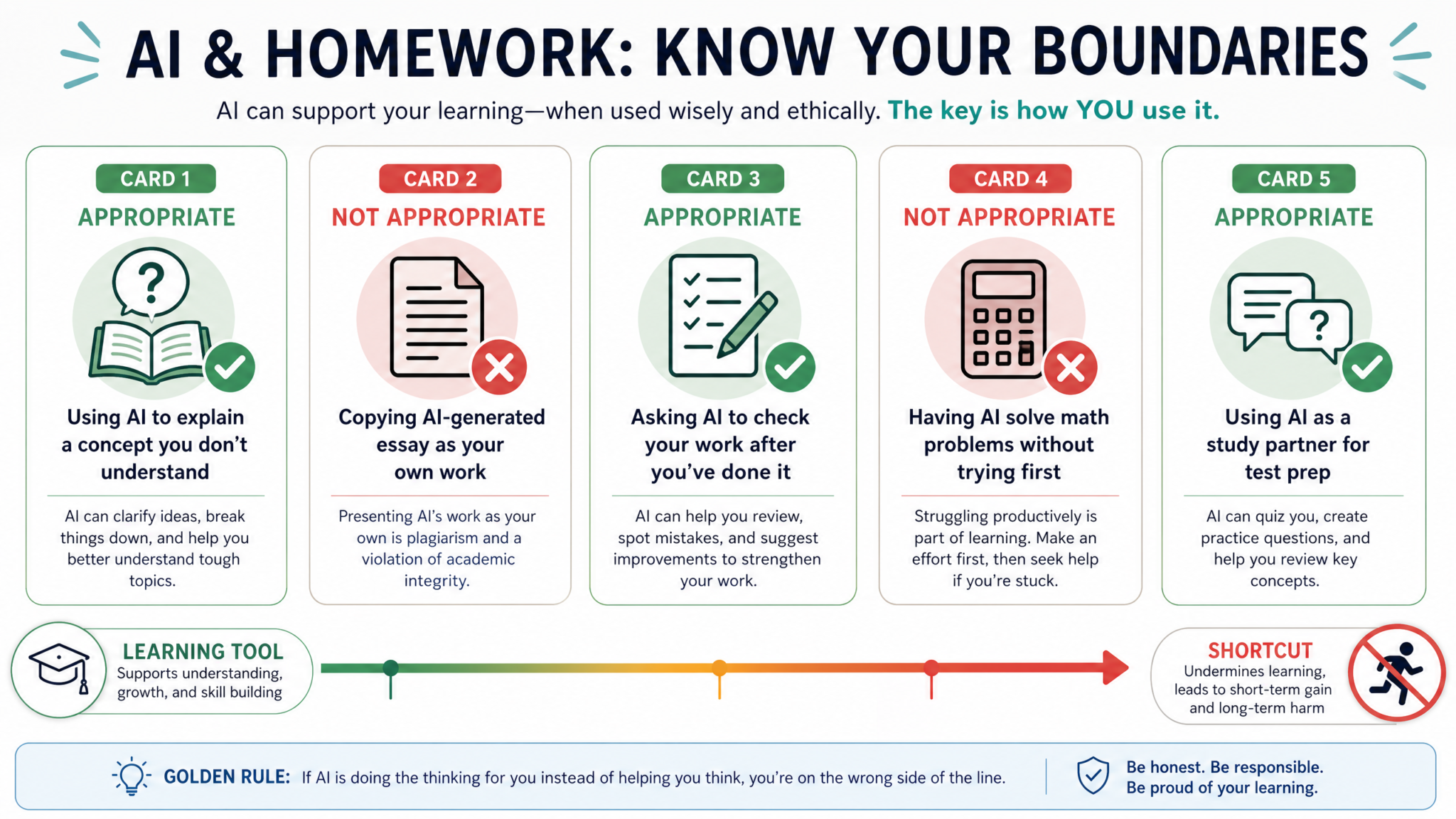
The 2025-2026 academic year saw school districts across North America grapple with a homework crisis that simple plagiarism detection tools were not equipped to handle. AI-assisted work exists on a spectrum from legitimate tutoring (student understands the material, AI helped explain a concept) to academic fraud (student submitted AI-generated work as their own). The challenge for parents is that this spectrum is genuinely difficult to navigate, and even well-intentioned teenagers can slide from one end to the other without fully realizing it.
According to a 2025 Stanford Center for Research on Education Outcomes report, students who used AI as a tutor — asking it to explain concepts and guide their thinking rather than generate answers — showed learning gains comparable to human tutoring. Students who used AI to generate completed assignments showed no learning gains and often demonstrated regressed understanding on subsequent assessments. The distinction is pedagogically significant, and it is something parents can actively shape.
How to Use ChatGPT as a Homework Tutor Without Compromising Academic Integrity
Prompt 11: Defining When AI Help Is Appropriate Versus Cheating
Parenting Context: Your teenager’s school almost certainly has an academic integrity policy that mentions AI, but it may be vague or inconsistently enforced. This prompt helps you create a family-level standard that goes beyond the school policy.
I need to help my teenager understand the meaningful difference between legitimate AI-assisted learning and academic dishonesty. Create a clear, principled framework that defines appropriate versus inappropriate AI use for schoolwork. The framework should: (1) articulate the underlying principle (what is the purpose of the assignment? what is the teacher trying to measure?), (2) provide a decision tree my teenager can use when starting any assignment, (3) include specific examples for common assignment types: essays, math problem sets, lab reports, creative writing, research projects, and presentations, (4) explain how to handle situations where the school policy is unclear or silent on AI, and (5) address the specific gray area of using AI to improve drafts versus generate drafts. Make this something my teenager can apply independently, not just rules they follow when I'm watching.Conversation Starter: “Here’s the question I want you to ask yourself every time: ‘After I finish this assignment, do I understand the material better than I did before?’ If the answer is no, AI might have helped you complete it but didn’t help you learn.”
Prompt 12: Creating a Study-First-Then-AI Workflow
Parenting Context: One of the most effective structural safeguards against over-reliance on AI is a workflow that front-loads independent effort before AI consultation. This prompt designs such a workflow for your teenager’s specific subjects and learning style.
Design a structured homework workflow for my [age]-year-old that builds in genuine independent effort before any AI consultation. My teenager takes these subjects: [list subjects]. Create a subject-by-subject workflow that specifies: (1) the minimum independent effort required before AI is used (e.g., attempt every problem at least once, write a first draft without AI), (2) the specific type of AI help that is appropriate for each subject after independent effort, (3) how to document their independent thinking so they can show their process if asked, (4) how to re-engage their own thinking after consulting AI rather than just copying outputs, and (5) a simple daily log format that tracks both independent effort and AI use. This workflow should be practical enough for a busy teenager to actually follow.Conversation Starter: “I’m not asking you to not use AI — I’m asking you to always try first. What if we created a system where AI is the second step, not the first?”
Prompt 13: Using AI as a Tutor, Not an Answer Machine
Parenting Context: The fundamental shift from “answer machine” to “tutor” comes down to the kinds of prompts your teenager uses. Teaching them to ask better questions of AI is one of the highest-leverage skills you can develop together.
Teach me how to show my teenager the difference between using ChatGPT as an answer machine versus using it as a personal tutor. Specifically: (1) show me the difference between a typical "answer machine" prompt and a "tutor mode" prompt for five common homework scenarios (essay writing, algebra, history research, science concepts, foreign language), (2) explain the pedagogical reason why tutor-mode prompting leads to better learning outcomes, (3) give me five specific "tutor mode" prompt templates my teenager can adapt for their own subjects, (4) explain how to set up ChatGPT to respond in tutor mode consistently (e.g., asking it to guide with questions rather than give direct answers), and (5) describe how a parent can recognize from the conversation history whether their teenager is using AI as a tutor versus answer machine.Conversation Starter: “What if instead of asking ChatGPT ‘What’s the answer to this problem,’ you asked it ‘Can you help me understand why my approach isn’t working?’ Let me show you what a different kind of conversation with AI looks like.”
Prompt 14: Building Understanding Before Using AI Shortcuts
Parenting Context: Cognitive science research on learning consistently shows that struggle — the productive confusion before understanding arrives — is where deep learning happens. AI shortcuts that bypass this struggle produce apparent competence without genuine understanding.
I want to help my teenager understand why building genuine understanding before using AI shortcuts matters for their long-term success. Help me explain this in terms they will find compelling by addressing: (1) the cognitive science of why struggling with difficult problems builds stronger neural pathways than getting immediate answers (explain this in teen-friendly language), (2) real-world scenarios where AI dependency would fail them — job interviews, standardized tests, real-time problem-solving — and why (3) a compelling analogy between AI shortcutting and other shortcuts that feel helpful short-term but cost them in the long run, (4) how to recognize when they genuinely understand something versus when they can only recognize correct answers they have already seen, and (5) strategies for staying motivated through productive struggle when AI could give them the answer instantly.Conversation Starter: “Here’s a question I want you to think about: If you use AI to get through every hard assignment, what happens when you’re in an exam room, a job interview, or a situation where AI isn’t available? What are you actually building?”
Prompt 15: Communicating with Teachers About AI Use
Parenting Context: Transparency with educators is both ethically appropriate and increasingly necessary in an era when AI detection tools are proliferating. This prompt helps your teenager develop the judgment to navigate AI disclosure appropriately.
Help me teach my teenager how to navigate conversations with teachers about their AI use. Create guidance that covers: (1) when and why they should proactively disclose AI assistance to their teachers (including a simple decision framework), (2) how to have that conversation in a way that demonstrates responsible use rather than triggering academic integrity concerns, (3) how to understand and navigate different teachers' AI policies within the same school, (4) what to do when a teacher's AI policy seems unclear or contradictory, (5) how to ask a teacher for clarification about AI use on a specific assignment before starting it, and (6) how to document AI use appropriately if their teacher or school requires it. Include example dialogue for each scenario that sounds natural for a teenager, not like a formal adult communication.Conversation Starter: “Let’s talk about what transparency looks like when it comes to using AI for school. If you used ChatGPT to help with an assignment, do you think your teacher would want to know? How would you even bring that up?”
Category 4: Digital Literacy and Online Safety
The Unique Privacy and Safety Risks of AI Tools
AI platforms present privacy and safety risks that are categorically different from social media or gaming platforms. When your teenager shares information with ChatGPT, they are interacting with a system that processes and may retain that information in ways that are not always transparent. The data privacy landscape for AI platforms is still evolving — OpenAI’s privacy policies for teen users have been significantly strengthened for the August 2026 teen platform launch, but the broader ecosystem of AI tools your teenager may use includes many players with far less rigorous standards.
Access 40,000+ AI Prompts for ChatGPT, Claude & Codex — Free!
Subscribe to get instant access to our complete Notion Prompt Library — the largest curated collection of prompts for ChatGPT, Claude, OpenAI Codex, and other leading AI models. Optimized for real-world workflows across coding, research, content creation, and business.
Beyond individual privacy, AI-generated misinformation represents a new category of information hazard. Unlike traditional misinformation, which typically requires human creation and intentional distribution, AI can generate highly persuasive false content at scale, instantly, on demand. A teenager who cannot recognize AI-generated misinformation is vulnerable not just to being deceived but to inadvertently spreading false information to their peers.
Teen Data Privacy and AI: What Parents Need to Know About ChatGPT’s Privacy Policy
Prompt 16: Teaching Data Privacy Awareness
Parenting Context: Data privacy conversations with teenagers often fail because they are too abstract. This prompt grounds privacy in concrete, relatable scenarios that make the stakes real.
Help me teach my teenager about data privacy in the context of AI tools in a way that is concrete, relevant, and not fear-mongering. Create a privacy awareness lesson that: (1) explains in simple terms what happens to conversations they have with AI systems (storage, training use, third-party sharing), (2) uses three or four specific scenarios that illustrate why sharing certain information with AI is risky — scenarios involving personal health information, family financial details, school conflicts, and relationship problems, (3) explains the difference between AI platforms with strong privacy protections and those without, and how to tell which is which, (4) creates a simple "privacy test" they can apply before sharing sensitive information with any AI tool, and (5) addresses the specific case of ChatGPT's teen privacy settings and what they actually protect versus what they do not. Be accurate and specific about actual privacy risks without exaggeration.Conversation Starter: “If you told ChatGPT something really personal — like a family problem or a health worry — do you know what happens to that information? Let me show you what the privacy policy actually says.”
Prompt 17: Understanding How AI Uses Personal Data
Parenting Context: The specifics of how AI companies use conversation data for model training is genuinely complex, and most adults do not understand it fully. This prompt helps you develop a working understanding you can share with your teenager.
Explain to me, in terms I can share with my teenager, exactly how major AI platforms like ChatGPT handle user conversation data. Specifically: (1) what data is collected during a typical AI conversation, (2) how conversation data may be used in model training and what opt-out options exist, (3) how teen accounts differ from adult accounts in terms of data handling (reference OpenAI's 2026 teen privacy policy specifically), (4) what "anonymization" means in practice and whether it fully protects user identity, (5) how long conversation data is typically retained, (6) what happens to data if an account is deleted, and (7) the specific types of personal information that teenagers should never share with any AI system regardless of privacy settings. Present this as information that empowers rather than alarms.Conversation Starter: “Do you know the difference between a conversation being saved and a conversation being used to train the AI? They’re actually two different things. Let’s talk about what that means for what you share.”
Prompt 18: Recognizing AI-Generated Misinformation
Parenting Context: Deepfakes, AI-written fake news, fabricated social media posts, and AI-generated images are now widespread. Your teenager needs specific pattern-recognition skills, not just general skepticism.
Create a comprehensive AI-generated misinformation detection guide for teenagers. Include: (1) the five most common types of AI-generated misinformation that circulate on platforms teenagers use (TikTok, Instagram, Reddit, Discord), with visual or textual characteristics that identify each type, (2) a specific step-by-step fact-checking protocol appropriate for a teenager's resources and attention span, (3) guidance on deepfake detection — what visual and audio cues indicate AI video generation, (4) how to identify AI-written text versus human-written text at a practical level (without requiring technical tools), (5) what to do when they encounter suspected misinformation — who to tell, whether to share or not, how to respond if peers are spreading it, and (6) why AI-generated misinformation is more dangerous than traditional misinformation, in terms they will find motivating rather than abstract.Conversation Starter: “Have you ever shared something online and then found out later it wasn’t true? Now imagine that but at a thousand times the scale, because AI can generate fake content instantly. How would you even know?”
Prompt 19: Safe Sharing Practices for Teen AI Users
Parenting Context: Safe sharing is about more than not giving your name and address to a chatbot — it is about understanding the aggregate risk of sharing seemingly innocuous information across multiple interactions over time.
Help me develop a "safe sharing" framework specifically for teenage AI users. This should go beyond basic privacy rules to address: (1) the concept of information aggregation — how individually harmless pieces of information can combine to create privacy risk, with a concrete teenage-relevant example, (2) specific categories of information that should never be shared in AI conversations under any circumstances, (3) information that is safe to share in some AI contexts but not others, with guidance on how to tell the difference, (4) how to get help with sensitive personal topics (mental health, relationships, identity) from AI while minimizing privacy risk, (5) the specific risks of sharing school-related information (class schedules, teacher names, school name, friend names) and why these seem harmless but may not be, and (6) a memorable personal information screening checklist they can use in under 30 seconds before typing anything sensitive.Conversation Starter: “Let’s talk about the difference between something being embarrassing to share and something being genuinely dangerous to share. When it comes to AI, those two categories overlap in ways that might surprise you.”
Prompt 20: Understanding AI Bias and Its Real-World Effects
Parenting Context: AI systems trained on human-generated data inevitably reflect human biases — including racial, gender, cultural, and socioeconomic biases. Teenagers who understand this are better equipped to use AI equitably and to challenge outputs that perpetuate bias.
Help me explain AI bias to my teenager in a way that is accurate, engaging, and connects to issues they care about. Cover: (1) a clear explanation of where AI bias comes from — training data, human labelers, design choices — without being overly technical, (2) three to four concrete examples of documented AI bias that relate to issues teenagers care about (bias in college application tools, job recommendation algorithms, image generation of different ethnicities, representation of different cultures), (3) how to recognize potentially biased AI output in practice, (4) why even well-intentioned AI systems can produce biased outputs, (5) what my teenager can do when they encounter AI bias — how to push back, how to report, how to supplement AI outputs with diverse sources, and (6) the bigger picture of why diverse representation in AI development matters and how it connects to their potential future careers. Connect this to media literacy skills they may already have.Conversation Starter: “Have you noticed that AI sometimes gives very different responses depending on how you phrase a question, or even whose perspective you ask it to take? There’s something interesting about why that happens. Let’s dig into it.”
Category 5: Building Healthy AI Habits
Why Habit Architecture Matters More Than Rules
Rules tell teenagers what not to do. Habits define what they naturally, reflexively do. The goal of the fifth and final category in this masterclass is not to add more restrictions to your teenager’s AI usage but to build the positive habits and rituals that naturally crowd out unhealthy patterns. A teenager who has established meaningful AI-free zones and times, who uses AI for creative expression rather than passive consumption, and who regularly engages in activities that AI cannot replicate — these habits are ultimately more protective than any agreement or consequence system.
Behavioral research in adolescent habit formation (particularly the work emerging from Stanford’s Persuasive Technology Lab and MIT’s Media Lab in 2024-2026) suggests that teenagers form lasting digital habits primarily through: repetition in consistent contexts, social reinforcement, and genuine enjoyment. The prompts in this section are designed to help you build AI habits that meet all three criteria.
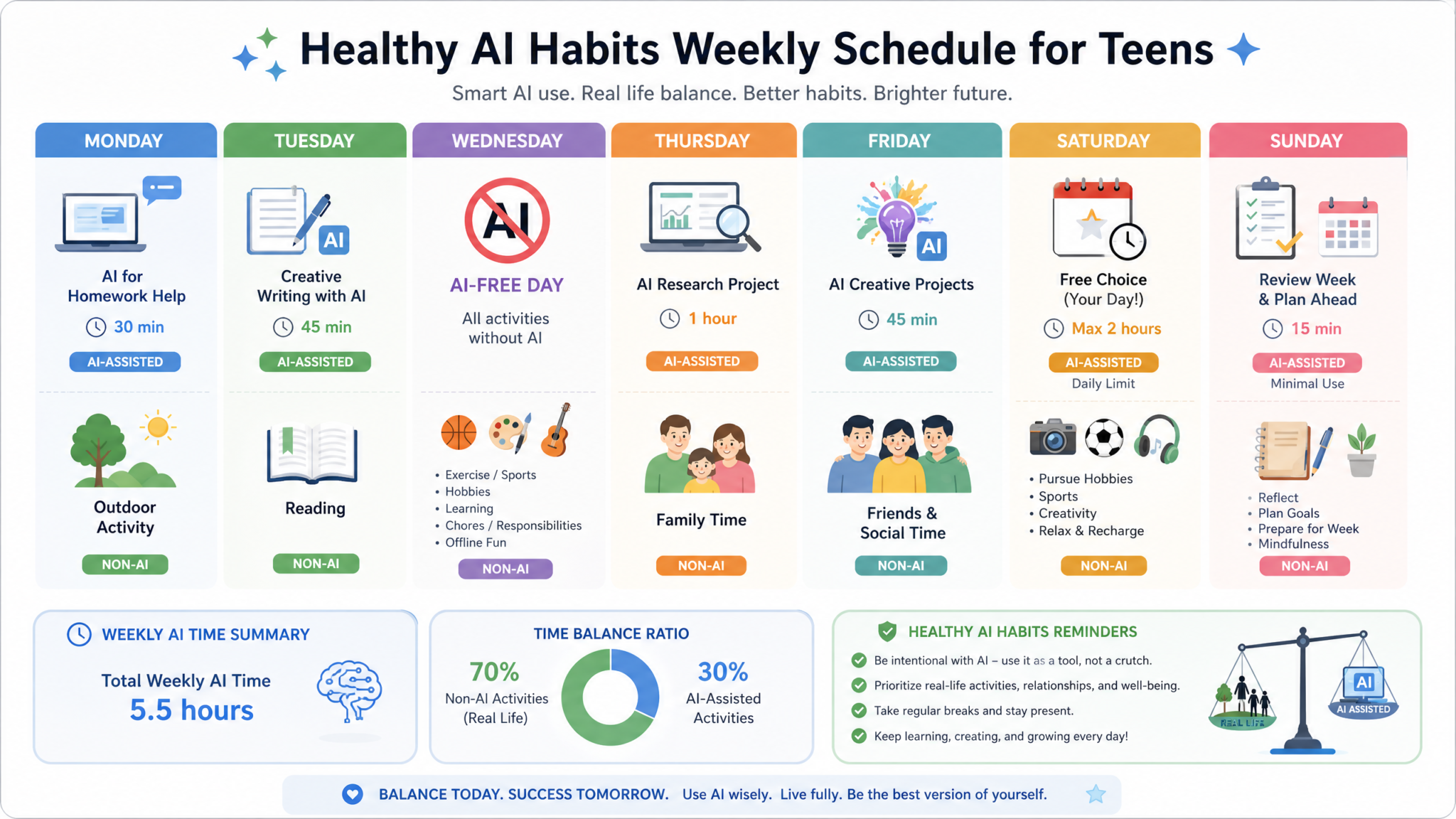
Prompt 21: Creating Balanced Screen Time Schedules That Include AI
Parenting Context: Many existing screen time frameworks do not account for the fundamentally different nature of AI use compared to passive video consumption or social media scrolling. This prompt creates an integrated schedule that distinguishes between AI uses with high educational value and those without.
Help me create a balanced weekly screen time schedule for my [age]-year-old that meaningfully distinguishes between different types of AI and screen use. My teenager's schedule includes: school from [hours], extracurriculars on [days], and [other relevant activities]. Create a schedule framework that: (1) differentiates between high-value AI use (tutoring, creative projects, learning new skills), medium-value AI use (entertainment with educational elements), and low-value AI use (passive consumption, procrastination-driven chatting), (2) allocates time for each category appropriately, (3) builds in mandatory screen-free periods that are realistic, not punitive, (4) includes specific transition rituals that help my teenager shift between AI use and non-AI activities, (5) adapts for school nights versus weekends, and (6) includes a flexibility mechanism for times when more or less AI use is genuinely warranted. Ground this in current adolescent sleep and cognitive research recommendations.Conversation Starter: “I’m not trying to limit your total screen time — I’m trying to make sure the time you spend with AI is actually worth it. Let’s think together about what that looks like in a typical week.”
Prompt 22: Establishing AI-Free Zones and Times That Actually Stick
Parenting Context: The most effective AI-free zones are established collaboratively and tied to positive experiences rather than to punishment or control. Mealtimes, family activities, and the hour before sleep are the three evidence-based priorities from adolescent neuroscience research.
Help me establish AI-free zones and times in our home that my teenager will genuinely respect, not just comply with when I'm watching. Draw on adolescent psychology and habit formation research to: (1) explain why certain times and locations are particularly important to protect from AI interruption (mealtimes, bedroom at night, social gatherings, outdoor activities), (2) suggest how to present these boundaries as enhancing rather than restricting their life, (3) recommend specific alternative activities for AI-free times that teenagers actually find engaging and will choose voluntarily, (4) address the most common teenage pushback arguments against AI-free zones and how to respond to each with empathy and logic, (5) design a gradual implementation plan that does not feel like a sudden crackdown, and (6) describe how parents can model AI-free behavior authentically rather than just imposing rules on teenagers. Include language that respects my teenager's growing autonomy.Conversation Starter: “I’ve noticed that when we’re all on devices at dinner, we don’t actually talk. I miss that. What if we tried an experiment for two weeks — no phones or AI at the table — and you tell me if you think it’s worth keeping after that?”
Prompt 23: Using AI for Creative Projects Rather Than Passive Consumption
Parenting Context: The distinction between using AI as a creative collaborator versus a content dispenser maps almost perfectly onto the distinction between active and passive learning. Teenagers who use AI creatively develop stronger AI literacy, better prompt engineering skills, and more genuine engagement with the technology.
Generate a collection of creative AI project ideas for teenagers that are genuinely engaging, develop real skills, and use AI as a collaborator rather than a content source. My teenager is interested in [list 2-3 interests from: music, visual art, writing, coding, gaming, social issues, sports, science, cooking, fashion]. For each interest area, provide: (1) three specific project ideas that use AI as a creative tool, (2) the specific skills the project develops beyond AI use (writing, coding, design thinking, etc.), (3) step-by-step guidance for getting started, (4) how to document and share the creative process in a way that demonstrates their own contribution versus AI contribution, (5) how the project might evolve into a portfolio piece or extracurricular activity, and (6) how to use AI collaboratively with friends on shared creative projects. Make these projects ambitious enough to be genuinely exciting, not trivial.Conversation Starter: “What if we thought of AI less like a search engine you ask for answers and more like a creative collaborator you build things with? What would you want to build?”
Prompt 24: Building Real-World Skills Alongside AI Skills
Parenting Context: The teenager who can only function with AI assistance is no more prepared for adult life than the teenager who can only navigate with GPS is prepared for a power outage. This prompt helps you articulate and invest in the non-AI competencies that remain essential and that AI dependency actually threatens.
Help me identify the most important real-world skills that teenage AI over-reliance specifically threatens, and create a plan for actively developing those skills alongside AI proficiency. Based on research in cognitive science, education, and workforce preparation, identify: (1) the top ten human skills that AI cannot replicate and that employers, educators, and researchers cite as increasingly valuable precisely because AI cannot replace them, (2) for each skill, a specific activity or practice that a teenager can engage in regularly that develops that skill, (3) how to frame these activities as valuable in their own right rather than as anti-AI restrictions, (4) how to connect skill-building activities to my teenager's existing interests and goals, (5) a weekly practice schedule that integrates real-world skill building with legitimate AI use, showing them as complementary rather than competing, and (6) how to help my teenager articulate their human skills in college applications and future job settings in an AI-saturated world.Conversation Starter: “In twenty years, what do you think employers or collaborators will value most in people? Let’s think about which of those things AI can already do and which things will still need a human — specifically, you.”
Prompt 25: Having Ongoing Conversations About AI Evolution
Parenting Context: The final and perhaps most important habit is the habit of conversation itself. The AI landscape will look radically different in twelve months. The specific rules and agreements you establish today will need to evolve. The only durable tool you have as a parent is an ongoing, honest, curious dialogue with your teenager about how AI is changing and what that means for your family.
Help me establish an ongoing family conversation practice about AI development that keeps my teenager and me genuinely informed and aligned as the technology evolves rapidly. Create a monthly "AI check-in" framework that includes: (1) a short list of sources — newsletters, podcasts, YouTube channels — appropriate for both a parent and a teenager to follow together for AI news (specific, real suggestions), (2) a monthly discussion format that is genuinely engaging for a teenager, not a lecture or quiz, (3) five recurring questions we can use every month to structure the conversation (questions about new developments, how we have each used AI differently this month, any concerns or surprises, what we want to learn, and whether any of our agreements need updating), (4) how to handle it when my teenager knows significantly more than I do about a specific AI development — how to make that an asset rather than a power struggle, (5) resources for learning about AI together as a family, and (6) how to talk about the longer-term societal and ethical questions about AI in a way that is honest about uncertainty without being anxiety-inducing.Conversation Starter: “I’m genuinely trying to understand where AI is going, and I think you probably have ideas I haven’t thought of. Can we agree to check in with each other once a month about what we’re noticing — not to make more rules, just to keep thinking about it together?”
Putting It All Together: A 90-Day Parent Action Plan
Twenty-five prompts can feel overwhelming if approached all at once. The following 90-day action plan sequences these tools into a realistic, progressive implementation that matches the pace at which family dynamics actually change.
Days 1–30: Foundation
- Use Prompts 1 and 2 to draft your family AI agreement. Schedule a 60-minute family conversation to review and revise it together.
- Use Prompt 4 to establish age-appropriate access levels as part of the agreement.
- Use Prompt 7 to run one AI hallucination detection exercise with your teenager — make it a game.
- Identify one AI-free zone from Prompt 22 and implement it as a two-week experiment.
Days 31–60: Development
- Use Prompts 11 and 12 to create the homework workflow as a back-to-school system.
- Use Prompt 13 to teach tutor-mode prompting — practice this together with a real homework assignment.
- Use Prompt 16 for a privacy awareness conversation, timed to coincide with any school AI policy communications you receive.
- Launch a creative AI project from Prompt 23 tied to your teenager’s genuine interests.
Days 61–90: Consolidation
- Use Prompt 5 to conduct your first quarterly agreement review.
- Use Prompt 24 to assess real-world skill development and integrate one new non-AI skill practice into your teenager’s weekly routine.
- Use Prompt 25 to establish the monthly AI check-in practice — this is the long-game investment that will pay off for years.
- Use Prompt 3 to revisit consequences in light of any violations or gray areas that emerged during the first 90 days.
A Note on Consistency Versus Perfection
You will not implement all of this perfectly. Your teenager will violate agreements, you will occasionally enforce rules inconsistently, and some prompts will generate ChatGPT outputs that do not fit your family’s culture and will need significant modification. This is entirely normal and expected.
What the research on digital parenting consistently shows is that engaged, conversational, relationship-centered approaches to digital tools significantly outperform rule-enforcement approaches in the long run. Teenagers who feel genuinely heard in conversations about AI — who feel that their parent is curious and thoughtful rather than fearful and controlling — develop substantially better digital judgment than teenagers who are simply monitored and restricted.
“The goal is not to control your teenager’s AI usage. The goal is to be the person your teenager wants to think through AI with — because you have modeled curiosity, honesty, and wisdom rather than fear and restriction.”
The 25 prompts in this masterclass are tools for that kind of parenting. They are designed to make you more informed, more prepared, and more confident in conversations that genuinely matter — not just for your teenager’s academic success, but for their development as thoughtful, ethical, capable participants in a world that AI is reshaping at breathtaking speed.
Staying Current as AI Evolves
The most important thing any parent can do in navigating the AI era is commit to ongoing learning. OpenAI’s teen platform launch in August 2026 is not an endpoint — it is the beginning of an accelerating integration of AI into every aspect of your teenager’s educational and social life. New AI tools, new capabilities, new risks, and new opportunities will emerge continuously.
The parents who will navigate this era most effectively are not those with the most restrictive controls — they are those with the most honest conversations, the most genuine curiosity, and the deepest commitment to modeling the thoughtful, ethical AI use they hope to see in their children.
You have already demonstrated that commitment by engaging with this material. Now take one prompt — just one — and put it to work today.
Best Parental Control Tools for AI Apps in 2026: A Comprehensive Parent Review
Quick Reference: All 25 Prompts by Category
| Category | Prompt # | Focus |
|---|---|---|
| AI Usage Agreements | 1 | Creating the Family AI Contract |
| AI Usage Agreements | 2 | Defining Acceptable Use Across Contexts |
| AI Usage Agreements | 3 | Establishing Proportional Consequences |
| AI Usage Agreements | 4 | Age-Appropriate Access Levels by Year |
| AI Usage Agreements | 5 | Quarterly Agreement Review Process |
| Critical Thinking | 6 | Evaluating AI Accuracy Through Exercises |
| Critical Thinking | 7 | Identifying AI Hallucinations in Real Time |
| Critical Thinking | 8 | Understanding AI Limitations |
| Critical Thinking | 9 | Comparing AI Answers with Authoritative Sources |
| Critical Thinking | 10 | Building Calibrated Skepticism |
| Homework Boundaries | 11 | Defining AI Help vs. Academic Dishonesty |
| Homework Boundaries | 12 | Study-First-Then-AI Workflow |
| Homework Boundaries | 13 | AI as Tutor Not Answer Machine |
| Homework Boundaries | 14 | Building Understanding Before Using Shortcuts |
| Homework Boundaries | 15 | Communicating with Teachers About AI Use |
| Digital Literacy & Safety | 16 | Teaching Data Privacy Awareness |
| Digital Literacy & Safety | 17 | Understanding How AI Uses Personal Data |
| Digital Literacy & Safety | 18 | Recognizing AI-Generated Misinformation |
| Digital Literacy & Safety | 19 | Safe Sharing Practices for AI Users |
| Digital Literacy & Safety | 20 | Understanding AI Bias and Its Effects |
| Healthy AI Habits | 21 | Balanced Screen Time Schedules Including AI |
| Healthy AI Habits | 22 | AI-Free Zones and Times That Stick |
| Healthy AI Habits | 23 | Using AI for Creative Projects |
| Healthy AI Habits | 24 | Building Real-World Skills Alongside AI Skills |
| Healthy AI Habits | 25 | Ongoing Conversations About AI Evolution |