
50 GPT-5.5 Prompts for Product Managers: Roadmaps, PRDs, User Stories, Sprint Planning, and Stakeholder Communication
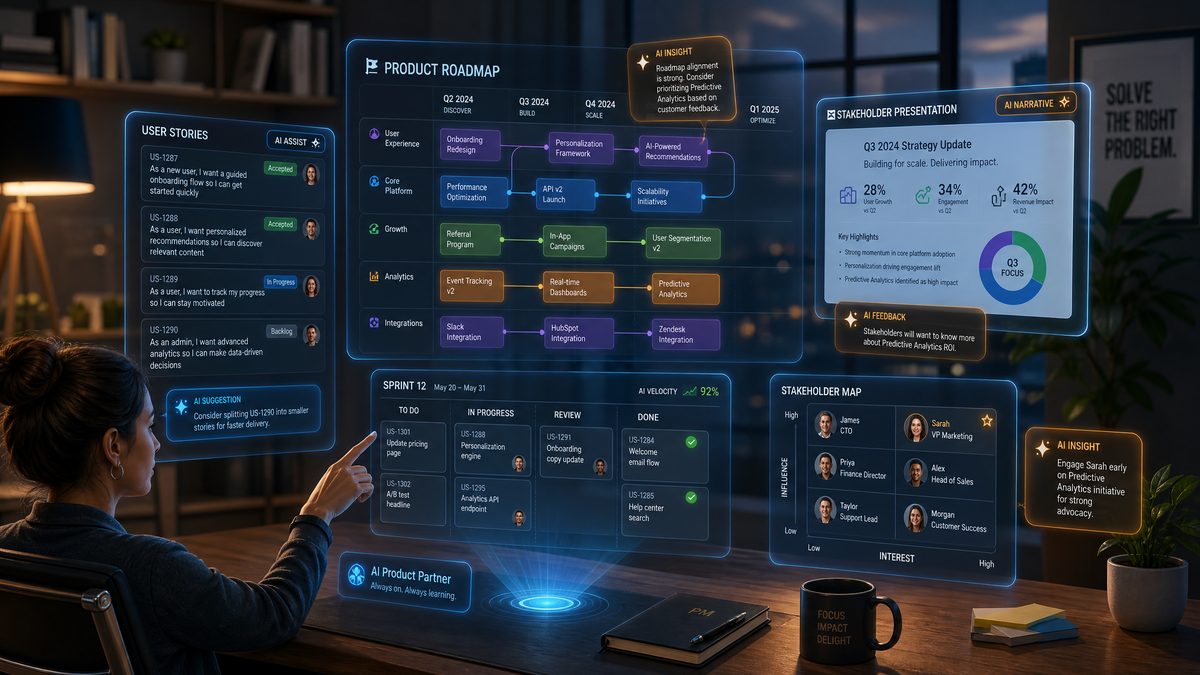
50 GPT-5.5 Prompts for Product Managers: Roadmaps, PRDs, User Stories, Sprint Planning, and Stakeholder Communication
Author: Markos Symeonides
Product managers in June 2026 are operating in a faster, more instrumented, and more AI-assisted product environment than ever before. GPT-5.5 can accelerate product discovery, roadmap planning, requirements writing, sprint preparation, and stakeholder communication, but the quality of the output still depends on the precision of the prompt. A vague request such as “write a roadmap” usually produces a generic plan. A structured prompt that includes business goals, customer segments, constraints, success metrics, dependencies, and decision criteria can produce a draft that is immediately useful for executive review, engineering discussion, or product operations workflows.
This prompts-by-use-case guide gives product managers 50 practical GPT-5.5 prompts across five core PM workflows: product roadmap creation, PRD writing, user story generation, sprint planning, and stakeholder communication. Each prompt is designed to be copied, customized, and reused in real product environments. The prompts are intentionally detailed so GPT-5.5 can reason through trade-offs, ask clarifying questions when necessary, and return structured artifacts that align with how modern product teams work.
For best results, replace the bracketed variables with your real context before running the prompt. Add your company’s product strategy, customer research, analytics, constraints, market positioning, team capacity, compliance requirements, and known risks. GPT-5.5 is strongest when it receives the same level of context you would give a senior product strategist, staff engineer, or experienced product operations lead.
How to Customize These GPT-5.5 Prompts for Product Management Workflows
Before using any of the prompts below, define the level of fidelity you need. A board-level roadmap summary requires different language, granularity, and confidence levels than an engineering-ready sprint plan. A PRD for a regulated healthcare workflow needs deeper risk treatment and compliance assumptions than a consumer onboarding experiment. The most effective PM prompts specify the audience, artifact format, decision being supported, available evidence, and acceptable assumptions.
Use these prompts as reusable templates rather than one-off commands. In practice, product managers can run a prompt once to generate a first draft, then follow up with requests such as “challenge the assumptions,” “convert this into a table,” “identify missing dependencies,” “rewrite for executives,” or “translate this into Jira-ready stories.” GPT-5.5 is particularly useful when you treat it as an analytical collaborator that can iterate through product judgment rather than simply generate text.
When customizing prompts, include five categories of context: product objective, user segment, business constraints, technical constraints, and success metrics. If your prompt contains these elements, GPT-5.5 can usually produce a structured, decision-ready output. If any category is missing, ask the model to explicitly list assumptions and questions before generating the final artifact.
Product managers working in startup environments will find significant overlap with our prompts collection for startup founders, which includes 50 GPT-5.5 prompts covering pitch deck creation, business plan development, fundraising strategy, and growth planning that complement the PM workflow prompts presented here. 50 GPT-5.5 Prompts for Startup Founders: Pitch Decks, Business Plans, Fundraising, and Growth Strategy
Section 1: Product Roadmap Creation Prompts
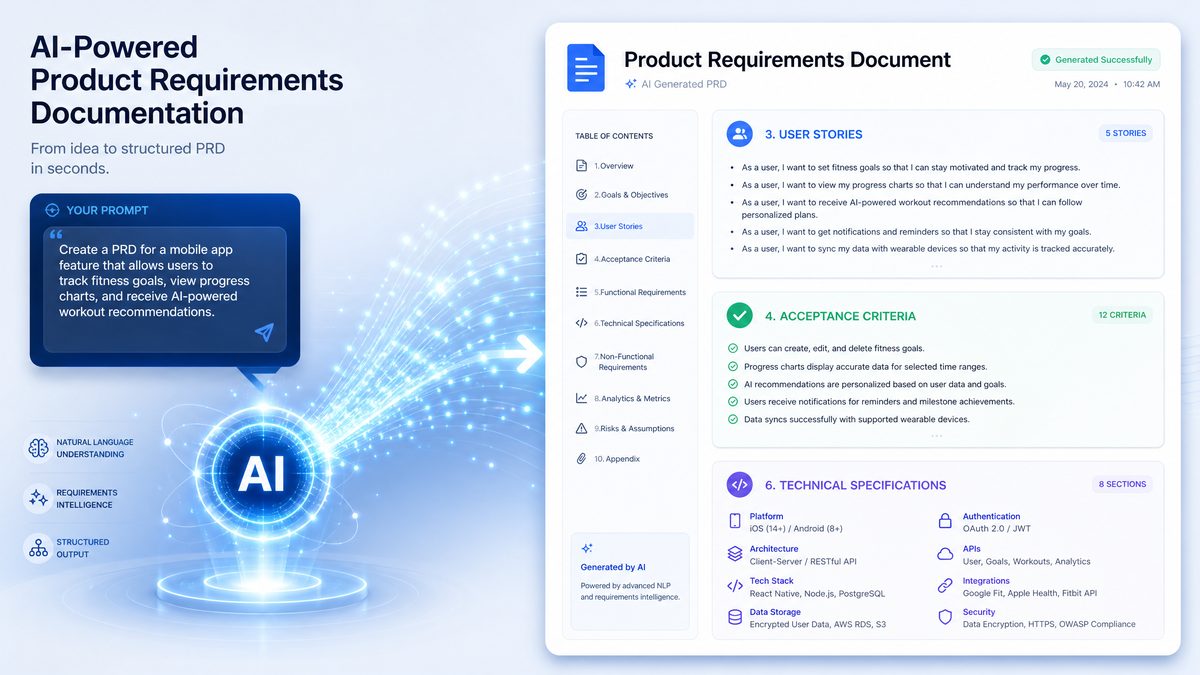
Roadmap creation is one of the highest-leverage PM workflows because it converts strategy into sequencing. A strong roadmap connects company goals, customer needs, market timing, technical dependencies, staffing realities, and measurable outcomes. GPT-5.5 can help product managers generate roadmap options, compare trade-offs, detect hidden dependencies, draft milestone plans, and prepare multiple roadmap views for executives, engineering, sales, and customer success teams.
The prompts in this section are designed for strategic roadmap generation, quarterly planning, feature prioritization, dependency mapping, and milestone tracking. To customize them, add your product vision, current roadmap, active bets, customer feedback themes, revenue targets, competitive pressure, engineering capacity, and any non-negotiable deadlines. If you are working in an enterprise environment, include security, compliance, data residency, procurement, and integration constraints.
-
1. Strategic Product Roadmap Generation
Act as a senior product strategy advisor. Create a 12-month strategic product roadmap for [product name], which serves [target users] in [market/category]. The company’s top business goals are [goal 1], [goal 2], and [goal 3]. Current product challenges include [challenge list]. Customer feedback themes include [themes]. Competitive pressures include [competitors or market shifts]. Engineering capacity is [team size/capacity], and major technical constraints are [constraints].

Produce a roadmap with quarterly themes, strategic objectives, major initiatives, expected customer impact, expected business impact, key risks, dependencies, and measurable success metrics. Include a short rationale for why each initiative belongs in its quarter. Also include a section called “Trade-offs and Sequencing Logic” that explains what should not be prioritized and why.
Customization tip: Add your current revenue model, retention metrics, and company stage. A startup roadmap should emphasize speed, validation, and market learning, while an enterprise roadmap may need governance, migration, enablement, and scalability milestones.
-
2. Quarterly Planning Roadmap
You are facilitating quarterly product planning for [quarter/year]. Build a detailed quarterly roadmap for [product/team] using the following inputs: company OKRs are [OKRs], product goals are [goals], engineering capacity is [capacity], carryover work is [carryover], planned launches are [launches], and known dependencies are [dependencies].

Return a planning-ready roadmap with initiatives grouped by Now, Next, and Later. For each initiative, include problem statement, target persona, business objective, estimated effort, confidence level, dependencies, launch milestone, success metric, and recommended owner. Identify any initiatives that should be descoped, deferred, or split into discovery and delivery phases.
Customization tip: Include the number of engineers, designers, data analysts, and QA resources available. GPT-5.5 can produce more realistic quarterly plans when capacity is specific rather than described as “limited.”
-
3. Feature Prioritization Using RICE and Strategic Fit
Act as a product operations lead. Prioritize the following feature candidates for [product name] using a combined RICE and strategic-fit model. Feature candidates: [feature list]. For each feature, estimate Reach, Impact, Confidence, Effort, strategic alignment, customer urgency, revenue potential, retention potential, and technical risk.

Create a scored prioritization table. Explain the assumptions behind each score. Recommend the top five features for the next planning cycle, the features to defer, and the features that need more discovery. Include a final section explaining how the ranking would change if the company optimized for revenue growth versus retention versus platform stability.
Customization tip: Replace subjective terms with actual data wherever possible. Add monthly active users, conversion rates, churn drivers, enterprise deal blockers, support ticket counts, and implementation cost ranges.
-
4. Roadmap Dependency Mapping
Analyze the following roadmap initiatives for dependency risk: [initiative list]. For each initiative, identify dependencies across engineering, design, data, infrastructure, security, legal, marketing, sales, support, partnerships, and customer enablement. Classify each dependency as blocking, high-impact non-blocking, or informational.

Create a dependency map in table format with initiative, dependency owner, dependency type, required completion date, risk level, mitigation plan, and escalation path. Then identify sequencing changes that would reduce roadmap risk without materially reducing customer or business impact.
Customization tip: This prompt works best when you include known platform migrations, API changes, vendor approvals, security reviews, and go-to-market launch dates. Dependency mapping is especially valuable before executive roadmap approval.
-
5. Milestone-Based Roadmap Tracking Plan
Create a milestone tracking framework for the following roadmap: [roadmap details]. Define major milestones from discovery through launch and post-launch measurement. For each milestone, include entry criteria, exit criteria, accountable owner, supporting teams, decision checkpoint, expected artifacts, and measurable evidence of progress.

Also create a weekly roadmap health report template that shows status, risks, decisions needed, scope changes, dependency changes, and metric movement. Use clear status categories: On Track, At Risk, Blocked, Descoped, and Launched.
Customization tip: Add your organization’s existing status language and reporting cadence. If your company uses Jira, Linear, Aha!, Productboard, or Azure DevOps, ask GPT-5.5 to adapt the milestone format to that system.
-
6. Outcome-Based Roadmap Conversion
Convert this feature-based roadmap into an outcome-based roadmap: [paste current roadmap]. The product serves [user segments], and the business goals are [goals]. For each feature or initiative, identify the underlying user problem, desired behavior change, business outcome, leading indicator, lagging indicator, and experiment or validation method.

Rewrite the roadmap so it is organized around outcomes instead of outputs. Include a mapping table that shows original feature, new outcome theme, metric target, validation plan, and recommended delivery scope.
Customization tip: Use this prompt when stakeholders are debating features without agreeing on outcomes. It helps shift discussions from “what should we build?” to “what measurable user or business change are we trying to create?”
-
7. Roadmap Scenario Planning
Create three roadmap scenarios for [product name] over the next [time period]: conservative, balanced, and aggressive. Use the following constraints: team capacity is [capacity], technical debt level is [level], budget constraints are [budget], market opportunity is [opportunity], and executive priorities are [priorities].

For each scenario, include initiatives, sequencing, resource assumptions, launch timing, expected upside, risk profile, and what must be true for the scenario to succeed. End with a recommendation and explain which scenario is most appropriate given the company’s current stage, competitive environment, and execution capacity.
Customization tip: Scenario planning is useful when executives want speed but engineering is concerned about feasibility. Ask GPT-5.5 to make assumptions explicit so trade-offs are visible before the planning meeting.
-
8. Customer Feedback to Roadmap Themes
Analyze the following customer feedback and convert it into roadmap themes: [paste feedback from interviews, surveys, support tickets, sales calls, win-loss notes, and community posts]. Segment the feedback by persona, account size, customer lifecycle stage, urgency, revenue relevance, and frequency.

Identify the top product opportunity themes, the user problems behind them, evidence strength, potential solutions, roadmap fit, and recommended priority. Distinguish between customer-requested features and underlying needs. Include a summary suitable for a product planning meeting.
Customization tip: Add customer metadata such as ARR, plan type, region, industry, and usage level. GPT-5.5 can help prevent loud-customer bias by separating frequency, value, urgency, and strategic relevance.
-
9. Technical Debt and Innovation Roadmap Balance
Help me balance innovation, customer-facing features, and technical debt in the roadmap for [product/team]. Current business priorities are [priorities]. Technical debt areas include [debt list]. Customer-facing feature requests include [feature list]. Platform risks include [risks]. Engineering capacity is [capacity].

Recommend a roadmap allocation model across innovation, growth features, retention features, reliability work, security work, and technical debt. Provide a percentage allocation, initiative examples, rationale, and risks of underinvesting in each category. Include a version for executive stakeholders and a version for engineering leadership.
Customization tip: This prompt is effective when engineering and business stakeholders are misaligned. Include incident history, developer velocity issues, deployment frequency, defect trends, or customer escalations to strengthen the technical debt case.
-
10. Roadmap Narrative for Executive Approval
Write an executive-ready roadmap narrative for [product name] covering [time period]. The audience is [executive team/board/business unit leaders]. The roadmap includes these initiatives: [initiatives]. The strategic goals are [goals]. Key trade-offs are [trade-offs]. Major risks are [risks]. Required decisions are [decisions].

Create a concise narrative that explains where the product is today, what market or customer change requires action, what the roadmap prioritizes, what it intentionally deprioritizes, expected business impact, investment required, and decisions needed from leadership. Include a one-page summary and a meeting talk track.
Customization tip: Executives need a decision narrative, not a feature catalog. Ask GPT-5.5 to highlight the strategic choices, opportunity cost, measurable outcomes, and consequences of delaying investment.
Section 2: PRD Writing Prompts
Product requirements documents remain critical in 2026, even as teams increasingly use lightweight specs, AI-generated prototypes, and continuous discovery workflows. A strong PRD clarifies the problem, target users, success criteria, scope, non-goals, technical considerations, data needs, launch plan, and risks. GPT-5.5 can speed up PRD drafting, but it should not replace product judgment, customer evidence, engineering review, or design collaboration.
The prompts in this section help PMs write product requirements documents, technical specifications, acceptance criteria, edge cases, API contracts, instrumentation requirements, and release readiness materials. To customize these prompts, include your discovery notes, user research, business case, existing architecture, compliance considerations, analytics events, design links, known dependencies, and unresolved questions.
Product managers collaborating with data teams will benefit from our companion prompts guide for data scientists, which provides 50 GPT-5.5 prompts for machine learning model evaluation, data pipeline management, and statistical analysis that PMs can use to better communicate requirements and validate analytical outputs. 50 GPT-5.5 Prompts for Data Scientists: Machine Learning, Data Cleaning, and Statistical Analysis
-
11. Full PRD Draft from Product Context
Act as a senior product manager and write a complete PRD for [feature/product initiative]. Context: target users are [users], user problem is [problem], business objective is [objective], current workflow is [current workflow], proposed solution is [solution], constraints are [constraints], and success metrics are [metrics].

Structure the PRD with overview, background, problem statement, goals, non-goals, personas, user journeys, functional requirements, non-functional requirements, data and analytics requirements, UX considerations, dependencies, risks, open questions, launch plan, rollout strategy, and success measurement. Make assumptions explicit and flag any missing information that must be resolved before engineering begins.
Customization tip: Paste real customer quotes and analytics data into the context. GPT-5.5 can create a stronger problem statement when it can connect user pain to measurable product or business impact.
-
12. PRD Problem Statement Refinement
Improve the problem statement for this PRD: [paste draft problem statement]. The target persona is [persona]. The current product experience is [current state]. Evidence includes [research, analytics, support data, sales feedback]. The business impact is [impact].

Rewrite the problem statement so it is specific, evidence-based, user-centered, and measurable. Include a weak version, a stronger version, and a final recommended version. Explain what makes the final version effective and identify any evidence gaps.
Customization tip: Use this before a PRD review. Weak problem statements often cause teams to debate solutions too early, while precise problem framing improves alignment across product, design, and engineering.
-
13. Functional Requirements Generation
Generate detailed functional requirements for [feature name]. The feature enables users to [user capability]. User roles include [roles]. Key workflows include [workflows]. Business rules include [rules]. Constraints include [constraints].

Return requirements in a numbered format with requirement ID, description, user role, priority, rationale, dependencies, acceptance criteria, and test considerations. Separate must-have, should-have, could-have, and out-of-scope requirements. Include assumptions and questions for engineering and design.
Customization tip: Add role permissions, lifecycle states, and data rules. GPT-5.5 can produce requirements that are easier to test when you describe who can do what, when, and under which conditions.
-
14. Non-Functional Requirements and Reliability Spec
Create non-functional requirements for [feature/system]. The product operates in [environment], supports [user volume], handles [data type], and must meet [performance/security/compliance requirements]. Known risks include [risks].

Define requirements for performance, scalability, reliability, availability, latency, security, privacy, accessibility, observability, auditability, data retention, localization, and operational support. For each requirement, include target standard, rationale, measurement method, and acceptance threshold.
Customization tip: This prompt is especially important for enterprise, fintech, healthcare, AI, and infrastructure products. Include internal standards such as uptime targets, SOC 2 requirements, GDPR obligations, or data residency constraints.
-
15. Acceptance Criteria for a PRD
Write acceptance criteria for the following product requirement: [requirement]. The user persona is [persona], the workflow is [workflow], business rules are [rules], and edge cases include [edge cases].

Use Given-When-Then format. Include happy path, alternate paths, error states, permission boundaries, empty states, loading states, accessibility expectations, analytics tracking, and failure handling. Organize the criteria so engineering and QA can use them directly during implementation and testing.
Customization tip: If your team uses behavior-driven development, ask GPT-5.5 to convert acceptance criteria into Gherkin scenarios. If not, request concise checklist-style criteria aligned with your QA workflow.
-
16. Edge Case Discovery for Requirements
Review this PRD or feature description and identify edge cases: [paste PRD or feature description]. Consider user behavior, permissions, concurrency, offline states, invalid inputs, data conflicts, integrations, rate limits, account states, billing status, localization, accessibility, compliance, security, and migration scenarios.

Return a table with edge case, affected user, trigger condition, expected product behavior, severity, likelihood, recommended requirement update, and test scenario. Highlight any edge cases that could create customer trust, revenue, legal, or data integrity risks.
Customization tip: Run this prompt before engineering estimation. Edge cases discovered after sprint planning often create scope creep, testing delays, or launch risk.
-
17. API Contract Draft for Product Managers
Help draft a product-level API contract for [API or integration feature]. The API will support [use case], users or systems include [clients], core actions include [actions], data objects include [objects], and constraints include [constraints].

Create a product-facing API contract with endpoint purpose, request fields, response fields, authentication expectations, permissions, error states, rate limits, idempotency considerations, versioning, webhook needs, audit logging, and backward compatibility requirements. Include open questions for engineering and partner teams.
Customization tip: This prompt is not a replacement for engineering API design, but it helps PMs clarify product intent before technical design. Include partner requirements and integration workflows for stronger results.
-
18. Technical Specification Companion to PRD
Convert this PRD into a technical specification outline for engineering review: [paste PRD]. Preserve the product intent while identifying technical components, data model changes, APIs, services, frontend changes, backend changes, infrastructure needs, security considerations, analytics instrumentation, migration needs, and rollout controls.

Return an engineering-facing spec outline with sections, key decisions, assumptions, dependencies, risks, and unresolved questions. Clearly distinguish product requirements from technical implementation recommendations.
Customization tip: Ask GPT-5.5 to flag areas where the PRD is ambiguous. Ambiguity is one of the biggest causes of engineering rework, especially for integrations, permissions, and data lifecycle requirements.
-
19. PRD Review Checklist
Review this PRD for completeness and execution readiness: [paste PRD]. Evaluate it from the perspective of product, engineering, design, data, security, legal, customer success, sales, and support.

Create a review checklist with strengths, missing requirements, ambiguous decisions, hidden risks, dependency concerns, measurement gaps, launch readiness gaps, and questions for the PRD review meeting. Score the PRD from 1 to 5 on clarity, feasibility, testability, strategic alignment, and customer evidence.
Customization tip: Use this prompt as a pre-review quality gate. It can help PMs strengthen the PRD before exposing it to a larger cross-functional audience.
-
20. PRD to Launch Readiness Plan
Convert this PRD into a launch readiness plan: [paste PRD]. The launch audience is [internal users/external customers/enterprise customers/developers]. The rollout model is [beta/phased rollout/general availability]. Teams involved are [teams].

Create a launch checklist covering product completion, engineering readiness, QA, data validation, security review, legal review, documentation, support enablement, sales enablement, customer communications, monitoring, rollback plan, and post-launch success review. Include owners, due dates, launch gates, and go/no-go criteria.
Customization tip: Include your release train, deployment cadence, and incident management process. GPT-5.5 can produce a more realistic plan when it knows whether your team ships continuously, weekly, monthly, or through controlled enterprise releases.
Section 3: User Story Generation Prompts
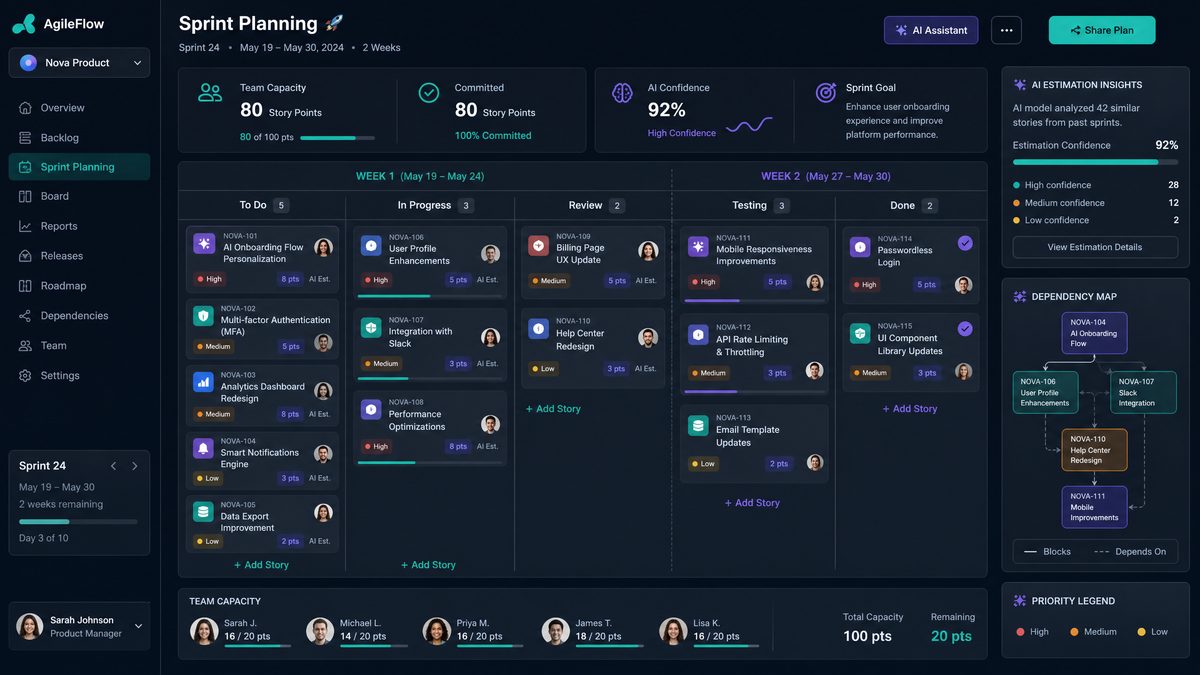
User stories translate product intent into implementable slices of user value. In modern product teams, user stories are strongest when they preserve customer context, define clear acceptance criteria, connect to measurable outcomes, and avoid becoming thinly disguised task lists. GPT-5.5 can help PMs decompose epics, write persona-based stories, generate acceptance criteria, identify missing stories, and create edge-case stories that improve delivery quality.
The prompts in this section are designed for epic decomposition, story writing, acceptance criteria, persona-based stories, edge case stories, technical-enabler stories, and backlog refinement. To customize them, provide the epic goal, target persona, workflow, design notes, technical constraints, business rules, and any known dependencies. If your team uses a specific format, such as “As a, I want, so that,” include it directly in the prompt.
-
21. Epic Decomposition into User Stories
Decompose this epic into implementation-ready user stories: [epic description]. The target users are [personas], core workflows are [workflows], business rules are [rules], and technical constraints are [constraints].

Create a story map with backbone activities, user tasks, and prioritized user stories. For each story, include title, user story format, user value, acceptance criteria, dependencies, suggested priority, and notes for design or engineering. Separate MVP stories from post-MVP enhancements.
Customization tip: Add your release goal and scope boundaries. GPT-5.5 can prevent over-decomposition when it knows what must be included in the first usable release versus later iterations.
-
22. Persona-Based User Stories
Write persona-based user stories for [feature]. Personas include [persona 1], [persona 2], and [persona 3]. Each persona has different goals, permissions, pain points, and success criteria: [persona details].

Generate user stories for each persona using the format “As a [persona], I want [capability], so that [benefit].” Include persona-specific acceptance criteria, priority, emotional or workflow context, and potential conflicts between personas. Recommend how to resolve conflicts in product behavior.
Customization tip: This is valuable for products with admins, managers, end users, developers, or external partners. Include permission levels and account types to avoid one-size-fits-all stories.
-
23. User Stories with Acceptance Criteria
Create user stories with acceptance criteria for this feature: [feature description]. The primary user journey is [journey], the business objective is [objective], and the constraints are [constraints].

For each story, include story title, user story, business value, acceptance criteria in Given-When-Then format, edge cases, analytics events, and test notes. Keep stories independently deliverable where possible and flag stories that are too large or dependent on unresolved decisions.
Customization tip: Add analytics requirements if the story must support experimentation, funnel analysis, or adoption tracking. Stories are easier to measure when instrumentation is considered during refinement.
-
24. Edge Case User Stories
Generate edge case user stories for [feature/workflow]. The normal workflow is [workflow]. Known edge cases include [known edge cases], but I want you to identify additional cases involving permissions, invalid inputs, empty states, network failures, duplicate actions, data conflicts, account states, billing restrictions, localization, and accessibility.

For each edge case story, include trigger, user impact, expected behavior, acceptance criteria, severity, and whether it belongs in MVP, launch readiness, or post-launch hardening.
Customization tip: Use this prompt after drafting happy-path stories. Many production incidents come from unhandled edge cases rather than core workflow failures.
-
25. Story Splitting for Smaller Delivery
Review these user stories and split any that are too large for a single sprint: [paste stories]. The team’s typical story size is [story point range or delivery expectation], and sprint length is [duration]. Constraints include [constraints].

For each oversized story, propose smaller vertical slices that still deliver user value. Avoid splitting only by technical layer unless necessary. Include recommended split, rationale, dependencies, acceptance criteria for each smaller story, and suggested sequencing.
Customization tip: Ask GPT-5.5 to preserve vertical value slices. Splitting stories into frontend-only and backend-only tasks can reduce user value visibility unless the team intentionally uses technical stories.
-
26. Technical Enabler Stories
Create technical enabler stories needed to support this product capability: [capability]. Product stories include [stories]. Technical work may involve [architecture, APIs, data model, infrastructure, security, observability, migration, or tooling].

Write enabler stories with clear technical outcome, product rationale, acceptance criteria, dependencies, and definition of done. Explain how each enabler supports user-facing value and whether it should be completed before, during, or after the related product stories.
Customization tip: Technical enabler stories are easier for stakeholders to accept when they are connected to risk reduction, scalability, security, reliability, or future delivery speed.
-
27. Backlog Gap Analysis
Analyze this backlog for missing user stories: [paste backlog]. The epic goal is [goal], target users are [users], workflows are [workflows], and launch criteria are [criteria].

Identify missing stories related to onboarding, permissions, data validation, error handling, notifications, analytics, admin controls, accessibility, localization, support tooling, security, and post-launch monitoring. Return a prioritized list of recommended stories with rationale and acceptance criteria.
Customization tip: Run this before backlog refinement. GPT-5.5 can act as a second reviewer and catch gaps that product, design, and engineering may miss when focused on the main flow.
-
28. User Story Rewrite for Clarity
Rewrite the following user stories to improve clarity, testability, and user value: [paste stories]. Preserve the intended scope but make each story specific, independently understandable, and measurable.

For each story, provide the original story, revised story, improved acceptance criteria, missing assumptions, and questions for refinement. Flag stories that describe implementation tasks rather than user outcomes and recommend better wording.
Customization tip: Use this prompt when a backlog has accumulated inconsistent story styles from multiple PMs, engineers, or business analysts.
-
29. Story Mapping for End-to-End Workflow
Create a user story map for this end-to-end workflow: [workflow]. Users include [personas]. The workflow begins when [start condition] and ends when [end condition]. Key product goals are [goals].

Map the workflow into activities, tasks, stories, MVP slice, release 2 slice, and future enhancements. Identify dependencies, risky assumptions, research questions, and opportunities to simplify the experience. Include a narrative summary explaining the recommended release slice.
Customization tip: Story mapping is useful for aligning design, product, and engineering around the full journey rather than isolated backlog items. Include screenshots, wireframe descriptions, or research notes when available.
-
30. Jira-Ready Story Package
Convert the following feature scope into Jira-ready user stories: [feature scope]. Use this Jira structure: summary, description, acceptance criteria, priority, labels, dependencies, design links, analytics requirements, QA notes, and definition of done.

Create stories that are clear enough for sprint planning. Include suggested labels, component names, and dependency notes. Flag any stories that require design decisions, technical spikes, legal review, security review, or customer validation before implementation.
Customization tip: Replace “Jira” with Linear, Azure DevOps, Shortcut, or your internal system if needed. Include your team’s naming conventions so GPT-5.5 produces copy-paste-ready backlog items.
Section 4: Sprint Planning Prompts
Sprint planning turns prioritized product work into an achievable delivery commitment. PMs must balance customer value, engineering capacity, dependencies, quality, technical risk, carryover work, stakeholder expectations, and sprint goals. GPT-5.5 can assist with capacity planning, story point estimation support, sprint goal drafting, risk assessment, dependency identification, scope negotiation, and sprint-readiness checks.
The prompts in this section are designed to help product managers collaborate more effectively with engineering managers, scrum masters, tech leads, designers, QA, and data teams. To customize them, include sprint length, team availability, holidays, support load, carryover items, story point history, velocity trends, planned work, dependencies, and known risks. GPT-5.5 should not be treated as the final estimator, but it can structure the planning conversation and identify inconsistencies before the meeting.
-
31. Sprint Capacity Planning
Help plan sprint capacity for [team name] for sprint [sprint dates]. Sprint length is [duration]. Team members and availability are [availability]. Historical velocity is [velocity]. Carryover work is [carryover]. Support or maintenance allocation is [allocation]. Planned stories are [story list].

Calculate realistic sprint capacity, accounting for holidays, PTO, meetings, support load, and carryover. Recommend which stories should be included, deferred, split, or clarified. Provide a capacity table, assumptions, risks, and a final recommended sprint commitment.
Customization tip: Include both story points and actual availability. GPT-5.5 can highlight when a sprint plan is unrealistic because nominal velocity does not match current team capacity.
-
32. Story Point Estimation Preparation
Prepare for story point estimation for these stories: [paste stories]. The team uses [Fibonacci/T-shirt sizing/other method]. Historical examples are: [examples of 1, 2, 3, 5, 8, 13 point stories]. Known complexity factors include [complexity factors].

For each story, suggest an estimated range, explain complexity drivers, identify unknowns, compare it with historical examples, and recommend questions the team should answer before final estimation. Do not present the estimate as authoritative; frame it as input for team discussion.
Customization tip: Estimation is team-owned. Use GPT-5.5 to prepare the conversation, surface uncertainty, and identify missing details, not to override engineering judgment.
-
33. Sprint Goal Setting
Create a clear sprint goal for the following planned work: [story list]. Product objective is [objective]. Release milestone is [milestone]. Customer or business value is [value]. Key risks are [risks].

Draft three possible sprint goals: user-value focused, technical-risk focused, and release-milestone focused. For each goal, explain what success looks like, which stories support it, what is out of scope, and what trade-offs the team may need to make if capacity changes.
Customization tip: A sprint goal should be more than a list of tickets. Include the intended product outcome so GPT-5.5 can produce a goal that helps the team make trade-off decisions mid-sprint.
-
34. Sprint Risk Assessment
Assess sprint risk for this proposed sprint backlog: [backlog]. Consider technical uncertainty, external dependencies, design readiness, unclear requirements, QA complexity, data migration, security review, customer commitments, and team availability.

Return a risk register with risk, affected story, probability, impact, early warning signal, mitigation plan, owner, and escalation path. Identify the top three risks most likely to threaten the sprint goal and recommend scope adjustments to reduce risk.
Customization tip: Run this before sprint planning and again after commitment. It helps PMs distinguish normal uncertainty from risks that require scope reduction, sequencing changes, or stakeholder escalation.
-
35. Sprint Dependency Identification
Identify dependencies in this sprint plan: [sprint plan]. Teams involved include [teams]. External systems include [systems]. Product dependencies include [dependencies]. Design and QA status are [status].

Create a dependency table with story, dependency, dependency owner, required date, impact if delayed, current status, and mitigation plan. Recommend sequencing changes inside the sprint to reduce idle time and avoid late blockers.
Customization tip: Include cross-team dependencies explicitly, especially for platform, data, security, or design-system work. GPT-5.5 can make hidden sequencing problems visible before they create blockers.
-
36. Sprint Planning Meeting Agenda
Create a sprint planning agenda for [team name]. Sprint dates are [dates]. Proposed work includes [stories]. Sprint objective is [objective]. Known concerns include [concerns]. Participants include [roles].

Build a time-boxed agenda covering context, previous sprint carryover, capacity review, sprint goal discussion, story walkthrough, estimation discussion, dependency review, risk review, commitment, and next steps. Include facilitation notes, decision points, and questions the PM should ask during the meeting.
Customization tip: Add your meeting length and team rituals. A 45-minute planning meeting for a mature team requires a different agenda than a two-hour planning session for a cross-functional release effort.
-
37. Definition of Ready Check
Evaluate whether these stories are ready for sprint planning: [paste stories]. Our definition of ready includes [criteria]. Product context is [context]. Design status is [status]. Engineering dependencies are [dependencies].

For each story, mark Ready, Nearly Ready, or Not Ready. Explain what is missing, what risk it creates, and what must be resolved before the story enters the sprint. Include recommended owner and due date for each readiness gap.
Customization tip: Use this prompt one to three days before sprint planning. It gives PMs time to clarify requirements, attach designs, confirm dependencies, or pull unsuitable stories out of the proposed sprint backlog.
-
38. Mid-Sprint Scope Replanning
Help replan the sprint after a scope or capacity change. Original sprint goal: [goal]. Original committed stories: [stories]. Current progress: [progress]. New issue or constraint: [issue]. Remaining capacity is [capacity]. Non-negotiable commitments are [commitments].

Recommend a revised sprint plan that preserves the highest-value outcome. Identify stories to keep, descale, split, defer, or swap. Provide stakeholder communication language explaining the change, the reason, and the expected impact.
Customization tip: This prompt is useful when production incidents, urgent executive requests, or underestimated work disrupt the sprint. Ask for both product and engineering trade-off language.
-
39. Sprint Review Narrative
Create a sprint review narrative for [team name]. Sprint goal was [goal]. Completed work includes [completed]. Incomplete work includes [incomplete]. Demo items include [demo items]. Metrics or evidence include [metrics]. Risks or follow-ups include [follow-ups].

Write a structured sprint review script that explains what was delivered, why it matters, what users can now do, what was learned, what remains incomplete, and what decisions or feedback are needed. Include a concise version for stakeholders and a more detailed version for the delivery team.
Customization tip: Include real demo links, screenshots, or metric snapshots when available. Sprint reviews are stronger when they connect delivery output to customer value and product learning.
-
40. Sprint Retrospective Input from Product Perspective
Prepare product-focused input for a sprint retrospective. Sprint goal was [goal]. Planned work was [planned]. Completed work was [completed]. Carryover was [carryover]. Issues included [issues]. Stakeholder feedback was [feedback]. Customer impact was [impact].

Identify what went well, what did not go well, where requirements or priorities changed, where dependencies slowed delivery, and what product process improvements should be tested next sprint. Provide constructive language that encourages learning without blame.
Customization tip: Use this to prepare, not dominate, the retrospective. GPT-5.5 can help PMs frame observations in a way that supports team improvement and avoids defensiveness.
Section 5: Stakeholder Communication Prompts
Stakeholder communication is one of the most consequential parts of product management. PMs must translate product complexity into clear narratives for executives, engineers, designers, sales, marketing, customer success, support, legal, finance, customers, and partners. GPT-5.5 can help tailor the same product update for different audiences while preserving accuracy, confidence level, and decision context.
The prompts in this section support executive summaries, board presentations, team updates, customer-facing release notes, cross-functional alignment, escalation messaging, decision memos, launch communications, and post-launch reporting. To customize them, define the audience, desired action, level of detail, tone, known sensitivities, metrics, risks, and decisions needed. Good stakeholder prompts do not merely ask GPT-5.5 to “summarize”; they specify what the audience must understand, decide, or do next.
-
41. Executive Product Summary
Write an executive product summary for [initiative/product area]. Audience is [executives]. The key update is [update]. Business goals are [goals]. Current status is [status]. Metrics include [metrics]. Risks include [risks]. Decisions needed are [decisions].

Create a concise executive summary with context, progress, business impact, customer impact, risks, trade-offs, and asks. Use clear, direct language and avoid implementation detail unless it affects strategy, investment, timeline, or risk.
Customization tip: Executives usually need implications, not activity logs. Include what changed, why it matters, what risk exists, and what decision or support you need.
-
42. Board Presentation Product Update
Create a board-level product update for [company/product]. The board needs to understand [strategic topic]. Product progress includes [progress]. Key metrics are [metrics]. Market context is [market context]. Customer evidence is [evidence]. Risks are [risks]. Investment needs are [needs].

Draft a slide-by-slide outline with titles, key messages, recommended visuals, supporting data, and speaker notes. Include sections for product strategy, roadmap progress, customer adoption, competitive positioning, execution risks, and decisions or guidance requested from the board.
Customization tip: Board materials should connect product execution to company value creation. Include revenue, retention, market expansion, margin, enterprise readiness, AI differentiation, or platform scalability depending on your company strategy.
-
43. Weekly Product Team Update
Write a weekly product team update for [team/product area]. This week’s progress includes [progress]. Upcoming work includes [upcoming]. Decisions made include [decisions]. Risks or blockers include [risks]. Metrics include [metrics]. Asks include [asks].

Create a clear update with sections for progress, next priorities, decisions, risks, dependencies, customer insights, and help needed. Keep the tone transparent, specific, and action-oriented. Include a short version for Slack or Teams and a longer version for email or documentation.
Customization tip: Add the preferred communication channel and audience size. A Slack update should be scannable, while a Confluence or Notion update can include more durable context.
-
44. Customer-Facing Release Notes
Write customer-facing release notes for [release name/version]. Released changes include [changes]. Target customers are [segments]. Benefits include [benefits]. Limitations or rollout notes include [limitations]. Support documentation is [documentation].

Create release notes that explain what is new, why it matters, who can use it, how to get started, and what limitations apply. Use customer-friendly language, avoid internal terminology, and include a concise summary plus detailed notes for power users or admins.
Customization tip: Include whether the release is generally available, beta, invite-only, region-limited, or plan-limited. Customers need eligibility and activation details, not just feature descriptions.
-
45. Cross-Functional Alignment Memo
Write a cross-functional alignment memo for [initiative]. Teams involved are [teams]. The initiative goal is [goal]. Scope includes [scope]. Non-goals include [non-goals]. Timeline is [timeline]. Dependencies are [dependencies]. Open decisions are [decisions].

Create a memo that aligns product, engineering, design, marketing, sales, customer success, support, legal, and data teams. Include context, objectives, scope, roles and responsibilities, timeline, risks, decision log, communication cadence, and next steps. Make areas of uncertainty explicit.
Customization tip: Use this before a launch kickoff or major roadmap initiative. Cross-functional misalignment often comes from unstated assumptions about scope, timing, ownership, and customer messaging.
-
46. Stakeholder Escalation Message
Draft a stakeholder escalation message for [issue]. Context: [context]. Impact: [customer/business/team impact]. Current status: [status]. Options are [options]. Recommendation is [recommendation]. Decision needed by [date]. Audience is [audience].

Write a concise escalation that explains the issue, impact, urgency, options, trade-offs, recommendation, and decision needed. Use calm, accountable language. Include a version for executives and a version for cross-functional team leads.
Customization tip: Escalations should not sound panicked or vague. Include a decision deadline, recommended option, and consequence of no decision so stakeholders can act quickly.
-
47. Product Decision Memo
Create a product decision memo for this decision: [decision]. Options considered are [options]. Criteria include [criteria]. Evidence includes [evidence]. Stakeholders include [stakeholders]. Risks include [risks]. Recommended decision is [recommendation].

Structure the memo with decision statement, background, goals, options, evaluation criteria, analysis, recommendation, trade-offs, risks, mitigation plan, and next steps. Include a brief section explaining what would cause us to revisit the decision later.
Customization tip: Decision memos are valuable for durable alignment. Ask GPT-5.5 to make trade-offs explicit so future teams understand why a choice was made, not just what was chosen.
-
48. Sales and Customer Success Enablement Brief
Write an enablement brief for sales and customer success about [feature/release]. Target customer segments are [segments]. Customer problems addressed are [problems]. Key benefits are [benefits]. Competitive positioning is [positioning]. Limitations are [limitations]. Pricing or packaging details are [details].

Create a practical enablement brief with overview, customer value proposition, qualifying questions, discovery questions, demo talking points, objection handling, limitations, ideal customer profile, rollout details, and escalation path. Include language that avoids overpromising.
Customization tip: Sales and CS teams need clear boundaries as much as benefits. Include what the feature does not do, which customers should not use it yet, and how to handle roadmap-sensitive questions.
-
49. Post-Launch Performance Report
Create a post-launch performance report for [feature/release]. Launch date was [date]. Goals were [goals]. Success metrics are [metrics]. Actual performance is [data]. Customer feedback is [feedback]. Issues encountered are [issues]. Next steps are [next steps].

Write a report with launch summary, adoption results, metric performance versus targets, customer feedback themes, operational issues, learnings, recommended follow-up actions, and decisions needed. Include an executive summary and a detailed analysis section for the product team.
Customization tip: Include both leading and lagging indicators. Early adoption may look strong while retention, conversion, support load, or revenue impact still needs more time to mature.
-
50. Difficult Stakeholder Conversation Preparation
Help me prepare for a difficult stakeholder conversation about [topic]. Stakeholder is [role/persona]. Their likely concerns are [concerns]. My position is [position]. Evidence includes [evidence]. Constraints include [constraints]. Desired outcome is [outcome].

Create a conversation plan with opening message, empathy statement, key points, evidence to present, likely objections, recommended responses, areas for compromise, boundaries to hold, and follow-up actions. Keep the tone collaborative, direct, and focused on product outcomes rather than personal disagreement.
Customization tip: Use this prompt when handling roadmap disappointment, scope cuts, delayed launches, rejected feature requests, or executive pressure. GPT-5.5 can help you prepare language that is firm without being defensive.
Practical Tips for Getting Better Product Management Outputs from GPT-5.5
The most reliable way to improve GPT-5.5 output is to provide structured context and a clear expected format. Instead of asking for a roadmap, ask for a quarterly roadmap with themes, initiatives, dependencies, risks, metrics, sequencing rationale, and trade-offs. Instead of asking for user stories, ask for stories grouped by persona, workflow, MVP scope, edge cases, and acceptance criteria. GPT-5.5 performs best when the prompt defines the artifact, audience, inputs, constraints, and decision use case.
For roadmap prompts, always include strategic goals and constraints. The model can generate attractive feature lists without understanding execution reality, so give it capacity, dependencies, deadlines, and trade-offs. If you need a more defensible roadmap, add customer evidence, revenue impact, retention data, support ticket volume, and competitive threats. Ask GPT-5.5 to explain what it would deprioritize, because the quality of roadmap thinking is often revealed by what a PM chooses not to build.
For PRD prompts, provide enough source material to avoid generic requirements. Include research notes, analytics, current workflows, screenshots described in text, known edge cases, technical constraints, and compliance requirements. Ask GPT-5.5 to flag assumptions rather than silently invent missing details. A good PRD draft from GPT-5.5 should accelerate collaboration, not create false confidence.
For user story prompts, request vertical slices of user value. GPT-5.5 can sometimes overproduce stories or split work into technical layers if the prompt is vague. Tell it your sprint size, story format, definition of ready, acceptance criteria style, and release scope. Ask it to separate MVP from future enhancements so your backlog does not become overloaded before refinement.
For sprint planning prompts, make capacity concrete. Add team availability, sprint length, carryover, support rotation, meeting load, historical velocity, and dependencies. GPT-5.5 can identify unrealistic sprint plans when it has enough data, but it should not replace engineering estimation. Use the output as preparation for team discussion rather than a final planning decision.
For stakeholder communication prompts, identify the desired action. A stakeholder update should usually drive a decision, create alignment, reduce uncertainty, or prepare a team for execution. Specify whether the audience is executives, engineers, sales, customers, or the board. Ask GPT-5.5 to create different versions for different audiences when the same initiative needs multiple communication layers.
Quality Control Checklist for AI-Generated PM Artifacts
AI-generated product artifacts should be reviewed with the same rigor as human-generated artifacts. GPT-5.5 can generate polished documents that appear complete while still containing assumptions, missing dependencies, vague metrics, or unrealistic sequencing. Product managers should treat AI output as a draft that requires validation through customer evidence, technical review, business alignment, and operational readiness checks.
| Artifact Type | What to Validate | Common AI Failure Mode | PM Review Action |
|---|---|---|---|
| Roadmap | Strategic alignment, capacity, sequencing, dependencies, measurable outcomes | Produces an appealing but overcommitted plan | Review with engineering, leadership, and customer-facing teams before approval |
| PRD | Problem clarity, requirements completeness, edge cases, non-goals, success metrics | Fills missing context with plausible assumptions | Ask the model to list assumptions and unresolved questions, then validate them |
| User Stories | Testability, independence, user value, acceptance criteria, story size | Creates too many stories or stories that are implementation tasks | Refine with engineering and QA using your definition of ready |
| Sprint Plan | Capacity, readiness, risk, dependencies, sprint goal coherence | Underestimates team constraints or treats estimates as certain | Use output as facilitation input, not as final commitment |
| Stakeholder Communication | Accuracy, tone, audience fit, decision clarity, risk transparency | Over-smooths uncertainty or hides trade-offs | Add explicit risks, asks, decision deadlines, and confidence levels |
A practical review habit is to ask GPT-5.5 for a critique after it generates an artifact. Follow up with: “Review the output above as a skeptical engineering leader, customer success director, and CFO. Identify missing context, weak assumptions, and risks.” This second pass often reveals gaps that the first generation does not expose. Product managers can then decide which critiques are valid and which are outside the intended scope.
Another useful pattern is to request confidence levels. For example, ask GPT-5.5 to mark each recommendation as high, medium, or low confidence based on the evidence supplied in the prompt. This prevents AI-generated output from sounding equally certain about well-supported conclusions and speculative ideas. In product management, calibrated uncertainty is more valuable than polished certainty.
Recommended Prompting Pattern for Product Managers
A strong PM prompt typically follows a predictable pattern: assign a role, provide context, define the artifact, specify constraints, request structure, require assumptions, and ask for trade-offs. This pattern works across roadmaps, PRDs, stories, sprint plans, and stakeholder communications. The more consistently you use this structure, the more reusable your prompt library becomes.
Act as [role or expert perspective].

Context:
- Product: [product]
- Users: [users]
- Business goal: [goal]
- Current problem: [problem]
- Evidence: [research, analytics, customer feedback]
- Constraints: [capacity, technical, legal, timing, budget]
- Known dependencies: [dependencies]

Task:
Create [artifact type] for [audience/use case].

Output format:
Include [sections, table fields, acceptance criteria, risks, metrics, decisions needed].

Quality requirements:
Make assumptions explicit, identify missing information, explain trade-offs, and recommend next steps.
This structure gives GPT-5.5 enough information to produce outputs that are specific, testable, and aligned with real product workflows. It also helps PMs avoid the most common problem with AI-generated product work: confident generic content that lacks operational usefulness.
Final Thoughts
GPT-5.5 can materially improve product management execution when used as a structured thinking partner. It can help PMs move faster from ambiguity to artifacts, from stakeholder noise to decision clarity, and from rough ideas to testable requirements. The highest-value use cases are not simple text generation; they are structured reasoning workflows where the model helps identify trade-offs, dependencies, risks, edge cases, and communication gaps.
The 50 prompts in this guide are designed to fit the daily realities of product managers: building roadmaps, writing PRDs, decomposing work, planning sprints, and keeping stakeholders aligned. Used well, they can reduce blank-page time, improve artifact quality, and create more consistent product operations across teams. Used carelessly, they can generate polished documents that still require validation. The difference comes down to context, review, and product judgment.
As AI-assisted product management becomes standard practice in 2026, the best PMs will not be those who simply ask GPT-5.5 for answers. They will be the PMs who know how to frame the right problem, provide the right evidence, challenge the output, and turn AI-generated drafts into better decisions for users, teams, and businesses.
Access 40,000+ AI Prompts for ChatGPT, Claude & Codex — Free!
Subscribe to get instant access to our complete Notion Prompt Library — the largest curated collection of prompts for ChatGPT, Claude, OpenAI Codex, and other leading AI models. Optimized for real-world workflows across coding, research, content creation, and business.