
50 GPT-5.5 Prompts for Financial Analysts: Portfolio Analysis, Risk Modeling, Market Research, and Regulatory Compliance

50 GPT-5.5 Prompts for Financial Analysts: Portfolio Analysis, Risk Modeling, Market Research, and Regulatory Compliance
By ChatGPT AI Hub Editorial Team | June 18, 2026
The integration of large language models into financial workflows has moved well beyond the experimental stage. As of mid-2026, GPT-5.5 represents one of the most capable tools available to financial professionals seeking to accelerate their analytical workflows, improve the depth of market research, and maintain rigorous compliance standards without sacrificing speed. For enterprise developers building AI-augmented finance platforms, and for analysts who interact directly with these models, the quality of prompts determines the quality of outputs — and the difference between mediocre and exceptional results often comes down to prompt engineering specificity.
This comprehensive guide delivers 50 battle-tested GPT-5.5 prompts organized across five critical domains: portfolio analysis, risk modeling, market research, regulatory compliance, and financial modeling automation. Each prompt is engineered for maximum precision, includes context about when and why to use it, and where relevant, demonstrates how to integrate the output into broader quantitative workflows. Whether you’re a buy-side analyst at an asset management firm, a risk officer at a regional bank, or a developer building the next generation of fintech tooling, these prompts will materially improve your AI-assisted work.
Financial analysts working with GPT-5.5 can benefit from seeing how other specialized professions structure their AI workflows. Our collection of 50 GPT-5.5 prompts for cybersecurity professionals demonstrates advanced threat analysis and incident response patterns that share similar analytical rigor with financial risk modeling approaches.
Why GPT-5.5 Changes the Game for Financial Analysis
Before diving into the prompts themselves, it’s worth understanding what makes GPT-5.5 specifically suited to financial applications. Compared to earlier models, GPT-5.5 demonstrates significantly improved numerical reasoning, longer context windows capable of processing entire earnings transcripts or regulatory filings, enhanced ability to maintain logical consistency across multi-step financial calculations, and far better calibration when expressing uncertainty — a critical feature when outputs inform investment decisions.
The model also shows meaningful improvement in understanding financial domain-specific language: GAAP versus IFRS accounting treatment differences, the nuances between different types of derivatives exposure, and the regulatory distinctions between Basel III and Basel IV capital requirements. This domain fluency means your prompts can be written at the level of a senior analyst rather than needing to define every term from scratch.
However, GPT-5.5 is not infallible. It does not have real-time market data access unless connected to tools or APIs, it can still hallucinate specific data points if you ask it to recall market prices or earnings figures from memory, and its outputs should never substitute for professional judgment in regulated financial contexts. The prompts in this guide are designed with these limitations in mind — they focus on analytical frameworks, interpretation, structuring, and synthesis rather than asking the model to generate data it cannot reliably produce.
For professionals who need to document their financial analysis and create client-facing reports, our guide on 50 GPT-5.5 prompts for technical writers covers documentation workflows including structured report generation, executive summaries, and compliance documentation that financial teams frequently produce.
Section 1: Portfolio Analysis Prompts
Portfolio analysis is one of the highest-leverage applications for GPT-5.5 in finance. The model excels at synthesizing multi-factor information, structuring attribution analyses, and helping analysts articulate portfolio thesis statements with precision. The following prompts cover portfolio construction, performance attribution, factor exposure analysis, and client-facing reporting.
Prompt 1: Portfolio Construction Rationale
You are a senior portfolio manager at a multi-asset investment firm. I will provide you with the following inputs:
- Target portfolio objective: [e.g., "Inflation-protected income with 4% annual yield target"]
- Investment universe: [e.g., "US investment-grade corporate bonds, TIPS, REITs, dividend equities"]
- Constraints: [e.g., "Maximum 20% in any single asset class, no below BBB- credit, 3-year investment horizon"]
- Current macro view: [e.g., "Moderately elevated inflation, late-cycle expansion, Fed on pause"]

Based on these inputs, provide:
1. A recommended asset allocation with percentage weights
2. The strategic rationale for each allocation decision
3. Key risks to the portfolio thesis
4. Monitoring triggers that would cause you to rebalance

Format the output as a structured investment memo suitable for a portfolio review committee.
When to use this: During portfolio construction reviews, onboarding new client mandates, or when stress-testing an existing allocation against a new macro view. The structured memo format ensures output can be directly integrated into presentation workflows.
Prompt 2: Performance Attribution Analysis
Analyze the following portfolio performance attribution data and provide a narrative explanation suitable for a quarterly investor letter.

Portfolio return: [X]% vs. Benchmark return: [Y]%
Attribution breakdown:
- Asset allocation effect: [+/- Z]%
- Security selection effect: [+/- W]%
- Currency effect: [+/- V]%
- Interaction effect: [+/- U]%

Top 3 contributors: [List with security name, weight, contribution]
Top 3 detractors: [List with security name, weight, contribution]

Write a 3-paragraph attribution narrative that: (1) explains the overall alpha/underperformance in plain language, (2) highlights whether outperformance was driven by skill or factor exposure, and (3) contextualizes results against the broader market environment during the period.
Prompt 3: Factor Exposure Audit
I'm reviewing a long-only equity portfolio for unintended factor exposures. The portfolio has the following characteristics versus its benchmark:

Size tilt: [e.g., "Overweight mid-cap by 15%"]
Value/Growth: [e.g., "Neutral to slight value tilt, P/E ratio 0.3x below index"]
Momentum: [e.g., "Underweight high-momentum names by 8%"]
Quality: [e.g., "Overweight high-ROE names by 12%"]
Volatility: [e.g., "Lower beta than benchmark, 0.87 vs 1.00"]
Sector deviations: [e.g., "Overweight healthcare +6%, underweight technology -9%"]

Identify: (1) Which factor exposures appear intentional vs. potentially inadvertent, (2) How these factor tilts might explain recent performance in a rising-rate environment, (3) What the portfolio may be inadvertently expressing as a macro view, (4) Recommended factor positions to monitor if the macro environment shifts to risk-off.
Prompt 4: Portfolio Stress Testing Scenarios
Design five stress test scenarios for a [describe portfolio: e.g., "60/40 equity/bond institutional portfolio with 15% alternatives allocation"] that cover the following risk categories:

1. Macro shock scenario
2. Geopolitical tail risk scenario
3. Liquidity crisis scenario
4. Sector-specific disruption scenario
5. Regulatory/policy change scenario

For each scenario, provide:
- A brief narrative description of the scenario (2-3 sentences)
- Expected directional impact on each major asset class
- Estimated portfolio-level drawdown range (expressed as a range, not a point estimate)
- Key assumptions underlying the scenario
- Historical precedent if applicable

Present in a table format with a narrative summary following.
Prompt 5: ESG Integration Assessment
Evaluate the ESG integration approach for the following portfolio mandate:
- Portfolio type: [e.g., "Core equity long-only, $2B AUM"]
- Current ESG approach: [e.g., "Exclusion-based screening, MSCI ESG ratings filter, minimum BB ESG rating"]
- Client requirements: [e.g., "Institutional pension fund with Net Zero 2040 commitment"]
- Benchmark: [e.g., "MSCI World Index"]

Provide: (1) An assessment of whether the current approach is consistent with best practices for institutional ESG mandates, (2) Gaps between the stated approach and the client's stated climate commitments, (3) Three specific enhancements to the methodology (e.g., TCFD alignment, scope 3 emissions integration, engagement overlay), (4) Potential tracking error impact of each enhancement.
Prompt 6: Client Portfolio Review Talking Points
Prepare a structured set of talking points for a quarterly portfolio review meeting with a [describe client: e.g., "high-net-worth individual, $5M portfolio, moderate risk tolerance, 10-year horizon"].

Portfolio context:
- YTD performance: [X]% vs. target benchmark [Y]%
- Notable events: [e.g., "Underweight cash going into Q2 volatility, added to fixed income in March"]
- Client concerns noted in last meeting: [e.g., "Concerned about AI sector concentration, asking about bond allocation"]

Generate talking points that: (1) acknowledge and address the client's stated concerns directly, (2) explain recent performance in accessible language without jargon, (3) articulate the forward-looking positioning rationale, (4) include two proactive discussion topics the advisor should raise. Use a bullet-point format suitable for meeting preparation notes.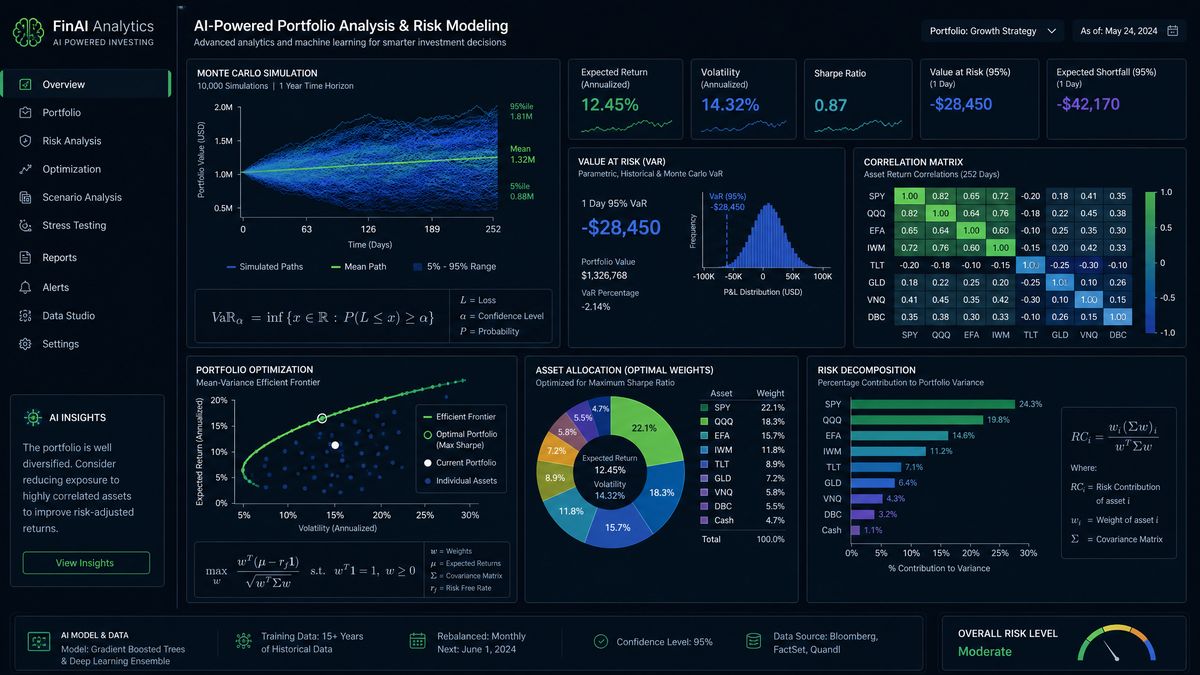
Section 2: Risk Modeling Prompts
Risk management represents perhaps the most consequential application of AI in finance. GPT-5.5’s ability to structure complex risk frameworks, interpret model outputs in narrative form, and identify edge cases in risk methodologies makes it a powerful tool for risk officers and quantitative analysts alike. The following prompts are designed for use alongside quantitative risk systems — GPT-5.5 provides the interpretive and structural layer, while purpose-built risk systems provide the underlying calculations.
For enterprise developers building integrated risk platforms, these prompts can be combined with API calls to risk analytics engines, with GPT-5.5 serving as the natural language interface that translates model outputs into stakeholder-ready narratives.
Prompt 7: VaR Model Interpretation
I have Value-at-Risk (VaR) model results that I need to interpret and communicate to senior management. Here are the outputs:

1-day 99% VaR: $[X]M (Historical Simulation method)
1-day 99% VaR: $[Y]M (Parametric/Variance-Covariance method)
1-day 99% VaR: $[Z]M (Monte Carlo method)
Current portfolio notional: $[W]B
Recent backtesting results: [X] exceptions in last 250 trading days

Provide: (1) An interpretation of what these VaR figures mean in plain language, (2) An explanation of why the three methods may be producing different estimates, (3) An assessment of the backtesting results against Basel framework thresholds (green/yellow/red zone), (4) Key limitations of VaR that should be communicated alongside these figures, (5) A one-paragraph executive summary suitable for a board risk committee report.
Prompt 8: Credit Risk Assessment Framework
Develop a credit risk assessment framework for evaluating [describe counterparty type: e.g., "mid-market commercial real estate borrowers seeking bridge loans of $10M-$50M"].

The framework should include:
1. Quantitative scoring criteria (suggest 5-7 metrics with weightings that sum to 100%)
2. Qualitative assessment factors
3. Concentration risk considerations
4. Collateral valuation methodology notes
5. Risk rating scale definition (e.g., 1-10 scale with default probability ranges)
6. Triggers for credit review or watchlist placement
7. Documentation requirements for each tier

Format as a structured framework document that could serve as a first draft of internal credit policy for review by a credit committee.
Prompt 9: Counterparty Risk Exposure Report
Draft a counterparty risk exposure summary for inclusion in a monthly risk report. The summary should address:

Input data:
- Total counterparty exposure: $[X]B gross, $[Y]B net of collateral
- Top 5 counterparty concentrations: [List names and exposure amounts]
- Collateral breakdown: [e.g., "65% cash, 25% government bonds, 10% equities"]
- Wrong-way risk identified: [Yes/No, and describe if yes]
- Recent credit events: [Any rating changes, CDS spread widening on key counterparties]

Generate a 400-word risk narrative that: (1) summarizes the current exposure profile, (2) highlights any concentration concerns against policy limits, (3) identifies the two highest-priority risk items for management attention, (4) recommends specific mitigation actions where applicable.
Prompt 10: Liquidity Risk Stress Test Design
Design a comprehensive liquidity stress testing framework for a [institution type: e.g., "regional bank with $15B in assets, 60% retail deposit funded, significant commercial real estate exposure"].

The framework must address:
1. Stress scenarios to test (suggest at least 4, ranging from idiosyncratic to systemic)
2. Cash flow projection methodology under each scenario
3. Liquidity buffer composition and adequacy assessment
4. LCR and NSFR impact under stress (reference Basel III/IV standards)
5. Survival horizon targets by scenario severity
6. Escalation triggers and management actions
7. Governance and reporting cadence

Present the framework as a structured technical document with a summary table of scenarios and key parameters.
Prompt 11: Model Risk Management Review
Conduct a model risk management (MRM) review checklist for the following model:

Model name: [e.g., "Loan Loss Provisioning Model v3.2"]
Model type: [e.g., "CECL expected credit loss estimation, statistical regression"]
Model use: [e.g., "Quarterly provision calculations for commercial loan portfolio, regulatory reporting"]
Last validation date: [Date]
Key inputs: [e.g., "Macroeconomic forecasts, LGD estimates, PD curves, collateral values"]

Generate a structured model risk assessment covering: (1) Model inventory documentation completeness, (2) Conceptual soundness review questions, (3) Data quality and input validation checks, (4) Performance monitoring metrics and benchmarks, (5) Limitations and compensating controls, (6) SR 11-7 / OCC 2011-12 compliance checklist items, (7) Recommended validation frequency based on model materiality and complexity.
Prompt 12: Operational Risk Event Analysis
Analyze the following operational risk event and produce a root cause analysis report:

Event description: [Describe the event, e.g., "Incorrect pricing data fed to risk system resulted in mis-stated VaR for 3 trading days. Error discovered during routine reconciliation. No client impact, but regulatory reporting required correction."]
Event date: [Date]
Discovery date: [Date]
Estimated financial impact: $[X] (direct) + $[Y] (remediation cost)
Business line affected: [e.g., "Fixed Income Trading"]
Regulatory implications: [e.g., "Required resubmission of daily large exposure report"]

Produce a root cause analysis report following the "5 Whys" methodology, identify Basel operational risk event category classification, assess whether this constitutes a reportable event under relevant frameworks, and recommend three specific process improvements to prevent recurrence.
Section 3: Market Research Prompts
Market research is a domain where GPT-5.5 can dramatically compress timelines for financial analysts. The synthesis of publicly available information, the structuring of competitive analyses, and the development of sector views are all areas where the model delivers high-quality output when given well-structured prompts. The key constraint to keep in mind: GPT-5.5’s training data has a knowledge cutoff, so these prompts are designed to work with analyst-provided data rather than relying on the model’s built-in market knowledge.
Prompt 13: Sector Deep Dive Framework
Conduct a structured sector analysis for [sector name: e.g., "US Commercial Banking"] using the following framework. I will provide the factual data; you provide the analytical structure and interpretation.

Sector data provided:
- Sector performance YTD vs. S&P 500: [Data]
- Current valuation multiples (P/E, P/B, EV/EBITDA): [Data]
- Key sector drivers: [List]
- Recent news and catalysts: [Summary]
- Regulatory developments: [Summary]

Organize the analysis across: (1) Industry structure and competitive dynamics using Porter's Five Forces, (2) Current cycle positioning (early/mid/late cycle characteristics), (3) Bull case vs. bear case thesis with probability weighting, (4) Key risks and tail scenarios, (5) Investment implications: which sub-segments or factor characteristics look most attractive/unattractive, and why.
Prompt 14: Earnings Call Transcript Analysis
Analyze the following earnings call transcript excerpt and identify:

[Paste transcript excerpt here]

Identify: (1) Management's tone and confidence level on key business drivers (rate as: Confident/Cautious/Uncertain for each), (2) Any forward guidance revisions explicit or implied, (3) Questions analysts asked that management deflected or answered vaguely — these represent potential areas of concern, (4) Three key quotes that most significantly impact the investment thesis (positive or negative), (5) Any language changes compared to prior quarters on [specific topic, e.g., "credit quality" or "margin guidance"], (6) An overall assessment: did management's message strengthen or weaken the investment case, and why?
Prompt 15: Competitive Intelligence Report
Structure a competitive intelligence report for [Company Name] versus its primary competitors. Use the following data I'm providing:

[Provide: Revenue, margins, growth rates, market share data for target company and 3-4 competitors]

Produce a competitive analysis covering: (1) Market positioning matrix (2x2) with axes of [your chosen dimensions, e.g., "Cost Position vs. Product Differentiation"], (2) Competitive moat assessment for each company (rate: Wide/Narrow/None with 2-sentence justification), (3) Key competitive threats over 12-24 month horizon, (4) Where the target company is gaining or losing ground versus peers, (5) Implications for pricing power and margin sustainability, (6) A "competitive risk score" (1-10 scale) with methodology explanation.
Prompt 16: Macroeconomic Scenario Modeling
Develop three macroeconomic scenarios for [time horizon: e.g., "12-18 months"] with the following base conditions:

Current conditions: [e.g., "US GDP growth 2.1%, CPI 3.2%, Fed Funds Rate 4.5%, unemployment 4.1%, 10Y Treasury yield 4.7%"]

Construct:
1. BASE CASE (assign 50-55% probability): Moderate growth continuation
2. BULL CASE (assign 20-25% probability): Soft landing/re-acceleration
3. BEAR CASE (assign 20-25% probability): Recession/policy error

For each scenario provide: (a) Narrative description (100 words), (b) Key macro variable projections in a table, (c) Asset class return implications (directional with magnitude estimates), (d) The single biggest risk to the scenario not playing out as expected, (e) Leading indicators to watch that would confirm or refute the scenario.
Prompt 17: IPO Analysis Framework
Analyze the following IPO and provide an institutional investor assessment:

Company: [Company name and description]
IPO details: [Price range, shares offered, use of proceeds, expected market cap]
Financial data: [Key metrics: revenue growth, gross margin, EBITDA margin, burn rate, cash runway]
Comparable companies: [List 3-5 public comps with their current trading multiples]
Key risks disclosed in S-1: [Summarize top 5]
Lock-up expiration: [Date and % of shares locked up]

Provide: (1) Valuation assessment using multiple methodologies (revenue multiple, DCF range, comp-adjusted), (2) Quality of earnings assessment, (3) Bull/bear considerations for the IPO allocation decision, (4) Lock-up expiration risk assessment, (5) Recommended participation tier: (Avoid / Monitor / Participate / Overweight) with rationale for an institutional growth equity mandate.
Prompt 18: Fixed Income Market Analysis
Provide a structured fixed income market analysis for the following segment:

Segment: [e.g., "US High Yield Corporate Bonds"]
Current market data I'm providing: [OAS spreads, default rates, new issuance volume, fund flows, leverage statistics, interest coverage data]

Structure the analysis as: (1) Current spread environment vs. historical percentiles, (2) Default cycle assessment — where are we in the credit cycle?, (3) Sector-level dispersion within the asset class, (4) Technical factors (supply/demand, fund flows), (5) Relative value vs. other fixed income segments (IG corps, leveraged loans, EM debt), (6) Key catalysts for spread tightening vs. widening, (7) Recommended duration and quality positioning within the asset class.
Section 4: Regulatory Compliance Prompts
Regulatory compliance is an area where the cost of errors is asymmetric and severe, which makes GPT-5.5 a powerful drafting and framework-development tool — while making it essential that human experts review all compliance-related outputs before use. These prompts are designed to help compliance officers, legal teams, and regulatory affairs professionals structure their work, draft initial documentation, and navigate complex regulatory frameworks more efficiently. They are not legal advice and should not be treated as final compliance determinations.
For organizations building automated compliance workflows, these prompts can be embedded into review pipelines where GPT-5.5 performs initial analysis and flagging, with human review gates before any regulatory submission.
Prompt 19: Regulatory Change Impact Assessment
Analyze the following regulatory change and provide an impact assessment for our institution:

Regulatory change: [e.g., "Basel IV final rule implementation — specific changes to market risk capital requirements under FRTB"]
Effective date: [Date]
Our institution type: [e.g., "US G-SIB with $800B in assets, significant trading book"]
Current approach: [e.g., "IMA approval for 85% of trading desks, 15% on SA"]

Provide: (1) Summary of the regulatory change in plain language, (2) Specific impacts on our institution's capital calculations, (3) Operational and system changes required, (4) Estimated timeline for implementation readiness, (5) Areas requiring regulatory guidance or interpretation, (6) Competitive implications (does this advantage/disadvantage large vs. small institutions?), (7) Priority action items for the next 90 days.
Prompt 20: AML/KYC Policy Review
Review the following AML/KYC policy section and identify gaps against current regulatory expectations:

Policy section provided: [Paste policy text]

Regulatory frameworks to benchmark against:
- FinCEN Customer Due Diligence (CDD) Rule requirements
- FATF Recommendations (most recent)
- BSA/AML examination manual standards
- Any relevant jurisdiction-specific requirements: [specify]

Identify: (1) Specific gaps or ambiguities in the current policy language, (2) Best practice language improvements for each identified gap, (3) Risk-based approach adequacy assessment, (4) Enhanced due diligence (EDD) trigger criteria assessment, (5) Beneficial ownership verification adequacy, (6) A revised version of the most critical policy paragraph incorporating identified improvements. Flag any section where regulatory interpretation is uncertain and expert legal review is warranted.
Prompt 21: FINRA/SEC Disclosure Review
Review the following client disclosure document for regulatory adequacy and clarity:

Document type: [e.g., "Form ADV Part 2A / Investment Advisory Agreement"]
Document text: [Paste relevant sections]
Applicable regulations: [e.g., "SEC Investment Advisers Act, Regulation Best Interest, FINRA Rules 2111 and 2010"]

Assess: (1) Whether all required disclosures appear to be present, (2) Conflicts of interest disclosures — are they specific enough to be meaningful?, (3) Fee disclosure clarity and completeness, (4) Language clarity assessment — is the document written at an appropriate reading level for the target client?, (5) Any language that could be misleading or create regulatory exposure, (6) Suggested revisions for the top 3 identified issues. Note: Flag sections requiring securities counsel review rather than attempting a definitive legal determination.
Prompt 22: GDPR/Data Privacy Compliance for Financial Data
Assess the data privacy compliance posture for the following financial data processing activity:

Processing activity: [e.g., "Using customer transaction history to train a credit scoring model for retail loan underwriting"]
Data types involved: [e.g., "Account transaction data, demographic data, behavioral data from mobile app"]
Jurisdictions: [e.g., "EU customers subject to GDPR, UK customers subject to UK GDPR, US customers subject to CCPA"]
Current legal basis claimed: [e.g., "Legitimate interests / contractual necessity"]

Analyze: (1) Whether the claimed legal basis is appropriate for this processing activity under each jurisdiction, (2) Data minimization assessment — is the full dataset necessary?, (3) Explainability requirements for automated decision-making (GDPR Art. 22), (4) Data subject rights implications, (5) Required privacy impact assessment (DPIA) triggers, (6) Cross-border data transfer compliance, (7) Recommended documentation and controls enhancements.
Prompt 23: MiFID II Best Execution Policy Review
Review and enhance our Best Execution Policy for MiFID II compliance:

Current policy summary: [Paste or describe current policy]
Asset classes covered: [List]
Execution venues used: [List primary venues and their characteristics]
Client types: Retail / Professional / Eligible Counterparty

Evaluate: (1) Whether the execution factors (price, cost, speed, likelihood of execution, size, nature, other) are appropriately weighted for each client type and asset class, (2) Monitoring and review adequacy — does the policy commit to sufficient oversight?, (3) RTS 27/28 reporting obligations addressed?, (4) Client disclosure adequacy, (5) Conflicts of interest identification in execution arrangements, (6) Specific policy language enhancements for top 3 deficiencies. Benchmark against ESMA guidelines on best execution under MiFID II.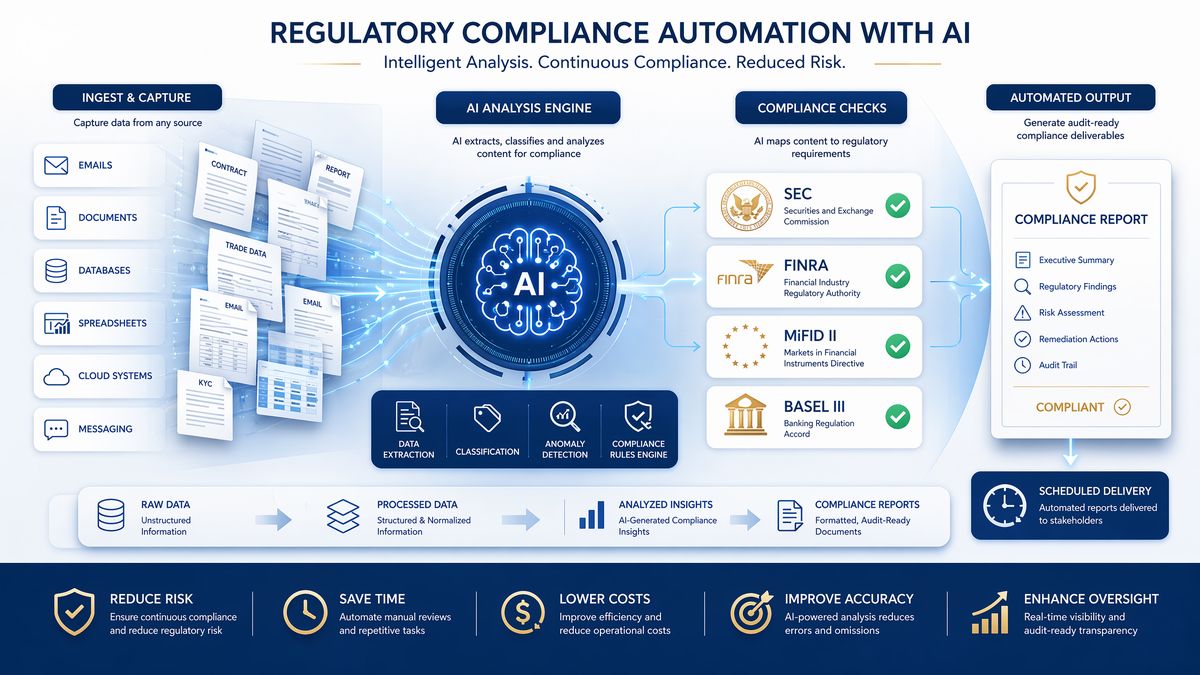
Prompt 24: Regulatory Examination Preparation
Prepare a regulatory examination readiness assessment for the following upcoming examination:

Examining body: [e.g., "Federal Reserve / OCC Joint Examination"]
Examination focus areas: [e.g., "BSA/AML compliance, model risk management, liquidity risk"]
Examination date: [Estimated date]
Last examination findings: [Summarize any prior MRAs or MRIAs]
Areas of known self-identified weakness: [List]

Generate: (1) A structured pre-examination workplan with 60-day countdown milestones, (2) Document preparation checklist for each examination focus area, (3) Staff preparation recommendations (who should be briefed, on what topics), (4) Common examiner questions in each focus area with suggested response frameworks, (5) Remediation status template for prior findings, (6) Go/No-Go criteria for examination readiness by focus area.
Prompt 25: CCAR/DFAST Stress Testing Narrative
Draft a narrative section for our annual stress testing submission addressing the following component:

Component: [e.g., "Capital Planning Process Description"]
Institution type: [e.g., "Category III bank holding company, $350B in assets"]
Submission type: [CCAR / DFAST]
Regulatory scenario used: [e.g., "Federal Reserve Severely Adverse Scenario"]
Key results to communicate: [e.g., "CET1 ratio trough: 8.2%, above 4.5% minimum; maximum loan loss rate: 4.8%"]
Capital actions planned: [e.g., "Dividend maintained at current level; share buyback paused during stress"]

Draft a 500-600 word narrative that: (1) describes the capital planning governance process, (2) explains how stress scenarios are integrated into capital decision-making, (3) articulates the key drivers of capital depletion under the adverse scenario, (4) demonstrates management's capacity to take corrective actions, (5) uses appropriate regulatory language while remaining clear and specific. Flag any section where institution-specific data points need to be verified against the actual submission.
Section 5: Financial Modeling and Automation Prompts
The final section addresses financial modeling workflows — an area where GPT-5.5 serves as a powerful code generation, documentation, and quality review tool. For developers building financial modeling platforms and analysts who work extensively in Python, R, or Excel, these prompts can dramatically accelerate model development, improve code quality, and ensure model documentation meets institutional standards.
Prompt 26: DCF Model Construction
Build a Python-based discounted cash flow (DCF) model framework for the following scenario:

Company characteristics: [e.g., "SaaS company, $200M ARR, 25% growth rate, 15% FCF margin, expanding internationally"]
Projection period: 10 years explicit forecast, terminal value
Key model inputs needed: Revenue growth rates by phase, EBITDA margins, capex as % of revenue, D&A, tax rate, working capital assumptions, WACC components
Sensitivity analysis: Required for growth rate and WACC assumptions

Generate Python code that: (1) Creates a clean, well-commented DCF class, (2) Implements both Gordon Growth Model and Exit Multiple terminal value methodologies, (3) Calculates WACC from component inputs, (4) Runs a sensitivity analysis outputting a heatmap-ready matrix, (5) Formats output as a structured DataFrame suitable for export. Include docstrings and type hints throughout.
import pandas as pd
import numpy as np
from dataclasses import dataclass
from typing import Optional
@dataclass
class DCFModel:
"""
Discounted Cash Flow model for equity valuation.
Attributes:
revenue_base: Current year revenue (USD millions)
growth_rates: List of annual revenue growth rates for projection period
ebitda_margins: List of EBITDA margins for projection period
capex_pct: Capital expenditure as % of revenue
da_pct: Depreciation & amortization as % of revenue
tax_rate: Effective tax rate
nwc_change_pct: Change in net working capital as % of revenue change
terminal_growth_rate: Long-term perpetuity growth rate
wacc: Weighted average cost of capital
net_debt: Current net debt (USD millions)
shares_outstanding: Diluted shares outstanding (millions)
"""
revenue_base: float
growth_rates: list[float]
ebitda_margins: list[float]
capex_pct: float
da_pct: float
tax_rate: float
nwc_change_pct: float
terminal_growth_rate: float
wacc: float
net_debt: float
shares_outstanding: float
def project_fcf(self) -> pd.DataFrame:
"""Projects free cash flows over the explicit forecast period."""
n_years = len(self.growth_rates)
revenues = [self.revenue_base]
for g in self.growth_rates:
revenues.append(revenues[-1] * (1 + g))
revenues = revenues[1:] # Exclude base year
results = []
for i, (rev, margin) in enumerate(zip(revenues, self.ebitda_margins)):
ebitda = rev * margin
da = rev * self.da_pct
ebit = ebitda - da
nopat = ebit * (1 - self.tax_rate)
capex = rev * self.capex_pct
nwc_change = (rev - (revenues[i-1] if i > 0 else self.revenue_base)) * self.nwc_change_pct
fcf = nopat + da - capex - nwc_change
results.append({
'Year': i + 1,
'Revenue': rev,
'EBITDA': ebitda,
'EBIT': ebit,
'NOPAT': nopat,
'D&A': da,
'CapEx': capex,
'NWC_Change': nwc_change,
'FCF': fcf
})
return pd.DataFrame(results)
def terminal_value_gordon_growth(self, final_fcf: float) -> float:
"""Calculates terminal value using Gordon Growth Model."""
if self.wacc <= self.terminal_growth_rate:
raise ValueError("WACC must exceed terminal growth rate")
return final_fcf * (1 + self.terminal_growth_rate) / (self.wacc - self.terminal_growth_rate)
def intrinsic_value_per_share(self) -> dict:
"""Returns enterprise value, equity value, and per-share intrinsic value."""
fcf_df = self.project_fcf()
n = len(fcf_df)
# Discount FCFs
discount_factors = [(1 / (1 + self.wacc) ** year) for year in fcf_df['Year']]
pv_fcfs = sum(fcf * df for fcf, df in zip(fcf_df['FCF'], discount_factors))
# Terminal value
tv = self.terminal_value_gordon_growth(fcf_df['FCF'].iloc[-1])
pv_tv = tv / (1 + self.wacc) ** n
enterprise_value = pv_fcfs + pv_tv
equity_value = enterprise_value - self.net_debt
intrinsic_value = equity_value / self.shares_outstanding
return {
'PV_Explicit_FCFs': pv_fcfs,
'PV_Terminal_Value': pv_tv,
'Enterprise_Value': enterprise_value,
'Equity_Value': equity_value,
'Intrinsic_Value_Per_Share': intrinsic_value,
'TV_Pct_of_EV': pv_tv / enterprise_value
}Prompt 27: Financial Statement Normalization
I need to normalize the following financial statements for comparability analysis. The company has the following non-recurring items that need to be adjusted:

Raw financial data: [Paste income statement and balance sheet data]
Non-recurring items identified: [e.g., "Q3 2025: $45M restructuring charge, $12M litigation settlement; Q2 2025: $8M acquisition-related costs; Q1 2025: $15M asset impairment"]
Accounting policy differences vs. peers: [e.g., "Company uses LIFO inventory accounting, peers use FIFO; LIFO reserve: $32M"]

Generate: (1) Adjusted income statement with all normalization adjustments clearly labeled, (2) Adjustment methodology justification for each item, (3) Normalized margin trajectory analysis, (4) Working capital normalization if inventory accounting differences are present, (5) A clear table showing reported vs. adjusted metrics for each period, (6) Quality of earnings assessment: are recurring earnings of sufficient quality to support the current valuation multiple?
Prompt 28: Monte Carlo Simulation Design
Design a Monte Carlo simulation for the following financial forecasting problem:

Problem: [e.g., "Estimate the probability distribution of 5-year cumulative free cash flow for a leveraged buyout investment"]
Key uncertain inputs: [e.g., "Revenue growth rate: mean 8%, std 4%; EBITDA margin: mean 22%, std 3%; Exit multiple: mean 10x, std 1.5x; Correlation between growth and margin: 0.3"]
Number of simulations: 10,000
Output required: Distribution of IRR, equity multiple, and probability of loss of capital

Generate Python code that: (1) Implements correlated random variable generation using Cholesky decomposition, (2) Runs the specified number of simulations, (3) Calculates IRR for each simulation path, (4) Produces summary statistics (mean, median, 10th/90th percentile, probability of IRR below hurdle rate), (5) Generates a histogram and a cumulative distribution function plot using matplotlib, (6) Includes a correlation matrix validation check. Comment each section clearly.
Prompt 29: Financial Model Documentation
Generate comprehensive model documentation for the following financial model:

Model name: [Your model name]
Model type: [e.g., "Three-statement integrated financial model with scenario analysis"]
Primary use: [e.g., "Investment committee support for M&A target valuation"]
Key assumptions: [List the most important model assumptions]
Output metrics: [e.g., "EV/EBITDA valuation range, IRR, payback period, sensitivity tables"]
Known limitations: [e.g., "Does not model integration costs, assumes flat tax rate, uses static working capital"]

Generate documentation covering: (1) Executive summary (model purpose, methodology, key outputs), (2) Assumption register with rationale and source for each key assumption, (3) Methodology description for each model component, (4) Known limitations and compensating analysis, (5) Sensitivity analysis interpretation guide, (6) Change log template, (7) Review and approval workflow. Format as a structured Word-document-ready template.
Prompt 30: Automated Financial Report Generation
Design a Python pipeline that reads financial data and generates a structured analyst report. The pipeline should:

Data inputs: [e.g., "Quarterly financial statements from SEC EDGAR API, current market data from provider API"]
Report components required: (1) Executive financial summary, (2) Revenue trend analysis with commentary, (3) Margin analysis and drivers, (4) Balance sheet health assessment, (5) Valuation metrics vs. peer group
Output format: Structured JSON that can be passed to a document generation template

Generate code that: (1) Defines a FinancialReport dataclass with all required components, (2) Implements a ReportGenerator class that calculates all required metrics, (3) Includes ratio calculation functions (liquidity, leverage, profitability, efficiency), (4) Generates a structured summary narrative for each section using formatted string templates, (5) Outputs validated JSON schema, (6) Includes error handling for missing data fields. Use type hints throughout and include unit test examples.
Quick Reference: 20 Additional High-Value Prompts
The following section provides 20 additional prompts across all five domains in a condensed format. Each is production-ready and can be expanded with the domain context and data specific to your use case.
| # | Prompt Title | Domain | Primary Use Case |
|---|---|---|---|
| 31 | Asset Allocation Optimization Rationale | Portfolio Analysis | Provide qualitative rationale for mean-variance optimization outputs |
| 32 | Fund Manager Due Diligence Report | Portfolio Analysis | Structure due diligence findings for external manager selection |
| 33 | Trade Idea Generation Framework | Portfolio Analysis | Develop structured investment theses from sector and macro views |
| 34 | Rebalancing Decision Memo | Portfolio Analysis | Document rationale for portfolio rebalancing decisions |
| 35 | Derivatives Exposure Summary | Risk Modeling | Interpret and narrate derivative book risk metrics |
| 36 | ICAAP Narrative Development | Risk Modeling | Draft ICAAP capital adequacy assessment narratives |
| 37 | Risk Appetite Statement Review | Risk Modeling | Evaluate and enhance board-level risk appetite frameworks |
| 38 | Third-Party Risk Assessment | Risk Modeling | Structure vendor/fintech partnership risk evaluations |
| 39 | M&A Target Competitive Analysis | Market Research | Analyze competitive positioning of M&A targets |
| 40 | Industry Supply Chain Risk Analysis | Market Research | Evaluate supply chain vulnerabilities affecting sector investments |
| 41 | Sell-Side Research Note Deconstruction | Market Research | Critically analyze sell-side research for bias and assumptions |
| 42 | Alternative Data Integration Framework | Market Research | Design workflows for incorporating satellite/web/card data |
| 43 | Volcker Rule Compliance Checklist | Regulatory Compliance | Review trading activities for Volcker Rule compliance |
| 44 | LIBOR Transition Documentation Review | Regulatory Compliance | Assess contract language for benchmark transition adequacy |
| 45 | ESG Regulatory Disclosure Framework | Regulatory Compliance | Structure SFDR/SEC climate disclosure compliance workflows |
| 46 | Whistleblower Policy Review | Regulatory Compliance | Assess internal whistleblower procedures for regulatory adequacy |
| 47 | Comparable Company Analysis Automation | Financial Modeling | Generate Python code for automated comps analysis |
| 48 | LBO Model Review Checklist | Financial Modeling | Systematically review LBO model assumptions and mechanics |
| 49 | Working Capital Analysis Automation | Financial Modeling | Build automated working capital trend and benchmark analysis |
| 50 | Investor Relations Q&A Preparation | Financial Modeling | Prepare management for likely investor questions on key metrics |
Best Practices for Using GPT-5.5 in Financial Workflows
The prompts in this guide are powerful, but their effectiveness depends heavily on how they’re deployed within broader financial workflows. The following best practices reflect lessons learned from enterprise deployments of GPT-5.5 in financial services contexts.
Data Separation and Confidentiality
Always evaluate whether the data you’re including in a prompt is appropriate to send to an external AI service. Many of the prompts in this guide reference [data inputs] in brackets precisely because you need to evaluate the sensitivity of those inputs before including them. For highly sensitive client data, portfolio holdings, or material non-public information, consider whether on-premises model deployment or API configurations with appropriate data processing agreements are required.
Output Validation Framework
No output from GPT-5.5 should flow directly into a financial report, regulatory submission, or client communication without human review. The model is a drafting and analytical acceleration tool, not an autonomous decision-maker. For each of the prompt categories in this guide, establish a review tier:
- Tier 1 (Internal analytical drafts): Analyst review and validation before use
- Tier 2 (Client-facing content): Senior analyst or portfolio manager review plus compliance check
- Tier 3 (Regulatory submissions): Legal/compliance sign-off required regardless of AI-assisted drafting
- Tier 4 (Investment decisions): GPT-5.5 output is one input to a documented investment decision process; final decision authority remains human
Prompt Versioning and Governance
For enterprise deployments, treat prompts as governed artifacts. This means version-controlling your prompt library, documenting the rationale for prompt design choices, testing prompts against known-good outputs when model versions change, and establishing ownership and review cycles for prompts used in production workflows.
# Example: Prompt registry structure for enterprise deployment

prompt_registry = {
    "portfolio_attribution_v2.1": {
        "prompt_text": "...",
        "domain": "portfolio_analysis",
        "model_version": "gpt-5.5",
        "last_validated": "2026-05-15",
        "owner": "Portfolio Analytics Team",
        "review_tier": 2,
        "known_limitations": [
            "Requires analyst to provide all numerical data",
            "Does not account for intraday pricing effects"
        ],
        "test_cases": ["test_case_001.json", "test_case_002.json"]
    }
}
Chain-of-Thought for Complex Financial Reasoning
For prompts involving complex multi-step financial reasoning — such as capital structure analysis, derivative pricing interpretation, or multi-scenario modeling — explicitly ask GPT-5.5 to show its reasoning step by step. This accomplishes two things: it improves the quality of the output by forcing more rigorous logical structure, and it makes the output more auditable because you can identify exactly where the model’s reasoning may have diverged from your expectations.
Structured Output Specifications
Financial workflows often require outputs in specific formats for integration with other systems. Use structured output specifications in your prompts — JSON schema definitions, specific table formats, or section headers — to ensure outputs are directly usable without significant reformatting. The code example below shows how to specify JSON output structure for API-integrated workflows:
SYSTEM PROMPT:
You are a financial analysis assistant. Always respond with valid JSON conforming to the provided schema.
Do not include explanation outside the JSON structure. Numerical values should be expressed as floats.

SCHEMA:
{
  "analysis_type": "string",
  "date": "string (YYYY-MM-DD)",
  "summary": "string (max 200 words)",
  "key_findings": ["array of strings, max 5 items"],
  "risk_factors": [
    {
      "risk_name": "string",
      "severity": "LOW|MEDIUM|HIGH|CRITICAL",
      "description": "string",
      "recommended_action": "string"
    }
  ],
  "confidence_level": "LOW|MEDIUM|HIGH",
  "caveats": ["array of strings"]
}
Measuring ROI: Where GPT-5.5 Delivers the Most Value
For financial services organizations evaluating or expanding their GPT-5.5 deployments, quantifying the return on investment is essential for sustaining and scaling these programs. Based on enterprise deployment patterns, the highest-value applications tend to cluster in the following areas:
| Application Area | Typical Time Savings | Quality Impact | Risk Level | Recommended Priority |
|---|---|---|---|---|
| Earnings transcript analysis | 70-80% reduction | High (improves coverage) | Low | Highest |
| Regulatory change impact assessment | 50-60% reduction | High (more comprehensive) | Medium | High |
| Financial model documentation | 60-75% reduction | High (more consistent) | Low | High |
| Client report drafting | 40-60% reduction | Medium (requires personalization) | Medium | High |
| Policy document drafting | 50-65% reduction | High (more comprehensive first drafts) | Medium-High | Medium |
| Regulatory submission drafting | 30-45% reduction | Medium (significant human review required) | High | Medium |
| Code generation for financial models | 40-70% reduction | High (especially for boilerplate) | Medium | High |
| Investment memo drafting | 40-55% reduction | High (consistent structure) | Medium | High |
Conclusion: Building a Production-Ready GPT-5.5 Finance Toolkit
The 50 prompts in this guide represent a starting point, not a ceiling. The most effective financial services organizations using GPT-5.5 in production have developed customized prompt libraries that reflect their specific investment processes, risk frameworks, and regulatory environments. They treat prompt engineering as a professional discipline, version-control their prompts, measure output quality systematically, and iterate continuously.
The pattern across all five domains covered in this guide — portfolio analysis, risk modeling, market research, regulatory compliance, and financial modeling — is consistent: GPT-5.5 delivers the most value when it’s given clear analytical frameworks, specific data inputs, structured output requirements, and a well-defined role. Vague prompts produce vague outputs. Precise prompts produce precise, actionable, and high-quality analytical work product.
For enterprise developers building the infrastructure around these capabilities, the priorities are clear: implement robust data governance before deploying client or confidential data, build human review workflows appropriate to each output tier, version-control your prompt assets, and measure quality continuously. The financial services industry has always been characterized by a premium on analytical precision and risk management discipline — those same principles apply directly to the deployment and governance of AI-assisted analytical tools.
The analysts and teams that master GPT-5.5 prompt engineering today will have a meaningful productivity and analytical depth advantage over those who don’t. The 50 prompts in this guide are designed to give you that foundation — structured, tested, and ready to deploy in professional financial workflows.
As GPT-5.5 continues to evolve and as OpenAI releases additional capabilities including enhanced tool use, improved code interpretation, and deeper domain specialization, the value of a well-maintained institutional prompt library will only increase. The investment in prompt engineering is an investment in a durable analytical capability — one that compounds over time as your library grows, your governance matures, and your teams develop deeper expertise in human-AI collaboration for financial analysis.
Access 40,000+ AI Prompts for ChatGPT, Claude & Codex — Free!
Subscribe to get instant access to our complete Notion Prompt Library — the largest curated collection of prompts for ChatGPT, Claude, OpenAI Codex, and other leading AI models. Optimized for real-world workflows across coding, research, content creation, and business.