
50 GPT-5.5 Prompts for Customer Success Managers: Churn Prediction, Onboarding Workflows, Health Scoring, and Renewal Strategy
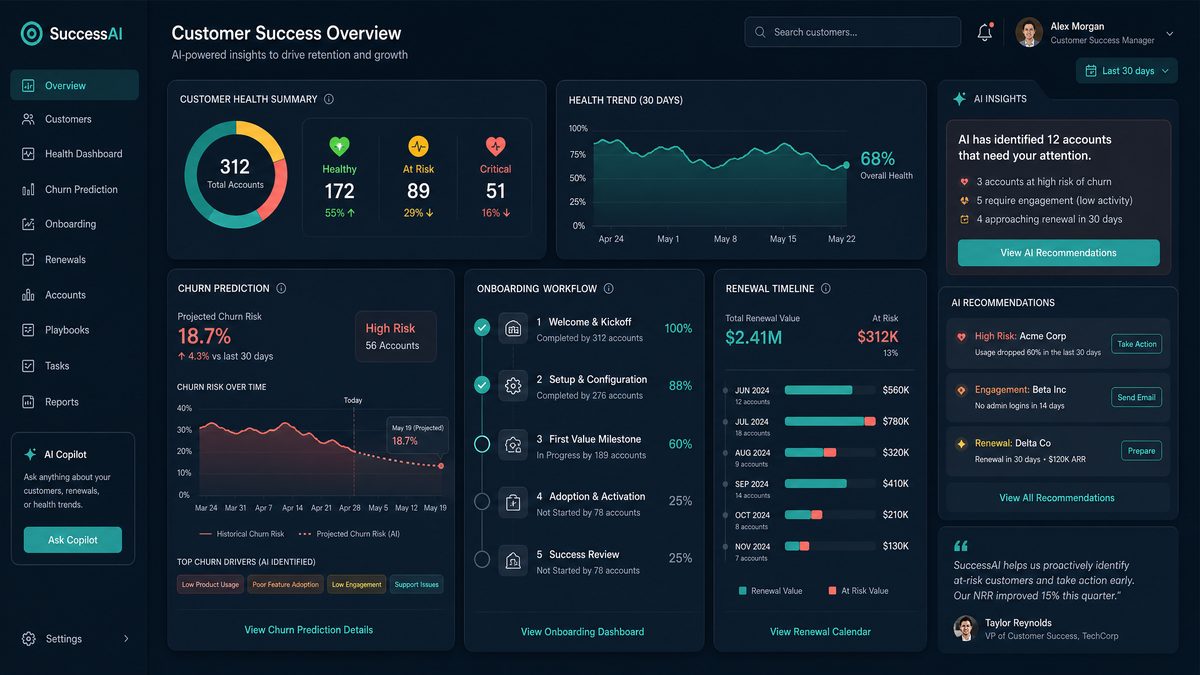
50 GPT-5.5 Prompts for Customer Success Managers: Churn Prediction, Onboarding Workflows, Health Scoring, and Renewal Strategy
Customer Success Managers are operating in one of the most data-intensive, relationship-dependent roles in modern enterprise software. You’re simultaneously tracking product adoption metrics, managing executive relationships, forecasting renewals, and identifying expansion opportunities — all while trying to prevent churn before it becomes visible in the numbers. GPT-5.5’s enhanced reasoning capabilities and extended context window make it a genuinely transformative tool for CSMs who know how to prompt it effectively.
This guide delivers 50 battle-tested prompts organized across six critical CS disciplines: customer health scoring, churn risk analysis, onboarding automation, QBR preparation, expansion opportunity identification, and renewal playbooks. Each prompt includes the full text, a breakdown of why it works, and guidance on what output to expect. Whether you’re managing a portfolio of 50 enterprise accounts or scaling a tech-touch program across thousands of SMB customers, these prompts will compress hours of analysis into minutes.
Before diving in, a note on prompt architecture: GPT-5.5 responds best when you provide role context, specify the output format, include relevant data, and define success criteria. The prompts in this guide follow that structure. You’ll notice each one establishes who you are, what data you’re working with, what format you need, and how the output should be used. That specificity is what separates prompts that produce generic advice from prompts that produce actionable intelligence.
For a deeper exploration of related enterprise AI strategies, our comprehensive guide on 10 Battle-Tested Prompts for marketers in 2026 provides detailed implementation frameworks and practical workflows that complement the approaches discussed in this article.
| Category | Prompts Covered | Primary Use Case |
|---|---|---|
| Customer Health Scoring | 1–10 | Building and interpreting health frameworks |
| Churn Risk Analysis | 11–20 | Early warning signals and risk mitigation |
| Onboarding Automation | 21–30 | Workflow design and time-to-value acceleration |
| QBR Preparation | 31–38 | Executive presentation and strategic alignment |
| Expansion Opportunity Identification | 39–44 | Upsell and cross-sell signal detection |
| Renewal Strategy and Playbooks | 45–50 | Renewal forecasting and negotiation preparation |
Section 1: Customer Health Scoring Prompts (1–10)
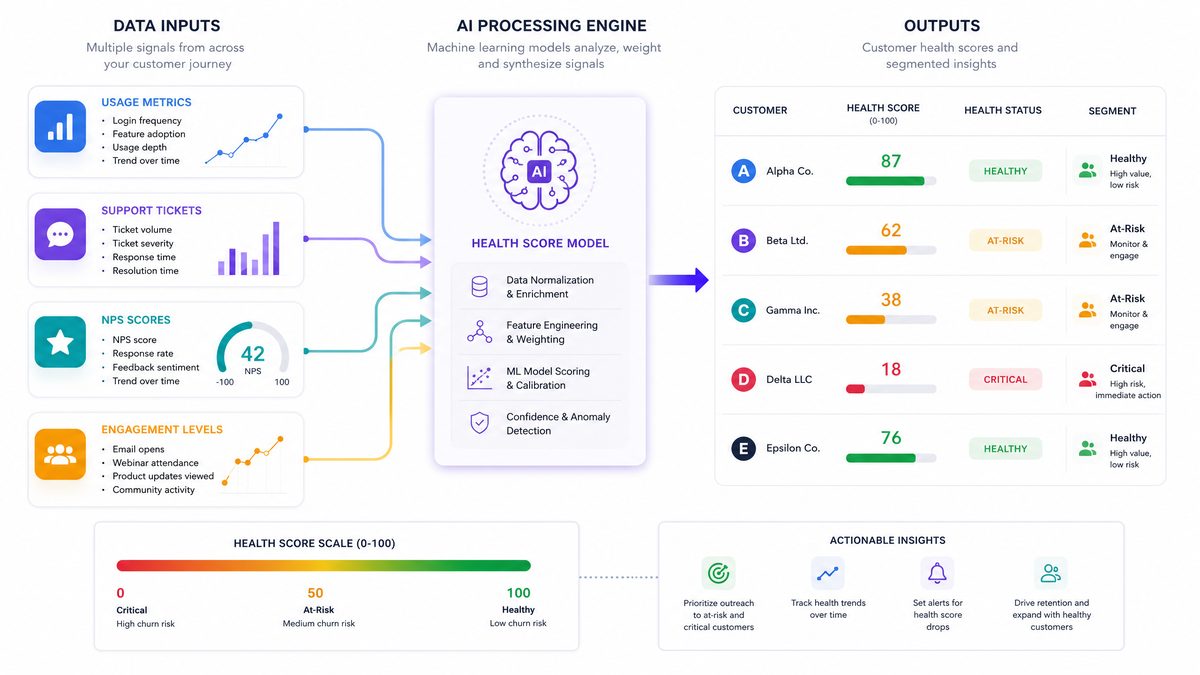
Customer health scores are only as useful as the framework behind them. Too many CS teams inherit a health score that was built by someone who left two years ago, uses metrics that no longer reflect product reality, and outputs a single red/yellow/green status that tells you nothing actionable. GPT-5.5 can help you build, audit, and interpret health scoring systems with the kind of nuanced, multi-dimensional analysis that typically requires a dedicated CS operations analyst.
Prompt 1: Build a Custom Health Score Framework
Full Prompt:
You are a Customer Success Operations expert with 10+ years of experience building health scoring systems for B2B SaaS companies. I need you to design a comprehensive customer health score framework for a [company type: e.g., mid-market HR software platform] with an average contract value of $[X] and a [X-month] contract cycle.
Our available data signals include: product login frequency, feature adoption rate (tracked across 12 core features), support ticket volume and CSAT scores, NPS responses, executive sponsor engagement (email response rate, meeting attendance), payment history, and integration usage depth.
Design a weighted health score model that: (1) assigns percentage weights to each signal category based on their predictive value for churn, (2) defines specific thresholds for red/yellow/green/blue (champion) status at each signal level, (3) explains the rationale for each weight, and (4) identifies which three signals should trigger an immediate CSM alert regardless of overall score. Output as a structured framework with a scoring table.
Why This Works: This prompt gives GPT-5.5 the specific data signals you actually have access to, preventing it from suggesting metrics you can’t measure. The four-tier output (including a “champion” blue tier) pushes beyond generic thinking. The request for alert triggers is critical — it forces the model to identify leading indicators that override aggregate scores.
Expected Output: A complete scoring table with weights, thresholds, rationale, and alert conditions. Expect the model to weight product adoption and executive engagement most heavily (typically 25–30% each) while flagging payment anomalies as an immediate alert trigger regardless of other scores.
Prompt 2: Audit an Existing Health Score for Blind Spots
Full Prompt:
Act as a CS Operations auditor. I’m going to share our current health score methodology and I need you to identify its blind spots, biases, and missing signals. Our current model weights: product logins (40%), support tickets filed (20%), NPS score (30%), contract value (10%). We apply this uniformly across all customer segments — SMB, mid-market, and enterprise.
Identify: (1) which signals are likely over-weighted and creating false positives, (2) which churn predictors are completely absent from this model, (3) why applying uniform weights across segments is problematic with specific examples, (4) the top 5 signals we should add immediately, and (5) a recommended segmented weighting approach. Be specific and critical — I need to present this audit to our VP of CS next week.
Why This Works: The explicit instruction to “be specific and critical” prevents GPT-5.5 from hedging. Framing it as a VP presentation forces executive-quality analysis. The uniform-weighting critique is a known failure mode that GPT-5.5 can address with genuine depth.
Prompt 3: Interpret Conflicting Health Signals
Full Prompt:
I’m a CSM analyzing an account showing contradictory health signals. Help me interpret what’s actually happening and what action to take. Account data: [Company Name] — $280K ARR, 18-month customer, renewal in 4 months. Signals: Daily active users up 23% month-over-month (positive), but the executive sponsor hasn’t responded to 3 emails in 6 weeks (negative). Feature adoption score: 78/100 (positive). Support tickets: 4 critical severity tickets in the last 30 days, all related to API integration failures (negative). Last NPS: 8 (positive, 3 months ago). No champion identified below VP level.
Analyze: (1) what story these conflicting signals are telling when viewed together, (2) the probability this account churns in the next 90 days and your reasoning, (3) the single most urgent action I should take this week, (4) a 30-60-90 day action plan, and (5) what additional information I need to gather in my next call.
Why This Works: Real accounts always have conflicting signals. This prompt trains GPT-5.5 to synthesize contradictory data points rather than average them. The specific data makes the output actionable rather than theoretical. The API integration issue combined with executive silence is a classic pre-churn pattern the model will identify.
Prompt 4: Build a Health Score Segmentation Matrix
Full Prompt:
Create a customer segmentation matrix that combines health score status with strategic account value to determine CSM resource allocation. I manage 45 accounts totaling $4.2M ARR. Help me build a 2×2 matrix using health score (healthy vs. at-risk) and account value (strategic vs. standard, where strategic = $100K+ ARR). For each of the four quadrants, define: the account profile, the recommended CSM engagement model (high-touch, tech-touch, hybrid), specific outreach cadence, which activities to prioritize vs. deprioritize, and realistic capacity expectations for a single CSM. Also flag which quadrant should consume no more than 15% of my weekly time.
Prompt 5: Generate Health Score Trend Analysis Narrative
Full Prompt:
I need to write a health trend narrative for my monthly CS leadership report. Given this 6-month health score data for my portfolio: Month 1: 68% healthy, 22% yellow, 10% red. Month 2: 71% healthy, 19% yellow, 10% red. Month 3: 69% healthy, 20% yellow, 11% red. Month 4: 65% healthy, 24% yellow, 11% red. Month 5: 61% healthy, 26% yellow, 13% red. Month 6: 58% healthy, 27% yellow, 15% red.
Write a 3-paragraph executive narrative that: identifies the trend and its significance, hypothesizes 3 possible root causes I should investigate, quantifies the ARR at risk if the trend continues at the same rate for 3 more months, and recommends two immediate interventions. Use precise language suitable for a VP-level audience. Do not soften the findings.
Why This Works: The “do not soften the findings” instruction is critical. Without it, AI models tend toward optimistic framing. The quantification request forces the model to do the math on ARR at risk, making the output immediately usable in a business review.
Prompts 6–10: Additional Health Scoring Prompts
Prompt 6 — Build a Health Score for a New Product Line: You are a CS strategist. We’re launching a new analytics module as an add-on to our core platform. I need a health score specifically for this module’s adoption. The module has 5 core use cases: dashboard creation, scheduled reports, data exports, API queries, and alert configuration. Define what “healthy adoption” looks like at 30, 60, and 90 days post-activation, what metrics to track for each use case, and what adoption threshold should trigger a CSM intervention call. Output as a structured adoption health framework.
Prompt 7 — Identify Leading vs. Lagging Indicators: Explain the difference between leading and lagging health indicators in B2B SaaS customer success with 5 specific examples of each. For each indicator, describe: what it measures, how far in advance it predicts churn or expansion, how to collect it, and how to act on it. Then rank all 10 by their predictive value for a [product category] platform and explain your ranking logic.
Prompt 8 — Create a Health Score Communication Template: Write a customer-facing health report template that I can send to executive sponsors monthly. It should communicate our assessment of their account health without using internal scoring terminology, highlight 2-3 wins from the previous month, flag one area for improvement with a specific recommendation, and include a forward-looking success milestone for the next 30 days. Keep it under 200 words, professional but not corporate-speak, and end with a clear call to action.
Prompt 9 — Benchmark Health Scores Against Industry Standards: What are the industry benchmark health score distributions for B2B SaaS companies at different growth stages (Series B, Series C, public company)? Specifically: what percentage of accounts should be in each health tier for a well-run CS organization, what churn rates correlate with different health score distributions, and what does it indicate when a company’s “healthy” percentage is above 80% vs. below 60%? Include data from publicly available CS benchmarks.
Prompt 10 — Automate Health Score Updates with a Data Processing Script: Write a Python script that takes a CSV input with columns [customer_id, login_count_30d, feature_adoption_pct, open_tickets, nps_score, days_since_last_exec_contact] and outputs a calculated health score using these weights: logins 25%, feature adoption 30%, tickets (inverse) 15%, NPS 20%, exec contact recency (inverse) 10%. Include threshold logic to assign red/yellow/green/blue status and flag any account where exec contact exceeds 45 days as an immediate alert regardless of overall score.
For Prompt 10, here’s the expected code structure GPT-5.5 will generate:
import pandas as pd
import numpy as np

def calculate_health_score(row):
    # Normalize each signal to 0-100 scale
    login_score = min(row['login_count_30d'] / 30 * 100, 100)
    adoption_score = row['feature_adoption_pct']
    ticket_score = max(100 - (row['open_tickets'] * 20), 0)
    nps_score = (row['nps_score'] / 10) * 100
    exec_score = max(100 - (row['days_since_last_exec_contact'] / 90 * 100), 0)

    # Apply weights
    weighted_score = (
        login_score * 0.25 +
        adoption_score * 0.30 +
        ticket_score * 0.15 +
        nps_score * 0.20 +
        exec_score * 0.10
    )
    return round(weighted_score, 1)

def assign_status(score, days_since_exec):
    if days_since_exec > 45:
        return 'ALERT - Exec Disengagement'
    elif score >= 80:
        return 'Blue - Champion'
    elif score >= 65:
        return 'Green - Healthy'
    elif score >= 45:
        return 'Yellow - At Risk'
    else:
        return 'Red - Critical'

df = pd.read_csv('customer_health_data.csv')
df['health_score'] = df.apply(calculate_health_score, axis=1)
df['status'] = df.apply(
    lambda row: assign_status(
        row['health_score'],
        row['days_since_last_exec_contact']
    ), axis=1
)
df.to_csv('health_scores_output.csv', index=False)
print(df[['customer_id', 'health_score', 'status']].to_string())
Section 2: Churn Risk Analysis Prompts (11–20)
Churn prediction is where AI assistance provides the highest ROI for CS teams. The difference between identifying a churn risk 90 days out versus 30 days out can mean the difference between a successful save and a lost account. GPT-5.5’s ability to process multiple data streams simultaneously and identify non-obvious correlations makes it exceptionally useful for churn analysis — provided you feed it the right data and ask the right questions. These prompts are designed to surface the early warning signals that human pattern recognition often misses until it’s too late.
Prompt 11: Create a Churn Risk Scoring Model
Full Prompt:
You are a data-driven CS strategist. Build a churn risk scoring model specifically for B2B SaaS accounts in the [industry] vertical with contracts between $50K–$500K ARR. The model should identify accounts likely to churn in the next 90 days.
Include: (1) a list of the 10 highest-predictive churn signals ranked by predictive strength, with the typical lead time each signal provides before churn, (2) a scoring rubric that assigns risk points to each signal, (3) a total risk score threshold that should trigger a “save” playbook, (4) signals that indicate the churn decision has already been made internally (and what to do differently in those cases), and (5) the 3 signals that most often appear in accounts that successfully renew after being flagged as high churn risk. Format as a reference document I can share with my CS team.
Prompt 12: Analyze a Specific At-Risk Account
Full Prompt:
Analyze this at-risk account and give me a churn probability assessment with supporting evidence. Account: [Company] — $175K ARR, SaaS platform for supply chain management, 26 months as a customer, renewal in 67 days. Recent signals: (1) Primary champion promoted to different department 8 weeks ago, new contact hasn’t engaged. (2) Login frequency dropped 31% over last 60 days. (3) Opened a support case questioning data export formats — potentially evaluating migration. (4) Missed last two scheduled check-in calls. (5) Finance contact requested full contract documentation including termination clause language last week. (6) LinkedIn shows they’ve been hiring for a role that overlaps with our platform’s core functionality.
Provide: churn probability percentage with confidence level, the single signal you weight most heavily and why, whether this appears to be a planned churn (already decided) or preventable churn, a recommended escalation approach with specific talking points, and what I should NOT do in this situation.
Why This Works: The combination of signals here — especially the contract documentation request and the LinkedIn hiring signal — represents a classic “silent churn” pattern. GPT-5.5 will correctly identify that the finance team requesting termination clause language is the most decisive signal, and will likely assess this as planned rather than preventable churn. That distinction changes the entire response strategy from “save” to “exit with expansion potential.”
Prompt 13: Build a Churn Risk Email Template
Full Prompt:
Write three different email templates for re-engaging an at-risk account, each using a different strategic approach: (1) Value Reaffirmation — reminds them of specific ROI they’ve achieved, (2) Executive Escalation — from my VP to their VP, creating urgency without desperation, (3) Direct Concern — honest acknowledgment that engagement has dropped and asking directly if there’s a problem we need to address.
For each email: keep it under 150 words, avoid generic phrases like “checking in” or “touching base,” include a specific variable for personalization [CUSTOMER_SPECIFIC_WIN], make the call to action a 20-minute call rather than a generic “let’s connect,” and write in a tone that conveys confidence rather than anxiety about the relationship. The account is [Company Name], $175K ARR, in the supply chain industry.
Prompt 14: Identify Systemic Churn Patterns Across Your Portfolio
Full Prompt:
I’m going to describe 5 accounts that churned in the last 12 months. Identify the common patterns, root causes, and what I should have done differently. Account 1: $85K ARR, 14 months, churned after champion left — no multi-threading established. Account 2: $210K ARR, 8 months, churned citing “didn’t achieve expected ROI” — success metrics were never formally defined at kickoff. Account 3: $55K ARR, 22 months, churned to a competitor with lower price — no value conversation in 6 months. Account 4: $340K ARR, 31 months, churned after internal restructuring — no executive sponsor relationship above director level. Account 5: $90K ARR, 11 months, churned citing poor onboarding — implementation took 4 months vs. promised 6 weeks.
Identify: the 3 root causes that appear across multiple churns, the earliest intervention point for each root cause, specific process changes to implement, and which of these churns was most preventable vs. structural. Then write a 1-page “lessons learned” summary I can present to my CS leadership team.
Prompt 15: Create a Churn Save Playbook
Full Prompt:
Design a comprehensive churn save playbook for enterprise accounts ($100K+ ARR) that are 60–90 days from renewal and showing high churn risk signals. The playbook should include: a decision tree for determining whether to attempt a save or manage a graceful exit, a week-by-week action plan for the 60-day save window, specific escalation triggers and who to involve at each stage (CSM, CS Manager, VP CS, CEO), email and call templates for each stage, a “concession ladder” showing what commercial flexibility to offer and in what sequence, success criteria for determining if the save attempt is working, and a clear exit point if the save isn’t gaining traction. Format as a structured playbook document.
Prompts 16–20: Additional Churn Risk Prompts
Prompt 16 — Churn Risk by Customer Cohort: Analyze churn risk patterns by customer acquisition cohort. Given that customers acquired in Q1-Q2 of a given year during a promotional pricing period have historically churned at 2.3x the rate of standard-priced customers, help me: identify what specific signals differentiate high-risk promotional cohort customers from stable ones, design a targeted intervention program for this cohort, calculate the ARR at risk if I have 40 customers from this cohort averaging $65K ARR each, and write the business case for dedicating a dedicated CSM to this cohort for 90 days.
Prompt 17 — Competitive Displacement Risk Assessment: I’ve heard through the grapevine that [Competitor Name] is actively targeting my top 10 accounts. Help me build a competitive displacement risk assessment. For each of these factors — contract timing, executive relationships, product gaps, pricing sensitivity, and champion stability — define what makes an account high vs. low risk for competitive displacement, and create a scoring rubric I can apply to my portfolio. Then write a competitive retention talking track that addresses the most common reasons customers switch to this specific competitor without disparaging them.
Prompt 18 — Post-Churn Analysis Interview Guide: Create a post-churn interview guide for conversations with customers who have decided not to renew. The guide should include 12 open-ended questions that uncover the real reason for churn (not the stated reason), instructions on how to create psychological safety so they give honest answers, a framework for categorizing responses into actionable vs. non-actionable feedback, and a template for documenting and sharing insights with product, sales, and leadership. Include guidance on who should conduct these interviews (not the CSM who owned the account) and the ideal timing (30 days post-churn).
Prompt 19 — Churn Forecast for Board Reporting: Help me build a churn forecast model for our board report. I have 180 accounts, $18.5M ARR. Current health distribution: 55% healthy ($10.2M ARR), 28% yellow ($5.2M ARR), 17% red ($3.1M ARR). Historical churn rates by tier: healthy accounts churn at 3% annually, yellow at 18%, red at 52%. Calculate: expected ARR churn over the next 12 months, the confidence interval for this forecast, what the churn rate would be if I moved 30% of yellow accounts to healthy through targeted intervention, and the ROI of hiring one additional CSM at $120K fully loaded cost if that CSM could move those yellow accounts. Show your math.
Prompt 20 — Build a Champion Departure Response Protocol: Champion departure is the single highest-risk event in customer success. Build a detailed response protocol for when a primary champion leaves an account. Include: the first 48-hour response checklist, how to identify and qualify a new champion candidate, a relationship transfer communication template from the departing champion to their successor, how to use the transition as an opportunity to reset and expand the relationship, and what to do when the departing champion was also the economic buyer. Provide specific language for each scenario.
Section 3: Onboarding Automation Prompts (21–30)
Onboarding is where churn is won or lost. Research consistently shows that customers who reach their first value milestone within 30 days of contract start have dramatically higher retention rates — Gainsight’s 2025 CS benchmark report found that accounts achieving time-to-value within the first month retained at 89% versus 61% for accounts that took 90+ days. Yet most CS teams are still running onboarding from spreadsheets and calendar invites. These prompts help you design, automate, and optimize onboarding programs that scale without sacrificing the personalization that drives early engagement.
Prompt 21: Design a Complete Onboarding Journey Map
Full Prompt:
Design a comprehensive 90-day onboarding journey map for a new enterprise customer ($150K+ ARR) for a [product type: e.g., project management and workflow automation platform]. The customer has 200 users across 4 departments, a dedicated IT admin, and an executive sponsor at the VP level.
The journey map should include: week-by-week milestones with specific success criteria, who owns each milestone (CSM, implementation engineer, customer champion, IT admin), the definition of “time-to-value” for this product type and when it should be achieved, automated touchpoints vs. high-touch CSM interventions and the trigger for each, risk gates at Day 14, Day 30, and Day 60 with escalation criteria, and a success scorecard the customer can self-assess against. Format as a structured timeline with clear ownership and success metrics at each stage.
Prompt 22: Write an Onboarding Kickoff Call Agenda
Full Prompt:
Write a detailed 60-minute kickoff call agenda for a new enterprise customer. The call will include their VP of Operations (executive sponsor), IT Director (technical lead), and 2 department heads (end user champions). Our side: CSM (me), Implementation Engineer, and Solutions Consultant.
The agenda should: open with a relationship-building segment that isn’t awkward or forced (5 minutes), establish shared success metrics that the customer defines — not metrics we impose (15 minutes), align on the implementation timeline and dependencies with specific decision points (15 minutes), introduce our support and escalation model (10 minutes), establish communication cadence and preferred channels (5 minutes), and close with clear next steps owned by specific people with deadlines (10 minutes). Include the specific questions I should ask in each segment, what I’m listening for in their answers, and any red flags that should change my approach mid-call.
Prompt 23: Create an Automated Onboarding Email Sequence
Full Prompt:
Write a 10-email automated onboarding sequence for new customers (SMB segment, $10K–$30K ARR, minimal CSM involvement). Each email should be triggered by specific events or time delays. The sequence should guide customers from activation to first value achievement in 30 days.
For each email provide: the trigger (time-based or event-based), subject line (A/B test two options), email body (under 150 words, one clear CTA), the behavioral goal of that email, and what happens if they don’t take the action (fallback trigger). Emails should cover: welcome and next steps, first login prompt, core feature introduction, integration setup, first use case completion, team invitation, advanced feature unlock, success check-in, case study/social proof, and 30-day milestone celebration. Write in a tone that’s warm but efficient — these are busy professionals.
Prompt 24: Build an Onboarding Risk Detection Framework
Full Prompt:
Create an onboarding risk detection framework that identifies at-risk new customers in their first 90 days before they become churn risks. Define: the 8 most common onboarding failure modes with their root causes, the specific behavioral signals that indicate each failure mode (measurable in product data), the intervention for each failure mode with timing, how to differentiate between customer-caused delays and vendor-caused delays, and the escalation criteria that should bring in senior CS leadership during onboarding. Include a “Day 30 Onboarding Health Check” template that a CSM can complete in 15 minutes to assess whether an account is on track.
Prompt 25: Design a Self-Service Onboarding Program for SMB
Full Prompt:
I need to design a fully self-service onboarding program for SMB customers (under $15K ARR) that achieves the same time-to-value outcomes as our high-touch enterprise onboarding but requires zero CSM involvement unless triggered by specific risk signals. The program should include: an in-product guided setup flow with milestone checkpoints, an automated resource delivery system that sends the right content at the right moment based on product behavior, a community forum strategy for peer-to-peer support, a digital success plan template customers complete themselves, and the 3 behavioral triggers that should automatically escalate a self-service customer to CSM-assisted onboarding. Define success metrics for this program and how to benchmark it against our high-touch model.
Prompts 26–30: Additional Onboarding Prompts
Prompt 26 — Onboarding Delay Response Protocol: Our implementation is running 3 weeks behind schedule due to customer-side resource constraints. The customer is frustrated and beginning to question their purchase decision. Write a recovery communication plan including: an honest acknowledgment email from me to the executive sponsor, a revised timeline with buffer built in, a “quick win” plan to deliver visible value within the next 10 days despite the delay, talking points for a recovery call, and how to reframe the delay as an opportunity to do the implementation better rather than faster. Include specific language for each communication.
Prompt 27 — Create Onboarding Success Metrics by Use Case: Define specific, measurable “time-to-value” metrics for 5 different customer use cases on our platform: (1) sales team using CRM integration, (2) marketing team using campaign automation, (3) support team using ticket management, (4) finance team using reporting dashboards, (5) operations team using workflow automation. For each use case: define what “first value” looks like, the metric that proves it was achieved, the realistic timeframe to achieve it, and the leading indicator that predicts whether they’ll get there.
Prompt 28 — Build an Executive Sponsor Engagement Program for Onboarding: Executive sponsors are critical during onboarding but are often disengaged after the contract is signed. Design a 90-day executive sponsor engagement program that keeps the VP-level buyer involved without overwhelming them. Include: a monthly executive briefing format (30 minutes max), what metrics to present vs. what to handle at the working level, how to use early wins to build executive advocacy, a template for the “30-day value report” sent directly to the executive, and how to identify when an executive sponsor is becoming a risk factor vs. an asset.
Prompt 29 — Onboarding Handoff from Sales to CS: The sales-to-CS handoff is where onboarding most often fails. Design a standardized handoff protocol that ensures CSMs receive everything they need to deliver a successful onboarding. Include: the mandatory information sales must document in CRM before handoff (with specific field names), a handoff call agenda between AE, CSM, and customer, how to handle situations where sales overpromised during the sales cycle, the customer communication that introduces the CSM and transitions the relationship, and an SLA for how quickly the CSM must schedule the kickoff call after contract signature.
Prompt 30 — Measure and Improve Onboarding Program Effectiveness: Help me build a measurement framework for our onboarding program. Define: the 6 KPIs that best measure onboarding effectiveness (beyond just “time-to-value”), how to calculate an “onboarding success score” that predicts 12-month retention, a cohort analysis approach that identifies which onboarding variables correlate with long-term retention, a feedback loop mechanism that continuously improves the onboarding program based on customer and CSM input, and a quarterly onboarding review template I can use with my team. Include benchmark targets for each KPI based on industry standards.
Section 4: QBR Preparation Prompts (31–38)
Quarterly Business Reviews are the highest-stakes recurring touchpoint in customer success. A well-executed QBR reinforces value, surfaces expansion opportunities, and strengthens executive relationships. A poorly executed QBR — one that’s just a product roadmap walkthrough or a data dump — is actively harmful, consuming executive time without delivering value and signaling that you don’t understand the customer’s business. GPT-5.5 can dramatically accelerate QBR preparation while improving the strategic quality of the content.
For a deeper exploration of related enterprise AI strategies, our comprehensive guide on Advanced Prompt Patterns for automation: Working Examples for Gemini 3.1 Pro and Cursor provides detailed implementation frameworks and practical workflows that complement the approaches discussed in this article.
Prompt 31: Build a QBR Narrative from Raw Data
Full Prompt:
Transform this raw customer data into a compelling QBR narrative for an executive audience. Customer: [Company Name], $280K ARR, financial services firm. Data: Users: 340 active out of 400 licensed (85% adoption). Top features used: reporting (92% of users), compliance workflows (78%), API integrations (45%). Support: 12 tickets this quarter, 10 resolved same-day, 2 escalated (both resolved within 48 hours). Business outcomes reported by champion: reduced monthly close process from 8 days to 5 days, eliminated 2 FTE of manual reporting work, achieved SOX compliance audit with zero findings for first time in 3 years.
Write a QBR executive summary that: leads with business outcomes (not product metrics), quantifies the value delivered in dollar terms where possible, acknowledges the 2 escalated tickets with what was learned, previews the next quarter’s value opportunity, and ends with a strategic question that opens a conversation about their business goals for next year. Write for a CFO audience — precise, outcome-focused, and brief.
Prompt 32: Prepare Strategic Questions for a QBR
Full Prompt:
I have a QBR next week with the CFO and VP of Operations of a mid-market manufacturing company. They’ve been a customer for 18 months using our ERP integration and financial reporting platform. I want this QBR to be genuinely strategic — not a product demo or a metrics review. Prepare 10 strategic business questions I can ask that: demonstrate I’ve researched their industry and business (reference manufacturing industry trends in 2026), surface new pain points our platform could address, identify their top 3 business priorities for next year, uncover internal political dynamics that affect platform adoption, and position me as a strategic advisor rather than a vendor. For each question, explain what I’m trying to learn and how I’ll use the answer.
Prompt 33: Create a QBR Slide Deck Outline
Full Prompt:
Create a 12-slide QBR deck outline for an enterprise customer that follows the “Past-Present-Future” framework. For each slide provide: the slide title, the key message in one sentence, the specific data or content to include, the talking points (3 bullets max), and the transition to the next slide. The deck should tell a coherent story from “here’s what we accomplished together” to “here’s what’s possible next quarter” with a clear expansion conversation embedded naturally in slide 9. The customer is a healthcare technology company, $420K ARR, 3-year relationship. Avoid slides that are just data tables — every slide should have a “so what” that connects to their business outcomes.
Prompt 34: Prepare for a Difficult QBR
Full Prompt:
Help me prepare for a difficult QBR. The customer is frustrated: adoption is at 52% (well below the 80% we committed to), there was a significant outage last quarter that affected them for 6 hours, and their champion told me privately that the CFO is questioning the ROI of the platform. The renewal is in 5 months at $195K ARR.
Prepare: an opening that acknowledges the difficult quarter without being defensive or over-apologetic, a factual account of the outage with what was done and what’s changed (I’ll fill in specifics), a recovery plan for adoption with specific milestones and accountability, how to address the ROI question before the CFO raises it, the one data point I need to find before this meeting that could change the narrative, and how to end the meeting with the relationship stronger than when it started despite the difficult content. Be direct — I need to walk in ready for a tough conversation.
Prompts 35–38: Additional QBR Prompts
Prompt 35 — ROI Calculator for QBR: Build an ROI calculation framework I can customize for each customer’s QBR. The framework should calculate value across three dimensions: (1) time savings — hours saved per user per week multiplied by fully-loaded hourly cost, (2) error reduction — cost of errors eliminated (compliance risk, rework, customer impact), (3) revenue acceleration — time-to-revenue improvements enabled by the platform. For each dimension, provide the formula, the data inputs I need to gather from the customer, and how to present the calculation in a way that a CFO will find credible rather than inflated. Include guidance on how to be conservative in your estimates to build credibility.
Prompt 36 — QBR Follow-Up Communication: Write a QBR follow-up email that: arrives within 24 hours of the meeting, summarizes the 3 key decisions made and who owns them with deadlines, captures the 2 open questions that need follow-up, reiterates the next quarter’s success plan in bullet form, and includes a specific “thank you” that references something the customer said in the meeting (I’ll fill in the specific reference). The email should be under 300 words, structured for easy scanning, and end with a clear next step. Write for a VP-level recipient who receives 200+ emails per day.
Prompt 37 — Annual Business Review vs. QBR Structure: Explain the strategic differences between a Quarterly Business Review and an Annual Business Review in customer success, and design a distinct format for each. The ABR should be more strategic, involve more senior stakeholders, and set the foundation for contract renewal. Include: the different attendee lists and why they matter, the different content and time allocation for each, how to use the ABR to plant seeds for expansion and renewal 6 months before the renewal date, and a specific agenda for a 90-minute ABR with an enterprise customer.
Prompt 38 — Build a QBR Preparation Checklist: Create a comprehensive QBR preparation checklist that a CSM should complete in the 2 weeks before a QBR. Organize it into: data gathering tasks (with specific systems to pull from), customer research tasks (what to review about their business, industry news, personnel changes), internal alignment tasks (who to brief before the meeting), logistics tasks, and the 30-minute prep session agenda the day before the QBR. Include time estimates for each task category and flag which tasks can be automated or delegated to CS Ops. Total prep time should not exceed 4 hours for a standard QBR.
Section 5: Expansion Opportunity Identification Prompts (39–44)
Net Revenue Retention is the metric that defines the health of a SaaS business, and expansion — upsell and cross-sell — is its primary driver. The best CSMs don’t pitch expansion; they identify the right moment when customer success naturally creates the conditions for a commercial conversation. These prompts help you build the systems and scripts to identify, qualify, and advance expansion opportunities without compromising the trusted advisor relationship.
Prompt 39: Build an Expansion Signal Detection Framework
Full Prompt:
Design a framework for detecting expansion-ready signals across my customer portfolio. I have access to: product usage data, support ticket content, NPS survey verbatims, QBR notes, LinkedIn company data, and CRM activity history. Define: the top 10 behavioral signals that indicate a customer is ready for an expansion conversation, how to differentiate between a customer who is ready to expand and one who is simply satisfied (satisfaction ≠ expansion readiness), the specific product usage thresholds that indicate a customer has outgrown their current tier, how to use NPS verbatims to identify upsell language the customer is already using, and a scoring system that ranks accounts by expansion probability. Include the 3 signals that should trigger an immediate expansion conversation regardless of other factors.
Prompt 40: Write an Expansion Conversation Script
Full Prompt:
Write a natural, non-salesy expansion conversation script for introducing an upsell opportunity during a regular check-in call. The customer is a 2-year customer, $85K ARR, healthy account, and they’ve been consistently hitting the limits of their current plan (hitting API rate limits 3x this month, have 8 users on a 10-seat license). The expansion opportunity is our Professional tier at $145K ARR which removes API limits, adds 25 seats, and includes our new AI analytics module.
The script should: transition naturally from a success conversation to the expansion topic, lead with the customer’s pain (API limits and seat constraints) before mentioning the solution, present the value of the upgrade in terms of what they can do that they can’t do today, handle the most likely objection (budget timing), and close with a next step that doesn’t require an immediate decision. Include stage directions for tone and pacing. The conversation should feel like a CSM having a helpful conversation, not a sales pitch.
Prompt 41: Identify Cross-Sell Opportunities from Support Tickets
Full Prompt:
I’m going to share 10 support ticket summaries from the last 90 days. For each ticket, identify whether it contains a hidden cross-sell or upsell signal, what product or feature addresses the underlying need, and how I should follow up. Here are the tickets: [Ticket 1: User asking how to export data to Excel every week — “is there a faster way?”] [Ticket 2: Admin asking if they can set up automatic user provisioning from their HR system] [Ticket 3: User frustrated that they can’t share dashboards with external stakeholders] [Ticket 4: Manager asking if there’s a way to get weekly summary emails without logging in] [Ticket 5: IT admin asking about SSO configuration] [Ticket 6: User asking how to create recurring reports] [Ticket 7: Team lead asking if multiple users can edit the same workflow simultaneously] [Ticket 8: User asking if the mobile app has offline capability] [Ticket 9: Admin asking about data retention policies for compliance] [Ticket 10: User asking if they can connect the platform to Salesforce]. Provide the analysis and a follow-up action for each.
Prompts 42–44: Additional Expansion Prompts
Prompt 42 — Build an Expansion Pipeline Dashboard: Design the metrics and structure for a CSM expansion pipeline dashboard. Include: the 5 pipeline stages for expansion opportunities (from “signal detected” to “closed-won”), the definition and exit criteria for each stage, how to calculate expansion pipeline coverage ratio and what a healthy ratio looks like, the leading indicators that predict expansion pipeline conversion, and how to present expansion pipeline to CS leadership in a weekly team meeting. Include a sample data table structure I can build in Salesforce or Gainsight.
Prompt 43 — Create an Expansion Business Case Template: Write a business case template that a CSM can customize for each expansion opportunity. The template should help the customer champion sell the expansion internally to their CFO or budget committee. Include: an executive summary section (1 paragraph), a current state vs. future state comparison, a quantified ROI section with conservative/base/optimistic scenarios, a risk section that addresses the cost of not expanding, an implementation timeline that minimizes disruption, and a clear ask with pricing options. The template should be editable and under 2 pages when completed. Write it from the customer champion’s perspective, not the vendor’s.
Prompt 44 — Expansion Timing Strategy: Advise on the optimal timing for expansion conversations across different scenarios: (1) a customer 6 months into a 12-month contract who is seeing strong early results, (2) a customer 2 months before renewal who is healthy but hasn’t been asked about expansion, (3) a customer who just achieved a major milestone using the platform, (4) a customer who just hired a new executive sponsor who doesn’t know the platform well yet, (5) a customer who just had a negative experience that was resolved successfully. For each scenario, define the ideal timing, the right framing, who to involve in the conversation, and what to avoid. Include the one scenario where you should NOT pursue expansion regardless of the signals.
Section 6: Renewal Strategy and Playbooks (45–50)
Renewal is the moment of truth in customer success. Everything you’ve done over the contract term — every QBR, every health score intervention, every onboarding milestone — either shows up in a smooth renewal or gets exposed in a difficult one. The prompts in this section are designed to help you build systematic renewal processes that start months before the renewal date and create the conditions for not just retention, but expansion at renewal.
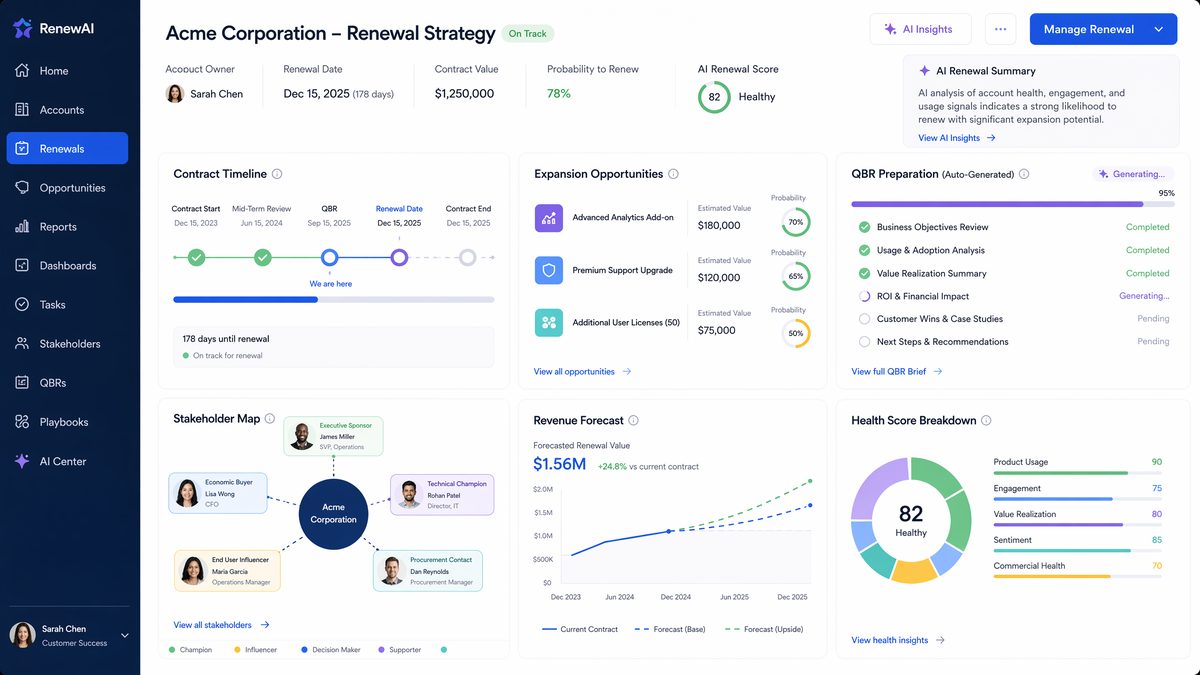
Prompt 45: Build a 90-Day Renewal Playbook
Full Prompt:
Create a detailed 90-day renewal playbook for enterprise accounts ($100K+ ARR). The playbook should cover Day 90 through Day 0 (renewal date) and include specific actions, communications, and milestones at each stage. Structure it as: Days 90–60 (foundation stage): what to assess, what conversations to have, and what risks to identify. Days 60–30 (momentum stage): how to build the renewal case, who to engage, and how to handle commercial conversations. Days 30–0 (close stage): negotiation preparation, objection handling, and contract execution. For each stage, define: the CSM’s primary activities, the AE’s role (if applicable), what should be in Salesforce/CRM, escalation triggers, and success criteria. Include a “renewal readiness scorecard” that predicts likelihood of smooth renewal vs. at-risk renewal.
Prompt 46: Write Renewal Negotiation Talking Points
Full Prompt:
Prepare renewal negotiation talking points for three different renewal scenarios. Scenario A: Healthy account requesting a 15% price reduction citing budget constraints — we want to hold price or accept minimal discount in exchange for a longer term. Scenario B: At-risk account that has underutilized the platform — they’re threatening to downgrade 40% of their licenses. Scenario C: Champion account that loves the product but their procurement team is pushing back on standard T&Cs and requesting custom SLAs we don’t normally offer.
For each scenario: provide the opening position and rationale, the concession ladder (what to give up and in what order), the value anchors to return to when the conversation goes commercial, the non-negotiables and why, and the walk-away point. Include specific language for each scenario — not generic negotiation principles, but actual sentences I can use. Also identify the psychological dynamic in each scenario and how to navigate it.
Prompt 47: Create a Renewal Forecast Model
Full Prompt:
Build a renewal forecast model that I can use for my monthly CS leadership report. I have 22 accounts renewing in the next 90 days totaling $3.8M ARR. Help me create: a classification system for renewal confidence (Commit, Best Case, Pipeline, At Risk) with specific criteria for each category, a weighted ARR forecast calculation that accounts for confidence levels, a sensitivity analysis showing best case vs. worst case renewal ARR, the 5 factors that most accurately predict renewal outcome at the 90-day mark, and a one-page renewal forecast template I can complete in 30 minutes each month. Include guidance on how to present forecast uncertainty to leadership without undermining confidence in the CS team.
Prompt 48: Handle a Multi-Stakeholder Renewal Objection
Full Prompt:
I’m facing a complex renewal situation with multiple stakeholders giving conflicting signals. The account is $320K ARR, renewal in 45 days. Champion (Director of Operations): enthusiastic, wants to renew and expand. CFO: skeptical, sent a note asking for “a detailed ROI justification before any renewal discussion.” IT Director: neutral but raised concerns about our security certifications in the last call. Procurement: standard process, but they’ve asked for 3 competitive bids as policy. CEO: not engaged, but the champion says he’s been asking about platform costs in executive meetings.
Develop a multi-stakeholder renewal strategy that: maps each stakeholder’s concern and motivation, defines the right person from our side to engage each stakeholder, sequences the conversations in the right order, provides specific content for the CFO’s ROI justification request, addresses the IT security concerns with specific documentation, and prepares me for the competitive bid process. Include a stakeholder communication plan for the next 45 days.
Prompt 49: Build a Renewal Risk Early Warning System
Full Prompt:
Design an automated renewal risk early warning system that flags accounts 180 days before renewal rather than 90 days. The system should: define the 12 signals to monitor in the 180-day pre-renewal window, assign risk weights to each signal, define the alert thresholds that trigger CSM notification, CSM Manager notification, and VP notification, create a weekly “renewal risk digest” format that a CSM can review in 10 minutes, and integrate with standard CS platforms (Gainsight, Salesforce, ChurnZero). Include the specific Gainsight Rules Engine logic or equivalent for implementing the top 3 alert conditions. The goal is to eliminate surprise churns by ensuring every at-risk renewal is identified and actioned at least 120 days before the renewal date.
Prompt 50: Create a Post-Renewal Expansion Strategy
Full Prompt:
Design a post-renewal expansion strategy that capitalizes on the momentum of a successful renewal. The strategy should cover the 90 days immediately following renewal signature. Include: how to use the renewal conversation to surface expansion opportunities that were mentioned but not acted on, a “renewal honeymoon” communication sequence that reinforces the decision and builds enthusiasm for the next contract period, how to introduce new features or products in the context of the goals they shared during renewal discussions, a success planning session agenda for the first 30 days of the new contract term, and how to identify and develop new champions within the account who can sponsor expansion initiatives. The goal is for every renewal to be the starting point of an expansion conversation, not the end of a retention conversation.
Advanced Prompt Engineering Tips for CS Professionals
Getting maximum value from GPT-5.5 in a customer success context requires more than copying and pasting these prompts. Here are the meta-level techniques that will make every prompt in this guide more effective.
Provide Real Data, Get Real Insights
The single most impactful thing you can do to improve prompt output quality is to include actual data. GPT-5.5 can process substantial amounts of text, so don’t summarize your account data — paste it. Include the actual numbers, the actual email threads (redacted for privacy), the actual support ticket text. The more specific your input, the more specific and actionable your output. Generic inputs produce generic outputs, regardless of how well the prompt is structured.
Use the “Role + Context + Format + Constraint” Architecture
Every high-performing prompt in this guide follows the same four-part architecture. First, establish a role (“You are a CS Operations expert”). Second, provide context (account data, company size, situation specifics). Third, define the output format (table, email, bullet list, narrative). Fourth, add constraints that push the model toward better output (“Be direct,” “Under 150 words,” “No generic advice”). Missing any one of these elements degrades output quality significantly.
Chain Prompts for Complex Analysis
For complex tasks like building a complete renewal playbook or designing a health scoring system, use prompt chaining rather than trying to accomplish everything in one prompt. Start with the strategic framework, then prompt for specific components, then prompt for implementation details. This approach produces more coherent, detailed output than a single mega-prompt, and allows you to course-correct at each stage.
Build a Prompt Library in Your CS Platform
The prompts in this guide should live in a shared library accessible to your entire CS team. Tools like Notion, Confluence, or even a shared Google Doc work well. Organize by use case, include notes on what works and what to customize, and review the library quarterly as your product and customer base evolve. A well-maintained prompt library is a genuine competitive advantage for CS teams.
Validate AI Output Against Customer Reality
GPT-5.5 produces sophisticated analysis, but it doesn’t know your customers. Always validate AI-generated insights against your direct knowledge of the account. Use the AI output as a structured starting point, then layer in the relationship intelligence, political dynamics, and historical context that only you possess. The combination of AI pattern recognition and human relationship intelligence is what produces genuinely exceptional customer success outcomes.
Access 40,000+ AI Prompts for ChatGPT, Claude & Codex — Free!
Subscribe to get instant access to our complete Notion Prompt Library — the largest curated collection of prompts for ChatGPT, Claude, OpenAI Codex, and other leading AI models. Optimized for real-world workflows across coding, research, content creation, and business.
Integrating These Prompts into Your Daily CS Workflow
The most effective CS teams don’t use AI sporadically — they build it into their daily workflow. Here’s a practical integration model based on the prompts in this guide.
Morning Portfolio Review (15 minutes)
- Run your health score analysis prompt against overnight product usage data
- Review the automated churn signal alerts from your early warning system
- Use Prompt 3 (conflicting health signals) for any accounts that need same-day attention
- Prioritize your outreach list based on the output
Account Preparation (30 minutes per account)
- Use Prompt