
The Complete Guide to Google’s Agent2Agent Protocol and OpenAI Codex Interoperability: Building Cross-Platform AI Agent Systems
The Complete Guide to Google’s Agent2Agent Protocol and OpenAI Codex Interoperability: Building Cross-Platform AI Agent Systems
By ChatGPT AI Hub • Technical Guide
Table of Contents
- Introduction
- What is Google’s Agent2Agent (A2A) Protocol and Why It Matters
- The Open Knowledge Framework (OKF) as a Knowledge Graph for Agents
- How A2A Differs from MCP (Model Context Protocol) by Anthropic
- OpenAI Codex Agent Architecture and Participation in A2A
- Building Cross-Platform Agent Systems That Work with Multiple Providers
- Implementation Patterns for Agent-to-Agent Communication
- Security and Authentication in Multi-Agent Systems
- Real-World Use Cases: Enterprise Workflows Spanning Multiple AI Providers
- Performance Considerations and Latency Management
- Reference Implementation: A Minimal A2A-MCP Bridge
- Observability and Debugging Across Agents
- Governance, Policy, and Compliance
- The Future of Agent Interoperability Standards
- Resources and Link Placeholders
Introduction
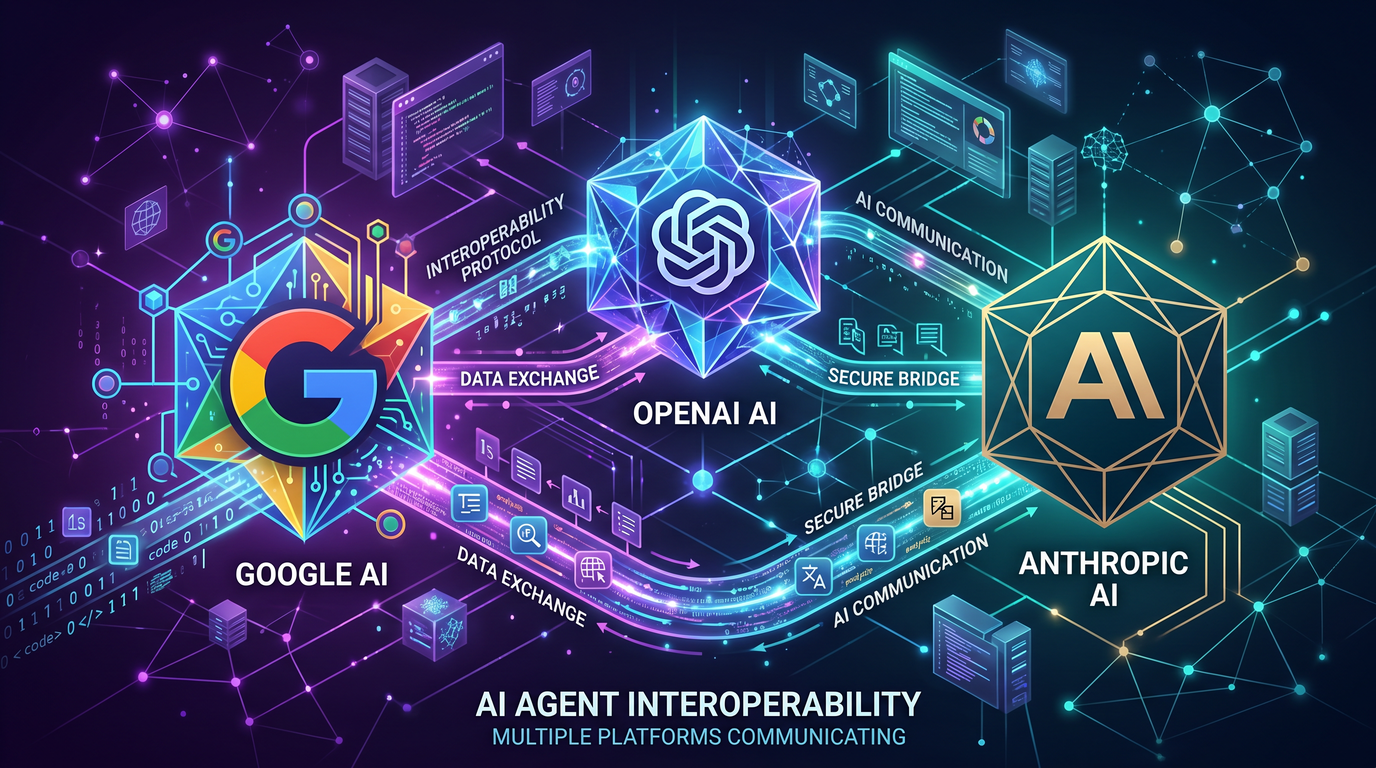
AI agents are evolving from isolated model wrappers into distributed, composable systems that learn, plan, and act across organizational boundaries. In modern enterprises, agents from different vendors—Google, OpenAI, Anthropic, open-source frameworks—are expected to collaborate on shared goals: analyzing data, triggering automations, orchestrating human approvals, and maintaining audit trails. Interoperability is no longer a convenience; it is a necessity for resilience, cost control, and governance.
This guide provides a comprehensive, pragmatic roadmap to building cross-platform agent ecosystems. We focus on an Agent2Agent (A2A) approach to inter-agent messaging and how it can coexist with, and complement, Anthropic’s Model Context Protocol (MCP) as well as OpenAI’s Codex-style agent architectures. You will learn how to design a robust message envelope, describe capabilities, link to a shared knowledge graph via an Open Knowledge Framework (OKF), secure traffic with modern identity primitives, and tune performance for multi-provider workflows. Throughout, we emphasize vendor-neutral patterns so you can adopt the standards that emerge while shipping production value now.
Whether you are integrating a code-execution agent reminiscent of OpenAI Codex with a planning agent based on Google’s stack, or creating a policy-bound orchestration layer that can speak MCP and A2A, this guide equips you with the concepts, schemas, and reference code to get started and scale.
What is Google’s Agent2Agent (A2A) Protocol and Why It Matters
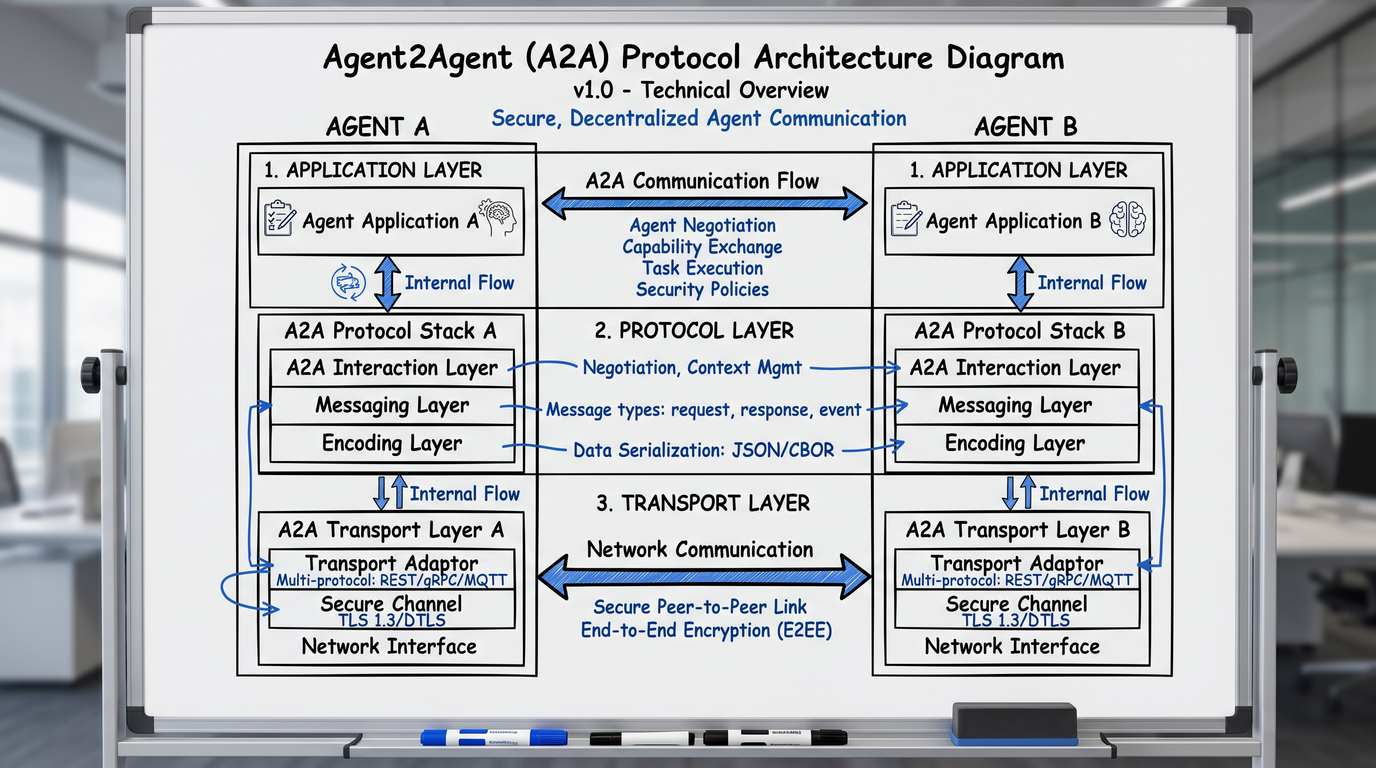
In this guide, we use “Agent2Agent (A2A)” to describe a protocol pattern for interoperable messaging among autonomous or semi-autonomous agents. At its core, A2A treats each agent—regardless of vendor or runtime—as a network-addressable principal with:
- A stable identity and trust root (e.g., OIDC identity, x.509/mTLS, or SPIFFE ID)
- Advertised capabilities and tool schemas (e.g., JSON Schema for tools, supported media types)
- A message envelope with routing, correlation, and policy metadata
- A mechanism to reference or exchange shared context via a knowledge graph (OKF)
- Streaming semantics for partial results and tool calls
Why it matters: enterprises increasingly mix and match best-in-class agents from different providers. A planning agent might leverage Google’s stack for long-horizon reasoning; a code agent inspired by OpenAI Codex might generate and execute scripts; a retrieval agent might run on a company-managed vector database; and a compliance agent may enforce enterprise policies. A2A patterns enable these agents to collaborate without forcing uniform vendor lock-in or proprietary APIs at every boundary.
Design principles of A2A-style systems
- Neutrality: focus on message semantics, not model internals
- Composability: minimal assumptions about agent internals; strong contracts at the interface
- Introspection: discoverability of capabilities and policies via machine-readable metadata
- Observability: traceability across agents for debugging, billing, and compliance
- Security by default: authenticated, authorized, and auditable messaging
These principles are not unique to any one vendor. They reflect lessons from distributed systems, microservices, and event-driven architectures adapted to the unique affordances and risks of AI agents.
A canonical A2A message envelope
While different deployments will tune fields to their needs, a structured envelope helps agents route, correlate, and enforce policy. Here is a vendor-neutral example:
{
  "v": "1.0",
  "id": "msg_01J2Z2DPC54F4NMXV3M2PHN3ZB",
  "ts": "2026-07-04T12:34:56.789Z",
  "trace": {
    "trace_id": "tr_86a1c7be67b84d80",
    "span_id": "sp_41c8b7936d1a",
    "parent_span_id": null
  },
  "from": {
    "agent_id": "agent://acme/planner",
    "display": "Acme Planner",
    "auth": { "method": "oidc", "sub": "[email protected]" }
  },
  "to": {
    "agent_id": "agent://acme/codex-executor",
    "display": "Code Executor",
    "routing": { "strategy": "direct" }
  },
  "ttl_ms": 300000,
  "policy": {
    "sensitivity": "internal",
    "compliance": ["sox"],
    "allow_tools": ["bash.run", "python.exec"],
    "deny_domains": ["*.personal-storage.example"]
  },
  "capabilities": [
    "a2a.streaming.v1",
    "a2a.toolcalls.v1",
    "a2a.okf.refs.v1"
  ],
  "intent": {
    "type": "task.request",
    "goal": "Generate a Python script to aggregate sales data and store results in BigQuery."
  },
  "context": {
    "okf_refs": [
      "okf://datasets/sales_2025_q4",
      "okf://schemas/bq/sales_agg_v2"
    ],
    "attachments": [
      {"type": "text/plain", "id": "att_01", "content": "Use region=us-central1; table=sales.daily"}
    ]
  },
  "body": {
    "prompt": "Write a Python script that queries the sales dataset and writes daily aggregates to BigQuery. Ensure idempotency and retries."
  }
}
The fields support traceability (trace_id), policy scoping (sensitivity, allow/deny), shared knowledge references (okf_refs), and a vendor-neutral capability advertisement. Agents can stream partial results in follow-up messages sharing the same id and trace.
The Open Knowledge Framework (OKF) as a Knowledge Graph for Agents
Multi-agent systems converge on a shared context: data products, schemas, APIs, glossaries, and policy objects. A practical way to socialize this context—without copying raw data—is to publish durable references into a knowledge graph we’ll call the Open Knowledge Framework (OKF). OKF is not prescriptive about underlying storage; it can be backed by RDF, property graphs, or JSON-LD documents. The key is consistent identifiers, typed relationships, and machine-readable metadata.
Why OKF helps A2A systems
- Decoupling: agents exchange references instead of bulky payloads
- Governance: attach policies, lineage, and data sensitivity to nodes/edges
- Discoverability: agents can query for resources by type, tag, or relationship
- Auditability: track which agent touched which resource and why
A minimal OKF JSON-LD schema
Below is a compact JSON-LD representation capturing datasets, schemas, and policies. You can host OKF resources over HTTPS, IPFS, or internal registries; agents refer to them using stable URIs.
{
  "@context": {
    "okf": "https://schema.example.org/okf#",
    "dct": "http://purl.org/dc/terms/",
    "prov": "http://www.w3.org/ns/prov#"
  },
  "@id": "okf://datasets/sales_2025_q4",
  "@type": "okf:Dataset",
  "dct:title": "Sales Q4 2025",
  "okf:storage": {
    "@type": "okf:BigQueryTable",
    "project": "acme-analytics",
    "dataset": "sales",
    "table": "daily",
    "region": "us-central1"
  },
  "okf:policy": {
    "@id": "okf://policy/sox-internal",
    "@type": "okf:Policy",
    "okf:rules": [
      {"effect": "allow", "action": "read", "principal": "group:data-analysts"},
      {"effect": "deny", "action": "exfiltrate", "principal": "any"}
    ]
  },
  "prov:wasDerivedFrom": "okf://datasets/sales_2025_q3"
}
Resolution and caching
Agents resolve OKF URIs using a registry service that returns canonical JSON-LD along with ETags and cache-control headers. To avoid excessive latency, deploy regional OKF edge caches and prefetch likely references based on user intent. Integrity can be ensured with content-addressed IDs or signed resources (e.g., JWS over JSON-LD).
Querying the graph
Expose read-only graph query endpoints to agents:
- SPARQL for RDF stores
- Gremlin or Cypher for property graphs
- Simple REST filters for JSON-LD documents (types, tags, relationships)
Keep read-write privileges limited to curator agents or humans under approval workflows, and stamp provenance on every mutation for audit.
How A2A Differs from MCP (Model Context Protocol) by Anthropic
Anthropic’s Model Context Protocol (MCP) focuses on connecting models to tools, data sources, and IDEs via a well-defined session and resource interface. It formalizes how a model can request tools, list resources, and stream results over transports like stdio or WebSocket. A2A, in contrast, addresses the broader scenario of autonomous agents messaging each other—potentially from different vendors or runtimes—with richer routing, policy, and knowledge references.
| Dimension | A2A (Agent-to-Agent) | MCP (Model Context Protocol) |
|---|---|---|
| Primary scope | Inter-agent messaging, routing, policy, and shared knowledge references | Model-to-tool/resource interface within an agent runtime |
| Transport | HTTP/2, HTTP/3, WebSocket, NATS/Kafka, gRPC; often multi-transport | Stdio, WebSocket; defined for model contexts |
| Addressing | Agent URIs, directories, presence, capability-based routing | Sessions with a single model runtime and its provided resources |
| Capabilities | Advertised across agents; used for discovery and delegation | Tool schemas/resources exposed by a host to the model |
| Knowledge graph | First-class OKF references to datasets, policies, artifacts | Resource listing and content retrieval scoped to a session |
| Interoperability target | Cross-vendor, multi-agent ecosystems | Consistent tool/resource interface for a single model host |
| State and policy | Envelope-level policy, TTLs, sensitivity, compliance tags | Session-level negotiated capabilities, prompts, resources |
In practice, these approaches complement each other. An MCP-compliant runtime can live behind an A2A-facing proxy: external agents talk A2A; the proxy translates to MCP for the internal model host. This pattern lets you onboard tools quickly with MCP while preserving cross-vendor connectivity with A2A.
OpenAI Codex Agent Architecture and Participation in A2A
Historically, OpenAI’s Codex popularized code-centric agents that can translate natural language into executable scripts, reason over source code, and interact with terminals or notebook kernels. Today, similar capabilities appear across multiple providers and in successors to Codex. Regardless of the exact model lineage, “Codex-style” agents share architectural traits ideal for A2A participation:
- Planning loop: understand goals, propose code actions, verify outcomes
- Tool use: shell, Python, database clients, cloud SDKs
- Sandboxed execution: secure code run-time, egress control
- Artifacts: persist code, logs, and results
An A2A adapter for a Codex-style agent
To join an A2A network, a code-execution agent needs:
- A2A listener endpoint (HTTP/WebSocket/gRPC) with authenticated ingress
- Capability descriptor enumerating tool names, input schemas, and safety policies
- Envelope handler to parse intent, fetch OKF references, and run tool calls
- Streaming of partial outputs (logs, code diffs, progress) and final artifacts
{
  "agent_id": "agent://acme/codex-executor",
  "display_name": "Acme Code Executor",
  "capabilities": {
    "a2a.toolcalls.v1": [
      {"tool": "python.exec", "input_schema": "okf://schemas/tools/python_exec_v1"},
      {"tool": "bash.run", "input_schema": "okf://schemas/tools/bash_run_v1"},
      {"tool": "bigquery.query", "input_schema": "okf://schemas/tools/bq_query_v1"}
    ],
    "a2a.streaming.v1": ["text/event-stream", "application/json-seq"],
    "a2a.okf.refs.v1": true
  },
  "policies": {
    "egress": ["*.googleapis.com", "vault.acme.example"],
    "allow_env": ["DATA_REGION", "BQ_PROJECT"],
    "deny_syscalls": ["ptrace", "mount"]
  },
  "endpoints": {
    "http": "https://agents.acme.example/codex-executor/a2a",
    "ws": "wss://agents.acme.example/codex-executor/a2a/ws"
  }
}
Execution flow under A2A
- Planner sends a task.request with OKF references and policy envelope.
- Executor resolves OKF resources (schemas, dataset URIs) via registry.
- Executor runs a planning-and-verify loop, streaming logs as SSE.
- Artifacts (scripts, notebooks) are saved to an artifact store referenced by OKF URIs.
- Final message returns structured results plus references to artifacts and logs.
This flow models a Codex-style agent as a responsible A2A citizen: it adheres to policy, annotates outputs, and records provenance for audit.
Building Cross-Platform Agent Systems That Work with Multiple Providers
Cross-platform means more than calling diverse APIs. It implies shared identity, policy, observability, and knowledge references so that agents from different stacks can cooperate safely. Here are the architectural building blocks:
Directories and discovery
- Agent Directory: maps agent:// URIs to endpoints, public keys, and capability manifests
- Presence Service: tracks agent liveness and capacity for load-aware routing
- Policy Directory: publishes reusable policy objects and consent requirements
{
  "agent_uri": "agent://contoso/retriever",
  "endpoints": {"http": "https://agents.contoso.example/retriever"},
  "keys": [{"kid": "2026-06", "kty": "EC", "crv": "P-256", "x": "...", "y": "..."}],
  "capabilities": ["a2a.okf.refs.v1", "a2a.streaming.v1", "retrieval.topk.v1"],
  "labels": {"region": "eu-west1", "tier": "gold"},
  "health": {"status": "ok", "updated_at": "2026-07-04T10:24:03Z"}
}
Capabilities and contracts
Standardize tool names and input/output schemas with JSON Schema or Protocol Buffers. Publish schemas into OKF so they are versioned and discoverable. Use semantic versioning for backward compatibility and negotiate versions at runtime.
Orchestration strategy
- Coordinator agent: assigns tasks to specialists based on capability tags, cost, and latency SLOs
- Policy agent: enforces org policies, performs red-teaming or PII scanning, signs envelopes
- Human-in-the-loop: integrate approval steps using A2A messages to and from human gateways
Data plane and runtimes
Mix cloud-managed runtimes (e.g., serverless functions for stateless agents), containerized services with GPU access, and edge workers for low-latency locales. Choose transports that match your trust boundary: mTLS HTTP/2 for cross-org; gRPC inside a VPC; message bus (NATS/Kafka) for fan-out and buffering.
Implementation Patterns for Agent-to-Agent Communication
The following patterns help you assemble reliable A2A systems. Each is transport-agnostic and compatible with MCP-based components through adapters.
1) Envelope + Capability Discovery
Start with a stable envelope schema and a discovery handshake. The sender fetches the recipient’s capability manifest and keys before transmitting. If versions mismatch, the sender falls back or selects an alternative recipient.
// TypeScript: discovery + send
type Capabilities = {
  capabilities: string[];
  schemas: Record<string, string>; // tool -> OKF schema URI
  keys: { kid: string; jwk: JsonWebKey }[];
  versions: { a2a: string };
};

async function resolveRecipient(agentUri: string): Promise<Capabilities> {
  const url = `https://directory.example.org/agents/resolve?uri=${encodeURIComponent(agentUri)}`;
  const res = await fetch(url, { headers: { "accept": "application/json" } });
  if (!res.ok) throw new Error(`Resolve failed: ${res.status}`);
  return res.json();
}

async function sendA2AMessage(recipient: string, envelope: any, signer: (e:any)=>Promise<any>) {
  const caps = await resolveRecipient(recipient);
  if (!caps.capabilities.includes("a2a.toolcalls.v1")) throw new Error("Incompatible recipient");
  const signed = await signer(envelope);
  return fetch(`https://gateway.example.org/a2a/send`, {
    method: "POST",
    headers: { "content-type": "application/a2a+json" },
    body: JSON.stringify(signed)
  });
}
2) Streaming Partial Results
Use Server-Sent Events (SSE) or WebSocket for agent logs, intermediate plans, or tool call results. Include correlation IDs and sequence numbers for resume support.
GET /a2a/stream?msg=msg_01J2Z... HTTP/1.1
Accept: text/event-stream
Authorization: Bearer eyJ... (JWT)

event: log
id: 1
data: {"level":"info","msg":"Creating venv..."}

event: toolcall
id: 2
data: {"tool":"python.exec","args":{"script_uri":"okf://artifacts/tmp.py"}}

event: progress
id: 3
data: {"pct": 65}

event: final
id: 4
data: {"status":"ok","artifacts":["okf://artifacts/report_123.ipynb"]}
3) Idempotency and Retries
Assign idempotency keys per task and implement at-least-once delivery with deduplication in the recipient. Store a short-lived cache keyed by id/from to return the prior result on duplicate arrivals.
4) Directory + Presence + Hedging
Query the directory for all agents with a capability, then select two recipients with low recent latency to hedge the first 5% of slow requests. Cancel the losing hedge when one completes successfully to reduce tail latency.
5) Translators Between Protocols (A2A ↔ MCP)
Place a sidecar or gateway that accepts A2A envelopes and converts them into MCP sessions and tool invocations. Return streams as A2A SSE events. This keeps the internal model interface simple while supporting external diversity.
// Pseudo: A2A -> MCP bridge outline
async function handleA2A(envelope: A2AEnvelope) {
  const mcp = await mcpConnect({ transport: "ws", url: MCP_URL });
  await mcp.open();
  const tools = await mcp.listTools();
  const plan = planFromIntent(envelope.intent, tools);
  for (const step of plan) {
    const res = await mcp.callTool(step.tool, step.args);
    streamToA2A(envelope.id, "tool_result", res);
  }
  await mcp.close();
  return finalizeA2A(envelope.id, { status: "ok" });
}
6) Knowledge-by-Reference
Pass OKF URIs, not raw blobs. Recipients fetch with their own credentials. This prevents accidental data spillage, enables centralized access control, and reduces payload size.
7) Human-in-the-Loop Gateways
Use an A2A-compatible human gateway: it accepts an envelope, renders a review screen, captures approvals or edits, and emits a signed “approval.granted” or “approval.denied” message back to the requesting agent with rationale.
8) Artifact Stores and Provenance
Persist scripts, diffs, logs, and notebooks in an artifact store referenced by OKF URIs. Attach provenance using W3C PROV or in-house metadata. Immutable artifacts with content hashes simplify verification and rollback.
Security and Authentication in Multi-Agent Systems
Security is existential for agents that can plan and act. An A2A network must verify who is talking, what they are allowed to do, and why. Below are core controls and practical steps.
Identity and trust roots
- OIDC/OAuth 2.0: agents obtain tokens with audience restricted to recipients
- mTLS (x.509): mutual TLS for transport-level authentication, often inside a VPC or mesh
- SPIFFE/SPIRE: workload identity and SVID rotation for zero-trust service meshes
# Example: mTLS server cert generation for an agent
openssl req -newkey rsa:2048 -nodes -keyout agent.key -x509 -days 90 -out agent.crt \
  -subj "/CN=agent.acme.example/O=Acme/OU=Agents"
# Distribute agent.crt to directory; install CA in clients.
Authorization and policy enforcement
- JWT-bound policies: embed policy hashes in envelopes and sign
- ABAC/RBAC with policy engine (e.g., OPA/Rego) at gateways and recipients
- Data egress control lists for code-execution agents
{
  "policy": {
    "id": "okf://policy/sox-internal",
    "hash": "sha256-4eaa...",
    "bindings": [{"role":"executor","principal":"agent://acme/codex-executor"}]
  },
  "sig": {
    "alg": "ES256",
    "kid": "2026-06",
    "jws": "eyJhbGciOiJFUzI1NiIsInR5cCI6IkpXVCJ9...."
  }
}
Secrets, execution sandboxes, and egress
Code-execution agents should run in gVisor/Firecracker or similar sandboxes, with:
- Just-in-time ephemeral credentials (short-lived tokens fetched from a vault)
- Outbound egress proxy that enforces domain allowlists and logs destinations
- Filesystem isolation and syscall filtering
Audit and non-repudiation
Sign envelopes and stream events; write append-only logs (e.g., to WORM storage). Tie each message to a trace_id that correlates with spans in your observability stack.
Privacy and data minimization
Minimize sensitive data in prompts. Prefer references to OKF resources with server-side filtering. Apply PII redaction tools as pre-processing steps and enforce token budgets that cap leakage.
Real-World Use Cases: Enterprise Workflows Spanning Multiple AI Providers
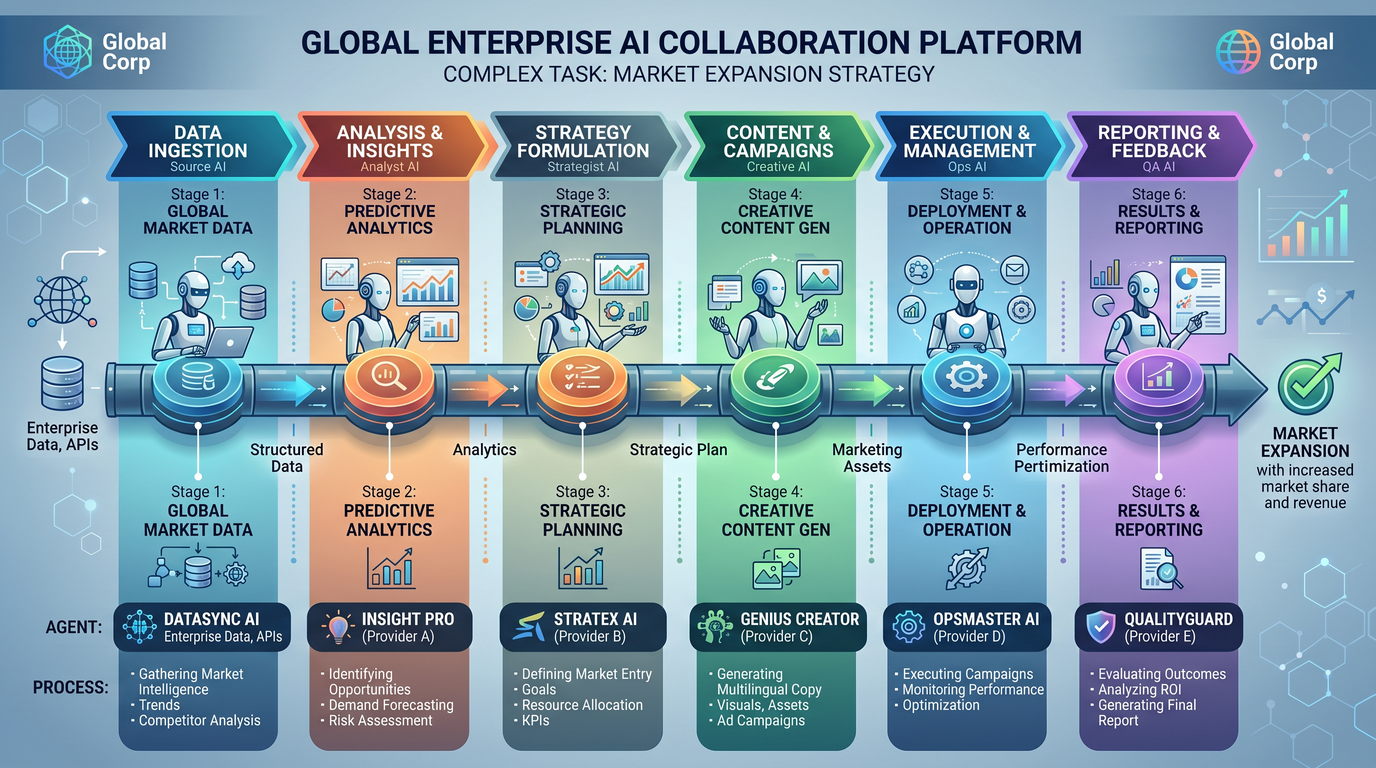
Cross-provider agent meshes are already emerging in enterprises that want resilience, regional performance, and best-of-breed specialization. Here are concrete patterns.
Analytics pipeline: planning + code generation + governance
A planning agent ingests a business objective (“daily revenue dashboard for EMEA”), queries OKF for datasets, and delegates to a code agent to generate a BigQuery job. A governance agent performs a policy check; a human gateway approves the artifact; the pipeline executes; a reporting agent publishes the dashboard. Each step is an A2A exchange with signed envelopes and OKF references.
Sales operations: CRM triage + document drafting + review
A retriever agent extracts CRM insights and augments a drafting agent that prepares emails or proposals. A brand-safety agent checks tone and legal disclaimers. A human approver edits and sends. Behind the scenes, different vendors power the retriever, drafter, and guardrail agents, but A2A keeps the workflow cohesive.
MLOps: evaluation agents + CI/CD for prompts and tools
Experiment agents generate prompt variants; evaluator agents run benchmarks; a code agent updates tool wrappers; a deployment agent promotes versions. Policies ensure that only approved combinations ship to production. OKF records lineage linking prompts, datasets, and evaluation metrics.
Incident response: detect, triage, automate
A SIEM-integrated agent detects anomalies and notifies a triage agent. A remediation agent proposes runbooks and executes after a human gateway’s approval. This demands strict egress controls and auditability, readily expressed via A2A policy envelopes and signed artifacts.
Performance Considerations and Latency Management
Performance in multi-agent systems depends on transport choices, message size, streaming granularity, and orchestration strategies. Here’s how to keep latencies low and throughput high without sacrificing safety.
Transport and encoding
- HTTP/2 or HTTP/3 for request multiplexing and head-of-line blocking mitigation
- WebSocket for bidirectional streams; consider protobuf for compact envelopes
- Compression with Zstd or Brotli for large JSON bodies; ensure dictionary attacks are mitigated
Batching, coalescing, and streaming
Coalesce small A2A messages when latencies permit, but prefer streaming for long-running code execution. If a code agent emits logs frequently, buffer to 200–400 ms intervals for network efficiency while staying interactive.
Hedging and timeouts
Employ controlled hedging for non-idempotent tasks with compensation logic, or limit hedging to discovery and planning steps. Use per-hop timeouts and propagate budgets in the envelope (ttl_ms).
OKF caching and prefetch
Cache hot OKF nodes with ETags and short TTLs; prefetch likely schemas referenced by an agent’s capability manifest. Co-locate OKF resolvers near agents to shave tens of milliseconds per hop.
Resource-aware routing
Annotate directory entries with resource hints (GPU availability, cold/warm state). Route GPU-bound tasks to warm pools. Avoid cold-start penalties by keeping a small canary pool hot.
Hedged send with cancellation (example)
# Python: hedged request to two candidates
import asyncio, aiohttp, random

async def send(session, url, payload, timeout):
  async with session.post(url, json=payload, timeout=timeout) as r:
    r.raise_for_status()
    return await r.json()

async def hedged_send(candidates, payload):
  async with aiohttp.ClientSession() as session:
    first, second = random.sample(candidates, 2)
    t1 = asyncio.create_task(send(session, first, payload, 20))
    # short delay before hedging
    await asyncio.sleep(0.05)
    t2 = asyncio.create_task(send(session, second, payload, 20))
    done, pending = await asyncio.wait({t1, t2}, return_when=asyncio.FIRST_COMPLETED)
    for p in pending:
      p.cancel()
    return list(done)[0].result()

# usage: result = await hedged_send(urls, envelope)
Reference Implementation: A Minimal A2A-MCP Bridge
This section demonstrates a compact bridge that accepts A2A messages and invokes an MCP server to fulfill tool calls, streaming results back to the A2A sender. It’s not production-ready but outlines key integration points.
Architecture
- A2A Gateway: exposes HTTP POST /a2a/send and GET /a2a/stream endpoints
- MCP Client: opens a WebSocket to the MCP server (e.g., a tool host)
- Directory: resolves agent capabilities and keys for verification
- OKF Resolver: fetches knowledge references on demand
Code sketch (Node.js)
import http from "http";
import { WebSocket } from "ws";
import { v4 as uuid } from "uuid";

const streams = new Map<string, any>(); // msg_id -> SSE response

function sseHeaders() {
  return {
    "Content-Type": "text/event-stream",
    "Cache-Control": "no-cache",
    "Connection": "keep-alive",
  };
}

function writeEvent(res, event, data, id) {
  if (id) res.write(`id: ${id}\n`);
  res.write(`event: ${event}\n`);
  res.write(`data: ${JSON.stringify(data)}\n\n`);
}

async function callMCP(tool, args) {
  const ws = new WebSocket(process.env.MCP_URL!);
  return await new Promise((resolve, reject) => {
    ws.on("open", () => {
      ws.send(JSON.stringify({ jsonrpc: "2.0", id: 1, method: "tools/call", params: { tool, args } }));
    });
    ws.on("message", (buf) => {
      const msg = JSON.parse(buf.toString());
      if (msg.result) resolve(msg.result);
      if (msg.error) reject(new Error(msg.error.message));
    });
    ws.on("error", reject);
  });
}

const server = http.createServer(async (req, res) => {
  // Stream endpoint
  if (req.method === "GET" && req.url?.startsWith("/a2a/stream")) {
    const msgId = new URL("http://x" + req.url).searchParams.get("msg");
    if (!msgId) { res.statusCode = 400; return res.end("missing msg"); }
    res.writeHead(200, sseHeaders());
    streams.set(msgId, res);
    req.on("close", () => streams.delete(msgId));
    return;
  }

  // Send endpoint
  if (req.method === "POST" && req.url === "/a2a/send") {
    const body = await new Promise<string>(r => {
      let b = ""; req.on("data", c => b += c); req.on("end", () => r(b));
    });
    const env = JSON.parse(body);
    // TODO: verify signature, check policy, resolve OKF refs as needed
    const stream = streams.get(env.id);
    const steps = planSteps(env); // naive planner
    for (const step of steps) {
      stream && writeEvent(stream, "toolcall", { tool: step.tool, args: step.args }, uuid());
      const out = await callMCP(step.tool, step.args);
      stream && writeEvent(stream, "tool_result", out, uuid());
    }
    // final
    stream && writeEvent(stream, "final", { status: "ok" }, uuid());
    res.writeHead(200, { "content-type": "application/json" });
    return res.end(JSON.stringify({ status: "accepted", id: env.id }));
  }

  res.statusCode = 404; res.end();
});

server.listen(8080);
Operational notes
- Add JWT verification and mTLS on the gateway
- Enforce envelope policy (denylist, TTL, sensitivity)
- Translate MCP streaming chunks to A2A SSE events
- Attach OpenTelemetry trace context to correlate spans
Observability and Debugging Across Agents
Multi-agent observability requires end-to-end tracing, structured logs, and metrics that capture queueing, retries, and human approvals. A2A envelopes carry a trace context; each agent emits spans annotated with tool names, OKF URIs, and policy decisions.
OpenTelemetry trace propagation
{
  "trace": {
    "trace_id": "tr_86a1c7be67b84d80",
    "span_id": "sp_planner_dispatch",
    "parent_span_id": null,
    "baggage": {
      "user": "u12345",
      "sensitivity": "internal"
    }
  }
}
Propagate W3C traceparent and tracestate headers over HTTP; for message buses, include trace context in message attributes. Sample at a low rate for hot paths and at a higher rate for error conditions to control cost.
Metrics
- P50/P95/P99 latencies per capability and per recipient
- Retry counts and deduplication hits
- Policy denials and egress violations
- Streaming backpressure and dropped events
Debugging playbook
- Reproduce with fixed idempotency key and log correlation to isolate dedups
- Enable verbose directory and OKF resolver logs for capability/version mismatches
- Replay A2A envelopes against a staging MCP bridge with sanitized OKF
- Attach human gateway transcripts for post-mortem clarity
Governance, Policy, and Compliance
Governance aligns agent autonomy with organizational risk tolerance. Express policies as reusable OKF objects with machine-enforceable rules and human-readable descriptions. Gate risky actions behind approvals and maintain immutable audit trails.
Patterns
- Guardrails-as-code: versioned policies applied by a policy agent and verified in CI
- Consent propagation: ensure human consents travel with the envelope across agents
- Data residency: route envelopes based on regional tags in OKF and agent labels
Compliance artifacts
The Agent2Agent protocol builds on the foundation of individual agent capabilities that platforms like OpenAI have been developing. Understanding how Codex agents operate internally helps developers design better cross-platform agent interactions. For a deep dive into single-platform agent orchestration, see our tutorial on Codex Record and Replay and how OpenAI’s screen recording feature turns workflows into reusable AI automation skills.
- Common envelope schemas with extension points and standard media types
- Shared capability registries for common tools (shell, Python, retrieval, SQL)
- Knowledge graph conventions (JSON-LD/RDF vocabularies) for data products and policies
- Interop suites and conformance tests for vendors and open-source agents
- Built-in safety semantics: policy hashes, consent markers, and provenance
As these standards mature, the pragmatic path is to implement vendor-neutral patterns now—sign envelopes, advertise capabilities, reference knowledge via OKF—and place adapters at the edges (e.g., MCP bridges). This future-proofs your architecture while letting you benefit from evolving ecosystems across Google, OpenAI, Anthropic, and open-source communities.
Access 40,000+ AI Prompts for ChatGPT, Claude & Codex — Free!
Subscribe to get instant access to our complete Notion Prompt Library — the largest curated collection of prompts for ChatGPT, Claude, OpenAI Codex, and other leading AI models. Optimized for real-world workflows across coding, research, content creation, and business.
Resources and Link Placeholders
Enterprise governance becomes even more critical when agents from multiple providers interact within a single workflow. Organizations need robust compliance frameworks that span across AI platforms. Our analysis covers how enterprise AI governance is evolving in 2026 from M-in compliance tools.
Starests, and OKF references. Add a security-first posture with identity, policy, and audit controls. Observe, measure, and tune tail latencies with hedging, streaming, and resource-aware routing. Finally, put a lightweight A2A↔MCP bridge in place so you can integrate agents from multiple providers without rewriting tool layers. This layered approach makes interoperability a feature, not a liability, in your AI strategy.