
OpenAI’s $40 Billion Government Stake: What the US Government’s 5% Ownership Means for AI Policy, Developers, and Enterprise Customers

OpenAI’s $40 Billion Government Stake: What the US Government’s 5% Ownership Means for AI Policy, Developers, and Enterprise Customers
Type: News/Analysis
Multiple reports indicate that OpenAI has discussed giving the United States government a minority ownership stake—approximately 5%—valued at or near $40 billion. While details remain fluid and unconfirmed, sources suggest the arrangement could be intertwined with regulatory concessions, national security guarantees, and gating of certain next-generation model capabilities (including a rumored GPT-5.6 “Sol” release with government-specific safeguards or staged access). This analysis explains why such a deal would be on the table, the mechanisms that could govern it, and—crucially—how developers and enterprise buyers should prepare for potential policy, compliance, and technical changes that may follow.
Important context: As of publication, no binding agreement has been publicly disclosed or finalized. The analysis below outlines plausible structures and impacts based on public reporting, prior precedents, and current US AI policy trends. Organizations should monitor official filings and regulatory announcements before making irreversible decisions.
Table of Contents
- Executive Summary
- What Is Reportedly Happening
- Why This Is Happening: Policy, Security, and Market Drivers
- Possible Governance Mechanics of a 5% US Stake
- Policy Implications: Standard-Setting, Audits, and Export Controls
- Developer Impacts: API Access, Feature Gating, and Compliance-by-Design
- Enterprise Implications: Data Sovereignty, Procurement, and Oversight
- Historical Precedents: Telecom, Defense, and Strategic Technology
- International Reactions and Geopolitical Dynamics
- Scenarios and Timelines: Best-, Base-, and Worst-Case Paths
- What Developers and Teams Should Do Now
- FAQs and Common Misconceptions
- Signals to Watch and Final Takeaways
Executive Summary
The reported discussions between OpenAI and the US government to formalize a 5% equity stake—pegged to a ~$40 billion valuation—reflect converging pressures: rising regulatory scrutiny of frontier models, national security concerns about dual-use capabilities, and market demands for clearer accountability. If consummated, the stake may be paired with special governance rights around the release of sensitive capabilities, beginning with or adjacent to a GPT-5.6 “Sol” model that could be subject to government-informed gating.
- Developers should expect: tighter know-your-customer (KYC) practices, more granular API feature gating by use case and geography, laid-out retention and event logging standards, and explicit in-app safety attestations. API rate, scope, and modality access could vary by verified identity and compliance tier.
- Enterprises should prepare: data residency controls, FedRAMP/FedRAMP-equivalent procurement requirements for public sector deals, more prescriptive model evaluation/audit evidence, and government oversight carve-outs that may affect SLAs and change-management timelines.
- Policy trajectory: a government stake—especially one coupled with observer rights or a “golden share” on high-risk releases—would accelerate the institutionalization of red-teaming, incident reporting, and export-control-aligned gating for certain capabilities and weights access.
- Global dynamics: allies may seek reciprocal assurances; rivals may re-accelerate national champions. Expect intensified policy competition on compute controls, weight exportability, and alignment standards.
- Action now: instrument usage analytics for policy-responsive feature flags; build consent flows and audit trails; design for regionalization; prepare AI bills of materials (AI-BOMs) and evaluation documentation; proactively adopt NIST AI RMF-style controls.
What Is Reportedly Happening
While formal filings have not been published, reporting suggests OpenAI and US officials have explored an equity-based arrangement whereby the US takes a 5% ownership position, valued near $40 billion, potentially structured as non-voting or limited-voting shares. Linked discussions reportedly touch on the rollout of advanced model capabilities—referenced in some accounts as GPT-5.6 “Sol”—and the prospect of government-informed gating mechanisms that sequence access by risk profile, industry, or geography.
Key contours based on public reporting and plausible structuring
- Stake size/value: Approximately 5% ownership, valued in the vicinity of $40B at implied enterprise levels consistent with recent frontier-model valuations.
- Voting vs. non-voting: A minority stake could be non-voting to avoid undue operational control, while still embedding governance channels (observer rights, information covenants, or special vetoes limited to defined safety triggers).
- Special rights: A “golden share” or policy rider might grant the government limited veto or delay powers on the release of capabilities classified as “high risk,” aligning with NIST AI RMF categories or future statutory definitions.
- Model gating: A staged release for certain capabilities (for instance, autonomous tool-use, code synthesis with exploit risk, or sensitive bio/chem reasoning), with audits and targeted access starting with vetted users and national-security-relevant agencies.
- Transparency/Audit: Regular red-team results, incident reports, and deployment plans submitted under confidentiality to designated agencies.
- Export-control alignment: Harmonized gating by geography, with compute and weights access controlled under updated export regimes.
From a corporate finance perspective, a government stake can be structured in multiple ways—direct equity, preferred shares with covenants, warrants, or a passive instrument paired with binding side letters. The architecture that emerges will dictate how operationally intrusive the stake is and how directly it shapes API feature rollout and enterprise SLAs.
Two guardrails are likely to shape the final contours: first, preserving OpenAI’s ability to innovate and compete globally; second, satisfying policymakers that frontier models won’t escape reasonable guardrails for national security and public safety. Straying too far in either direction undermines the rationale for the deal.

Why This Is Happening: Policy, Security, and Market Drivers
Several drivers have converged to put a government stake on the table. These include intensifying policy scrutiny of foundation models, rising concern about dual-use and proliferation risks, and market demands for stable rules of the road that reduce uncertainty and unlock larger enterprise and public-sector deployments.
Regulatory pressure on frontier models
- Executive actions and guidance: Recent executive priorities have flagged model evaluation, safety reporting, and watermarking as areas where voluntary commitments are evolving toward formal expectations. Agencies are building playbooks for how to assess high-risk deployments.
- Legislative signals: While the US lacks a comprehensive AI statute, bipartisan interest in incident reporting, model registration (for certain risk classes), and export-related constraints is strengthening.
- Liability pressure: Plaintiffs and policymakers are probing where liability should attach for downstream harms. Even if current law limits direct liability, firms anticipate new duties of care for high-risk capabilities.
National security and dual-use concerns
- Capabilities convergence: As models improve, distinctions between benign and harmful competencies blur. Advanced automation, code generation with exploit risk, and chemistry/biology reasoning elevate dual-use anxieties.
- Compute and weights control: Securing leading-edge compute and model weights has become a policy priority. Stake-driven governance offers a mechanism to align private release cadences with national priorities.
- Election integrity and information operations: Policymakers are acutely aware of synthetic media risks and coordinated influence campaigns, prompting calls for stronger provenance and rate limiting.
Market stabilization and enterprise readiness
- Procurement friction: Large buyers—especially regulated enterprises and the public sector—seek predictable compliance baselines. A structured government relationship could accelerate trust and standardization.
- Capital intensity: Training and serving frontier models at scale is capital-intensive. A government-aligned path could unlock complementary support (e.g., access to specialized compute or programmatic contracts) without direct subsidies.
- Global competition: Firms face international rivals backed by state-led strategies. A domestic public–private compact can shape norms before more fragmented, protectionist regimes emerge.
Possible Governance Mechanics of a 5% US Stake
Structuring matters. The difference between a passive economic stake and a policy-conditional instrument with specific rights is enormous in practice. Below are plausible governance mechanisms that could accompany a 5% position.
Structural options
| Structure | What It Is | Pros | Cons | Likely Fit |
|---|---|---|---|---|
| Non-voting equity + side letter | Economic stake with no formal voting; policy covenants in a separate agreement | Minimizes operational intrusion; preserves agility | Enforceability hinges on contract; public optics may be mixed | High |
| Preferred shares with special rights | Preferred class grants limited veto or delay rights over defined “high-risk releases” | Direct, bounded control aligned to risk | Complex; may chill innovation if overbroad | Medium |
| Board observer | Government gains observer seat, access to information, no voting | Transparency without formal control | Confidentiality and FOIA risks to manage | Medium–High |
| Golden share | Special veto right for narrowly defined categories (e.g., weights release) | Clear, tail-risk-oriented safeguard | Politically sensitive; must be tightly scoped | Medium |
| Warrants / options tied to compliance KPIs | Instruments vest when compliance milestones are met | Aligns incentives; transparent metrics | Hard to define KPIs without gaming | Low–Medium |
Release gating and “Sol”-class capabilities
Reports reference a GPT-5.6 “Sol” model as part of government-gated considerations. In practical terms, “gating” could mean:
- Capability scoping: Identifying specific capabilities (e.g., autonomous multi-step tool orchestration; cyber ranges; high-fidelity simulation) that require enhanced vetting.
- Tiered access: Allowing controlled access to vetted developers, research partners, and agencies while broader release is deferred pending safety benchmarks.
- Geofencing: Enforcing access by jurisdiction, considering sanctions and export controls.
- Operational audits: Pre-deployment red-teaming and independent evaluations with documented mitigations.
Information and audit rights
- Incident reporting: Confidential notification to designated agencies for high-severity safety incidents, with postmortems and remediation steps.
- Evaluation artifacts: Standardized reports on model evaluations (capability cards, risk registers, mitigation matrices).
- Third-party assessments: Periodic reviews by accredited labs with results shared under NDA.
Export-control alignment
Expect tighter coupling between model capability classes and export regimes. Weight portability, fine-tuning scopes, and API cross-border usage could face more granular controls, harmonized with compute export policies and clarified de minimis thresholds.
Policy Implications: Standard-Setting, Audits, and Export Controls
A government stake—especially if paired with reporting requirements—would likely catalyze more uniform, standardized expectations across the US market for model governance. While not a statute, a flagship public–private arrangement often becomes a template others emulate, including competitors and regulators.
Standard-setting momentum
- Evaluation baselines: Codified evaluation suites for dual-use risk, with documented pass/fail thresholds prior to releasing sensitive features.
- Model and capability cards: Expanded “model cards” describing risk ratings, use restrictions, and mitigation strategies, possibly mandated for enterprise and public-sector deals.
- Watermarking/provenance: Strengthened provenance via content credentials and cryptographic schemes; canonical headers on API responses to aid downstream labeling.
Audit and assurance
- Assurance regimes: Convergence around SOC 2-like audits for AI safety controls, with standardized control catalogs and evidence formats.
- Incident taxonomies: Shared severity scales and mandatory reporting for defined categories (e.g., jailbreak proliferation, misuse events causing material harm).
- Evaluator accreditation: Growth of accredited labs capable of running red team playbooks with reproducible scoring.
Export controls and cross-border access
- Weights vs. API: Differentiated rules for distributing weights vs. providing API access; weights subject to tighter controls, API subject to identity and geolocation checks.
- Developer KYC: Stronger identity verification for high-capability access tiers, with sanctions screening and beneficial ownership attestations.
- Compliance logs: Retention and secure storage of access logs to satisfy audit trails while maintaining privacy safeguards.
Net effect: a clearer, if stricter, operating environment where developers gain predictability at the cost of additional compliance work. For many enterprises, that tradeoff speeds adoption.
Developer Impacts: API Access, Feature Gating, and Compliance-by-Design
Developers tend to feel policy changes first through API terms, access tiers, and SDK updates. If a stake-driven governance model materializes, anticipate practical changes across identity verification, feature access, logging, and content handling.
What may change for API users
- Identity tiers: “Anonymous” or lightweight signups may be constrained for sensitive capabilities. Expect stronger KYC for elevated rate limits or high-risk features.
- Feature flags: Capabilities like autonomous tool-use, code execution, or privileged retrieval could be gated behind compliance attestations and jurisdiction checks.
- Region-aware APIs: More explicit region parameters; workloads may need to be pinned to US/EU regions to meet data sovereignty or export rules.
- Content provenance: Response metadata with signatures or content credentials to help downstream labeling and audit.
- Event logging: Required capture of prompt/response hashes, policy decisions, and safety filter outcomes for a defined retention period.
Practical code patterns to prepare now
Build compliance-by-design into your API clients and services so you can turn controls on quickly if requirements harden.
1) Propagate compliance headers and capture response metadata
# Python example: wrapping the LLM client with compliance headers and structured logging
import os, time, json, hashlib
import requests

OPENAI_API_KEY = os.getenv("OPENAI_API_KEY")
BASE_URL = os.getenv("OPENAI_BASE_URL", "https://api.openai.com/v1")

def sha256_digest(text: str) -> str:
    return hashlib.sha256(text.encode("utf-8")).hexdigest()

def llm_request(model: str, messages: list, user_id: str, region: str, purpose: str, capability_tier: str):
    url = f"{BASE_URL}/chat/completions"
    headers = {
        "Authorization": f"Bearer {OPENAI_API_KEY}",
        "Content-Type": "application/json",
        # Hypothetical compliance headers
        "X-AI-Use-Case": purpose,                # e.g., "customer_support", "code_gen", "bio_research"
        "X-AI-Region": region,                   # e.g., "us", "eu"
        "X-AI-Capability-Tier": capability_tier, # e.g., "baseline", "elevated", "sensitive"
        "X-AI-User-Id": user_id,                 # pseudonymous or real per policy
    }
    payload = {
        "model": model,
        "messages": messages,
        "metadata": {"purpose": purpose, "region": region, "tier": capability_tier}
    }

    t0 = time.time()
    r = requests.post(url, headers=headers, data=json.dumps(payload), timeout=60)
    dt = time.time() - t0
    r.raise_for_status()
    data = r.json()

    # Collect audit log with hashes rather than raw content (privacy by design)
    prompt_text = " || ".join([m.get("content","") for m in messages if m.get("role") == "user"])
    response_text = data["choices"][0]["message"]["content"]

    audit_record = {
        "ts": int(time.time()),
        "latency_ms": int(dt*1000),
        "model": model,
        "request_hash": sha256_digest(prompt_text),
        "response_hash": sha256_digest(response_text),
        "purpose": purpose,
        "region": region,
        "tier": capability_tier,
        "policy_decisions": data.get("policy", {}),  # hypothetical field for safety filter outcomes
        "provenance": data.get("provenance", {}),    # hypothetical content credentials block
    }
    print(json.dumps(audit_record, separators=(",", ":")))
    return data

# Usage
if __name__ == "__main__":
    llm_request(
        model="gpt-5_6-sol",  # hypothetical identifier
        messages=[{"role": "user", "content": "Summarize our Q3 security review highlights."}],
        user_id="user_42",
        region="us",
        purpose="security_summary",
        capability_tier="baseline"
    )
2) Implement geofencing and capability gating
// Node.js/Express middleware example to enforce region and capability rules
const allowlist = {
  "us": ["baseline", "elevated", "sensitive"],
  "eu": ["baseline", "elevated"],
  "other": ["baseline"]
};

function inferRegion(req) {
  // Prefer explicit; fallback to GEO-IP; ensure accuracy and privacy compliance
  return req.headers["x-ai-region"] || req.headers["cf-ipcountry"]?.toLowerCase() || "other";
}

function capabilityAllowed(region, tier) {
  const allowed = allowlist[region] || allowlist["other"];
  return allowed.includes(tier);
}

function capabilityGate(req, res, next) {
  const region = inferRegion(req);
  const tier = req.headers["x-ai-capability-tier"] || "baseline";
  if (!capabilityAllowed(region, tier)) {
    return res.status(403).json({
      error: "capability_not_permitted",
      detail: `Tier ${tier} not permitted from region ${region}`
    });
  }
  req.context = { region, tier };
  next();
}

module.exports = { capabilityGate };
3) Log consent and purpose limitation
# Example: capturing explicit consent and use-case intent before invoking sensitive capabilities
from datetime import datetime
from dataclasses import dataclass, asdict
import json, uuid

@dataclass
class ConsentRecord:
    consent_id: str
    user_id: str
    purpose: str
    timestamp: str
    data_retention_days: int
    tos_version: str
    model: str
    capability_tier: str

def capture_consent(user_id: str, purpose: str, model: str, tier: str, retention_days: int = 30) -> ConsentRecord:
    rec = ConsentRecord(
        consent_id=str(uuid.uuid4()),
        user_id=user_id,
        purpose=purpose,
        timestamp=datetime.utcnow().isoformat() + "Z",
        data_retention_days=retention_days,
        tos_version="2026-06-01",
        model=model,
        capability_tier=tier
    )
    print(json.dumps(asdict(rec)))
    return rec
4) Content provenance verification
// Example: verifying a hypothetical provenance signature on model outputs
import crypto from "crypto";

function verifyProvenance(payload, signature, publicKeyPem) {
  const verifier = crypto.createVerify("RSA-SHA256");
  verifier.update(JSON.stringify(payload));
  verifier.end();
  return verifier.verify(publicKeyPem, Buffer.from(signature, "base64"));
}
Developer checklists
- Add region and capability headers to all requests; implement a deny-by-default policy for undefined regions.
- Instrument audit logs with hashed prompts/responses and policy decisions; define retention windows aligned to your privacy policy.
- Implement consent capture and purpose limitation for high-risk features; enable per-tenant controls.
- Establish content provenance verification; surface indicators to end-users when content is AI-generated.
- Prepare for stronger identity verification for elevated access; maintain KYC/KYB evidence securely.
- Validate rate-limits and model access using server-side checks; do not rely on client-only gating.
Enterprise Implications: Data Sovereignty, Procurement, and Oversight
For enterprise buyers, a US government stake can bring two things: clearer compliance pathways and new oversight obligations. The net effect, if well-implemented, is to reduce policy uncertainty and make it easier to adopt frontier models at scale—especially in regulated sectors—provided organizations adapt architecture, contracts, and governance.
Data residency and sovereignty
- Regional processing: Expect stronger regional processing commitments (e.g., “US-only” or “EU-only” execution paths) with explicit controls to prevent cross-border drift.
- Logging boundaries: Audit logs and model evaluation artifacts may need to remain in-region; cross-border replication will need DPA carve-outs and encryption-at-rest with key locality.
- Key management: Customer-managed keys and split-key architectures likely become standard for sensitive workloads.
Government oversight carve-outs
- Security reviews: Providers may reserve the right to delay or restrict features following government-notified risk advisories, affecting SLAs and rollout schedules.
- Incident response: Enhanced incident cooperation clauses, including time-bound data preservation for investigations.
- Change control: More formal change notices for model updates that materially alter risk profiles or evaluation results.
Procurement and assurances
- Assurance kits: Standardized security and safety documentation packages to accelerate vendor risk reviews.
- Evaluation reports: Regular delivery of model cards, red-team summaries, and mitigation matrices as part of quarterly business reviews.
- Public-sector pathways: FedRAMP or FedRAMP-like pathways for workloads serving federal, state, and local agencies, including continuous monitoring.
Architecture patterns that align with likely policy shifts
# Example: Kubernetes policy to constrain egress and enforce regional endpoints
apiVersion: networking.k8s.io/v1
kind: NetworkPolicy
metadata:
  name: ai-egress-policy
spec:
  podSelector:
    matchLabels:
      app: ai-worker
  policyTypes:
  - Egress
  egress:
  - to:
    - ipBlock:
        cidr: 203.0.113.0/24  # Hypothetical US region endpoint range
    ports:
    - protocol: TCP
      port: 443
---
# OPA/Rego snippet to enforce region tag and capability tier in service calls
package policies.ai

default allow = false

allow {
  input.headers["x-ai-region"] == "us"
  tier := input.headers["x-ai-capability-tier"]
  tier == "baseline" or tier == "elevated" or (tier == "sensitive" and input.user.is_verified)
}
Enterprise readiness table
| Domain | What to Expect | Enterprise Action |
|---|---|---|
| Contracts | New clauses for oversight, incident reporting, and change management | Pre-negotiate data preservation windows; define material change thresholds |
| Security | Mandated logging, provenance, and role-based access to sensitive features | Implement centralized policy engines; attest to security control coverage |
| Privacy | Purpose limitation and stricter retention defaults | Adopt per-use-case DPAs; automate deletion and redaction workflows |
| Compliance | Alignment to standardized AI control catalogs and audits | Map controls to NIST AI RMF-like frameworks; gather evidence continuously |
| Resilience | Potential for capability throttling during advisories | Design fallbacks/ablation modes; maintain multi-model strategies |
These shifts are manageable—and many are already considered best practice. Enterprises that move early to formalize AI governance will enjoy smoother procurement cycles and faster time-to-value.
Historical Precedents: Telecom, Defense, and Strategic Technology
Although a direct equity stake in a frontier AI company feels novel, there are historical analogs where the US government exerted structured influence over strategic technologies—often in response to national security and public-safety imperatives.
Telecom and critical infrastructure
- Common carriage and oversight: The telephone system evolved under heavy regulation aimed at universal service and reliability. While AI is not a utility, parallels exist around safety, reliability, and resilience expectations.
- Emergency priority: Telecom networks adopted priority schemes for emergency services—an analogue to gating high-risk AI capabilities during crises.
Defense industrial base
- Dual-use norms: Aerospace and cyber defense contractors operate under export controls, classified contracts, and compliance frameworks that balance innovation and secrecy.
- In-Q-Tel and strategic investment: The government has previously invested in high-importance technologies via intermediaries, shaping commercialization paths without day-to-day control.
Internet backbone and standards
- Public–private standard-setting: From encryption export controls in the 1990s to today’s TLS/PKI norms, government and industry have co-evolved security baselines that balance openness and control.
- Content moderation pressures: Platforms developed governance tooling under policy and societal pressures; AI will follow a similar arc toward standard content provenance and abuse throttling.
Semiconductors and supply chain security
- Export regimes and domestic capacity: Semiconductors illustrate how export controls, domestic incentives, and corporate strategies interact—expect AI compute and model weights to follow a related pattern.
- Compliance ecosystems: Compliance vendors, auditors, and secure supply chains arose around chip production; AI will see an analogous ecosystem for model assurance.
| Precedent | Similarity to AI Stake | Key Difference | Implication for AI |
|---|---|---|---|
| Telecom regulation | Safety, reliability, emergency priorities | Telecom is infrastructure; AI is a general-purpose capability | Expect reliability and emergency throttling norms |
| Defense contractors | Export controls, dual-use risk management | Defense is largely closed; AI spans consumer and enterprise | Hybrid: public APIs with defense-grade guardrails |
| In-Q-Tel investments | Government stakes guiding commercialization | In-Q-Tel is arm’s-length; a direct stake is more visible | Greater signaling effect on industry standards |
| CHIPS Act regime | Strategic tech with export controls | Hardware-centric vs. model/software-centric | Tighter coupling between compute and model control |
International Reactions and Geopolitical Dynamics
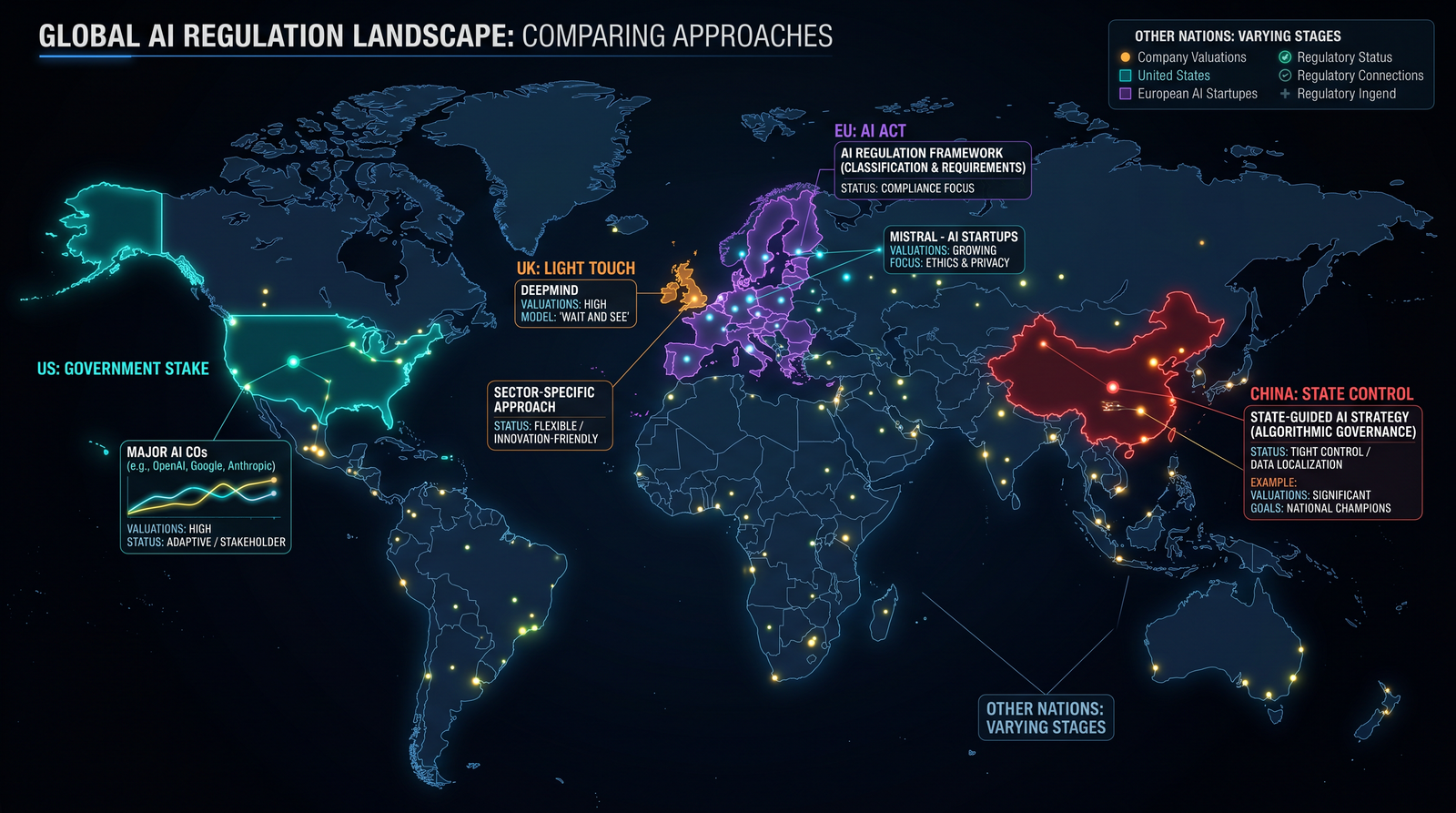
Any formal US stake in a flagship AI company will reverberate globally. Allies may push for reciprocal transparency or access arrangements; competitors may redouble efforts to develop sovereign models and walled-garden ecosystems.
Likely perspectives by region
| Region | Likely Reaction | Policy/Market Implications |
|---|---|---|
| European Union | Supportive of strong safety baselines but wary of US extraterritorial reach | Pressure for EU-localized processing and aligned evaluations; possible reciprocity asks |
| United Kingdom | Seeks harmonization with US/UK safety institutes | Opportunity for transatlantic evaluation standards; model labs coordination |
| Canada/Australia | Alignment with US controls likely | Streamlined cross-border procurement; shared incident taxonomies |
| Japan/Korea | Pragmatic cooperation, interest in supply-chain security | Joint initiatives on compute and model assurance |
| India | Push for open access and domestic innovation while respecting safety | Localized data centers; balanced export adherence |
| China | Accelerate sovereign stack; limit reliance on US APIs | Further fragmentation; alternative ecosystems |
| GCC/Israel/Singapore | Attract regional AI hubs; demand strong residency controls | Data localization and government cloud carve-outs |
Global ripple effects raise the premium on portability and regionalization. Developers should architect for model-provider diversity and resilient, region-aware deployments from the outset.
Scenarios and Timelines: Best-, Base-, and Worst-Case Paths
Given the uncertainty around final terms, scenario planning helps teams avoid being surprised. The scenarios below assume a decision window over the next 6–12 months, with policy implementation lagging by 3–9 months depending on complexity.
| Scenario | Summary | Developer Impact | Enterprise Impact | Timing Signals |
|---|---|---|---|---|
| Best case | Stake with narrowly scoped rights; clear, developer-friendly standards; minimal disruption | Predictable gating, simple headers/attestations; strong docs | Assurance kits standardize procurement; faster adoption | Co-published guidance, SDK updates, pilot audits |
| Base case | Stake plus government observer; robust safety audits; staged release of “Sol”-class capabilities | Stronger KYC, regionalization; more logging; geofencing | New oversight clauses; incident cooperation; regional pinning | Model cards expand; export rules update; enterprise addenda |
| Worst case | Overbroad vetoes and ad hoc policy shifts slow innovation and create fragmentation | Frequent breaking changes; opaque throttling | Procurement delays; multi-model migrations become necessary | Inconsistent advisories; emergency halts without clear SLAs |
Implementation timeline sketch
- Month 0–2: Announcement window; initial SDK and policy previews; voluntary adoption encouraged.
- Month 3–6: Formalization of developer compliance tiers; enterprise contract addenda; first gated releases.
- Month 6–12: Audit regimes and accreditation bodies scale; provenance defaults on; export-aligned geofencing operational.
What Developers and Teams Should Do Now
Regardless of the final form of any stake, the direction is clear: more structured oversight, standardized evaluations, and stronger identity/region controls. You can prepare now with modest engineering effort, yielding benefits even absent new mandates.
1) Implement policy-responsive feature flags
# Example: central feature flag service for capability gating
from enum import Enum
from typing import Dict

class Tier(str, Enum):
    BASELINE = "baseline"
    ELEVATED = "elevated"
    SENSITIVE = "sensitive"

class FlagService:
    def __init__(self):
        self.flags: Dict[str, Dict] = {
            "autonomous_tool_use": {"us": [Tier.ELEVATED, Tier.SENSITIVE], "eu": [Tier.ELEVATED], "other": [Tier.BASELINE]},
            "code_exec": {"us": [Tier.SENSITIVE], "eu": [], "other": []},
        }

    def allowed(self, feature: str, region: str, tier: Tier) -> bool:
        region = region if region in self.flags.get(feature, {}) else "other"
        return tier in self.flags.get(feature, {}).get(region, [])

flags = FlagService()
assert flags.allowed("autonomous_tool_use", "us", Tier.ELEVATED) is True
2) Build an AI Bill of Materials (AI-BOM)
Document models, versions, prompts, tools, data sources, and mitigations. This accelerates audits and internal risk reviews.
| Component | Details | Owner | Evidence |
|---|---|---|---|
| Model | Model name, version, capability tier | ML lead | Model card, changelog |
| Prompt | Template, guardrails, tool schema | App team | Repo, tests |
| Data | Sources, residency, retention | Data eng | DPA, lineage |
| Mitigations | Filters, rate limits, human-in-loop | Risk | Test reports |
3) Create an evaluation and red-team pipeline
# GitHub Actions: run evals/red-team checks on PRs that change prompts/tools
name: ai-evals
on:
  pull_request:
    paths:
      - "prompts/**"
      - "tools/**"
jobs:
  run-evals:
    runs-on: ubuntu-latest
    steps:
      - uses: actions/checkout@v4
      - name: Setup Python
        uses: actions/setup-python@v5
        with:
          python-version: "3.11"
      - name: Install deps
        run: pip install -r evals/requirements.txt
      - name: Run evaluations
        run: python evals/run.py --config evals/config.yaml --report out/report.json
      - name: Upload artifact
        uses: actions/upload-artifact@v4
        with:
          name: eval-report
          path: out/report.json
4) Prepare identity verification and rate-tier segmentation
- Map use cases requiring KYB/KYC and implement verification flows.
- Separate rate tiers and feature access by verification status.
- Maintain evidence of verification and sanctions screening securely.
5) Adopt privacy-preserving logging
Hash prompts and responses; capture policy decisions and provenance; retain per your policy; segregate access by role; and establish secure deletion workflows.
6) Build for regionalization from day one
- Abstract provider endpoints; enforce region pinning and data egress restrictions in code and infrastructure.
- Keep encryption keys local to region; consider customer-managed keys for sensitive tenants.
- Document data flows for audits and DPAs.
7) Engage legal and risk early
Form an internal AI governance working group with engineering, product, security, legal, and compliance. Pre-draft contract addenda for incident reporting, change control, and oversight clauses so you can execute quickly when providers update terms.
FAQs and Common Misconceptions
Is this stake finalized?
No public confirmation exists as of this writing. Reports indicate active discussions. Treat specific terms as provisional until official filings or announcements are made.
Access 40,000+ AI Prompts for ChatGPT, Claude & Codex — Free!
Subscribe to get instant access to our complete Notion Prompt Library — the largest curated collection of prompts for ChatGPT, Claude, OpenAI Codex, and other leading AI models. Optimized for real-world workflows across coding, research, content creation, and business.
Does a stake mean government “control” of OpenAI?
Not necessarily. A 5% stake is minority by definition. Any influence would depend on special rights negotiated—such as observer status or narrowly scoped vetoes tied to specific high-risk capability releases.
Will my app lose access to current models?
Unlikely. The most plausible changes focus on sensitive capabilities, identity verification, and logging standards, not wholesale removal of broadly-used functionality.
How does this interact with export controls?
A stake could coordinate model capability gating with export regimes, shaping where certain features or weights are available. Expect stronger geolocation checks and identity requirements for higher-risk tiers.
Signals to Watch and Final Takeaways
Signals to watch
- Official announcements detailing the structure (non-voting vs. special rights).
- SDK and API spec updates adding compliance headers, provenance metadata, or region parameters.
- Publication of standardized evaluation suites and accreditation of third-party labs.
- Export-control updates tying capability classes to geography or identity tiers.
- Enterprise contract addenda featuring oversight and incident cooperation clauses.
Final takeaways
- Prepare for identity- and region-aware feature gating. Implement headers and deny-by-default policies for undefined contexts.
- Instrument privacy-preserving audit trails and content provenance now; you will likely need them regardless of policy outcomes.
- Build an AI-BOM and evaluation pipeline; they will speed procurement and mitigate surprise from model updates.
- Treat “Sol”-class capability gating as a near-certainty for the most sensitive features; design your product so ablation leaves core value intact.
- Stay agile with provider abstraction and multi-model strategies to hedge against policy or provider shocks.
Additional Resources and Context
For teams building formal governance, consider mapping your controls to established frameworks, engaging with evaluation communities, and operationalizing a robust model lifecycle. Related deep dives:
To deepen your understanding of adjacent AI capabilities, explore our detailed analysis in The Codex API Development Playbook, which examines 15 prompts for building production REST APIs. The frameworks and prompt patterns discussed there integrate seamlessly with the strategies outlined in this article.
,
To deepen your understanding of adjacent AI capabilities, explore our detailed analysis in 30 ChatGPT-5.5 Prompts for Content Strategists, which examines prompts for editorial calendars, SEO briefs, audience research. The frameworks and prompt patterns discussed there integrate seamlessly with the strategies outlined in this article.
, and
Organizations implementing these workflows will also benefit from understanding Codex Record and Replay, which covers OpenAI’s screen recording feature for workflow automation in detail. The methodologies presented there provide a natural extension of the concepts explored above, particularly for teams scaling their AI-assisted processes.
.
Appendix: Risk-to-Control Mapping
| Risk | Indicator | Control | Evidence |
|---|---|---|---|
| Unauthorized region access | Requests from disallowed geos | Geofencing middleware; deny-by-default; IP+header checks | Access logs with region decision outcomes |
| Misuse of sensitive capabilities | Spike in high-risk prompts | Tiered access, safety filters, human-in-loop | Policy decision logs; red-team results |
| Compliance audit gaps | Missing evaluation artifacts | AI-BOM; standardized evals; quarterly reports | Model cards; eval summaries; QBR packets |
| Data localization breach | Cross-border data drift | Regional endpoints; DLP; key locality | Data flow diagrams; key custody receipts |
| Provenance disputes | Unlabeled AI content | Cryptographic signatures; visible indicators | Signature verification logs; UI screenshots |
Closing
Whether or not a 5% US government stake in OpenAI lands exactly as reported, the momentum is unmistakable: frontier AI is entering a more formalized era of governance. For developers and enterprises, the right response is not to pause innovation, but to embed compliance-by-design, prepare for identity and region gating, and document your model lifecycle with a rigor that meets rising expectations. Teams that make these investments now will be best positioned to harness next-generation capabilities—“Sol”-class and beyond—without disruption when new standards take hold.
This analysis reflects conditions and reporting available at the time of writing and should not be construed as legal advice. Monitor official disclosures and update your implementation plan accordingly.