
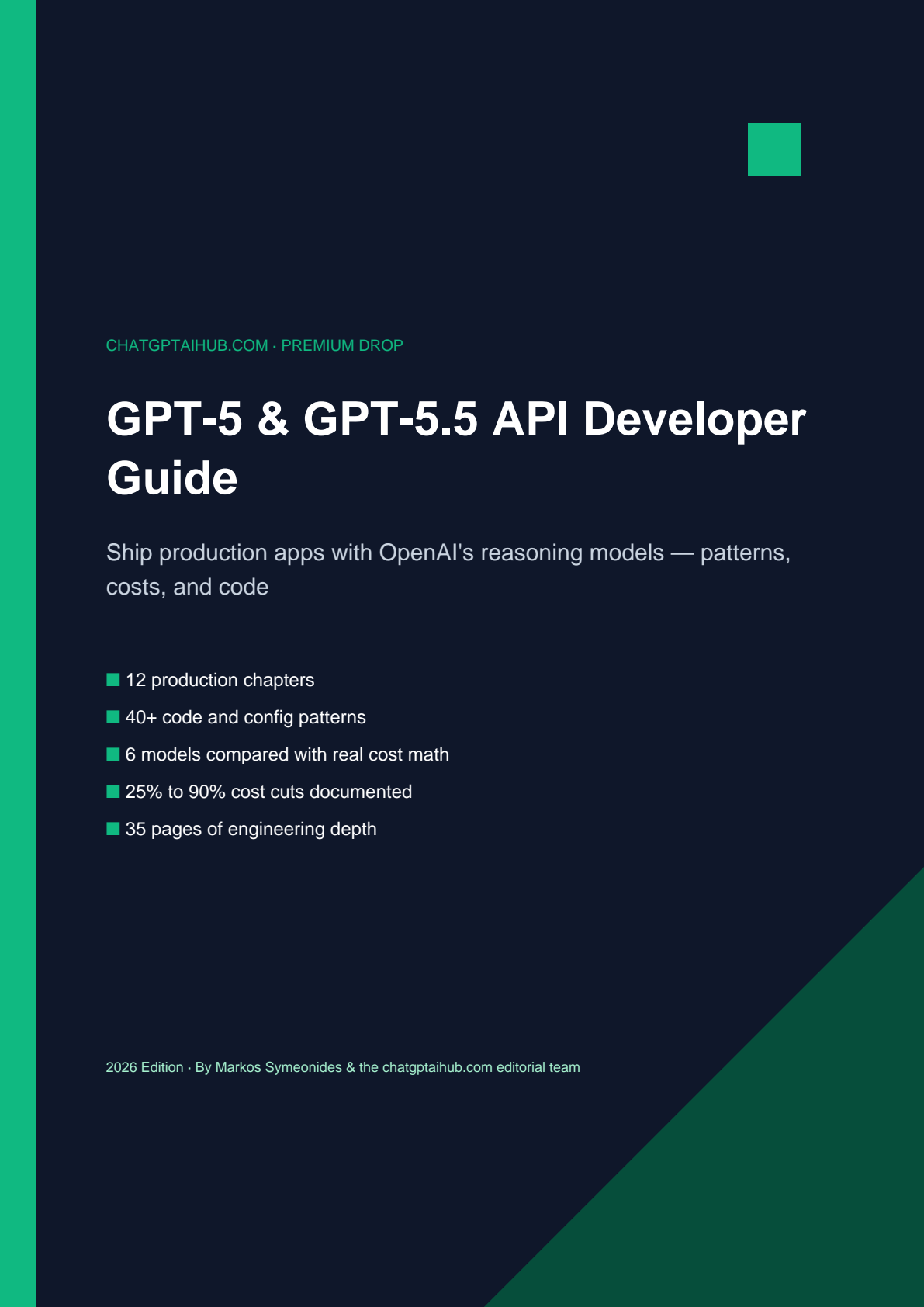
GPT-5 & GPT-5.5 API Developer Guide 2026: Comprehensive Free PDF for Backend Developers
⚡ TL;DR — Key Takeaways
- 35-page technical playbook covering GPT-5.1, GPT-5.4, GPT-5.4-pro, and GPT-5.5 for production backend developers
- 12 chapters with concrete code patterns, cost math, and named tools — no vague best practices
- Includes production RAG, function calling, prompt caching (25-90% cost cuts), multi-model routing, and eval frameworks
- For senior backend developers, staff engineers, and tech leads shipping AI features in 2026
- Free with chatgptaihub.com signup — immediate PDF download, no drip campaign
Why Most GPT-5 Integrations Are Leaking Money and Reliability
In 2026, many production OpenAI integrations still run on outdated codebases originally built for GPT-4o or early GPT-5 versions. These legacy implementations often result in inflated costs—sometimes two to four times higher than necessary—and poor latency performance. Additionally, product reliability suffers during OpenAI service disruptions, leading to customer dissatisfaction and lost revenue.
This situation is not due to poor engineering but rather the rapid evolution of the OpenAI API and ecosystem. Key changes include:
- The Responses API replacing Chat Completions as the primary endpoint.
- Prompt caching techniques that reduce input token costs by 75-90% when prompts are structured correctly.
- Structured outputs with strict JSON schemas that eliminate parsing errors and improve downstream reliability.
- New model releases like GPT-5.1, GPT-5.4, and GPT-5.5 (via OpenRouter) offering better performance and cost-efficiency.
Teams focused on shipping features often miss these updates, resulting in costly and fragile AI integrations. This playbook is designed to be the definitive resource for backend developers and tech leads to build reliable, cost-effective, and maintainable GPT-5 and GPT-5.5 integrations in 2026.
Key Benefits of Updating Your Integration
- Reduce OpenAI API costs by up to 90% through prompt caching and cost engineering.
- Improve latency and user experience by tuning reasoning parameters and streaming responses.
- Increase reliability with structured outputs and multi-model fallbacks.
- Ensure compliance and governance for regulated industries.
- Future-proof your codebase against upcoming model deprecations and upgrades.
What Is Inside the 35-Page Playbook
The playbook is structured as a progressive guide, not just a reference manual. It walks you through everything from understanding the latest OpenAI model landscape to advanced operational patterns for production AI systems.
Chapter Breakdown
| Chapter | Title & Description | Pages |
|---|---|---|
| 1 |
The 2026 OpenAI Model Landscape A grounded tour of every model you can call from the OpenAI API today — GPT-5.1, GPT-5.1 Pro, GPT-5 Pro, GPT-5.4, GPT-5.4-pro — plus GPT-5.5 on OpenRouter, and when each earns its keep. |
4 |
| 2 |
Setting Up a Production-Grade Client Move beyond the getting-started snippet: a hardened OpenAI client with retries, timeouts, structured logging, and cost accounting baked in. |
4 |
| 3 |
Mastering the Responses API The Responses endpoint replaces Chat Completions for new work. Learn its shape, its persisted state, and how to use reasoning_effort like a professional. |
4 |
| 4 |
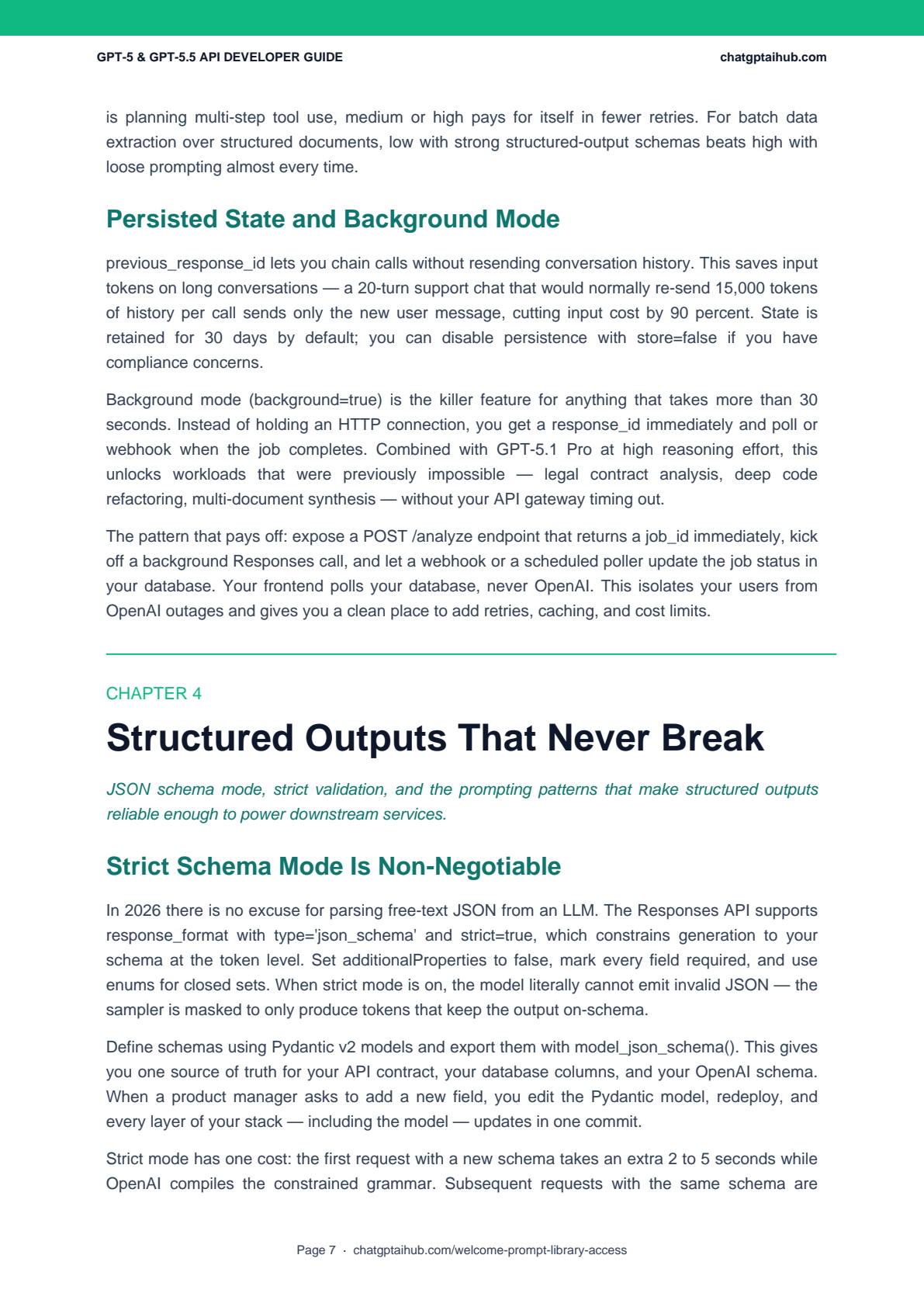
Structured Outputs That Never Break JSON schema mode, strict validation, and the prompting patterns that make structured outputs reliable enough to power downstream services. |
3 |
| 5 |
Function Calling and Tool Orchestration How to design tools the model will actually call correctly, handle parallel calls, and build agent loops that terminate. |
4 |
| 6 |
Prompt Caching and Cost Engineering The techniques that move OpenAI bills from ‘concerning’ to ‘sustainable’ — cached prefixes, context compression, and per-feature budgets. |
4 |
| 7 |
Building Reliable RAG With GPT-5.1 and GPT-5.4 A production RAG stack: embeddings, hybrid search, reranking, citation enforcement, and eval loops that catch regressions. |
4 |
| 8 |
Streaming, Latency, and User Experience How to stream responses, hide latency behind good UX, and choose the right model for perceived-speed-critical features. |
3 |
| 9 |
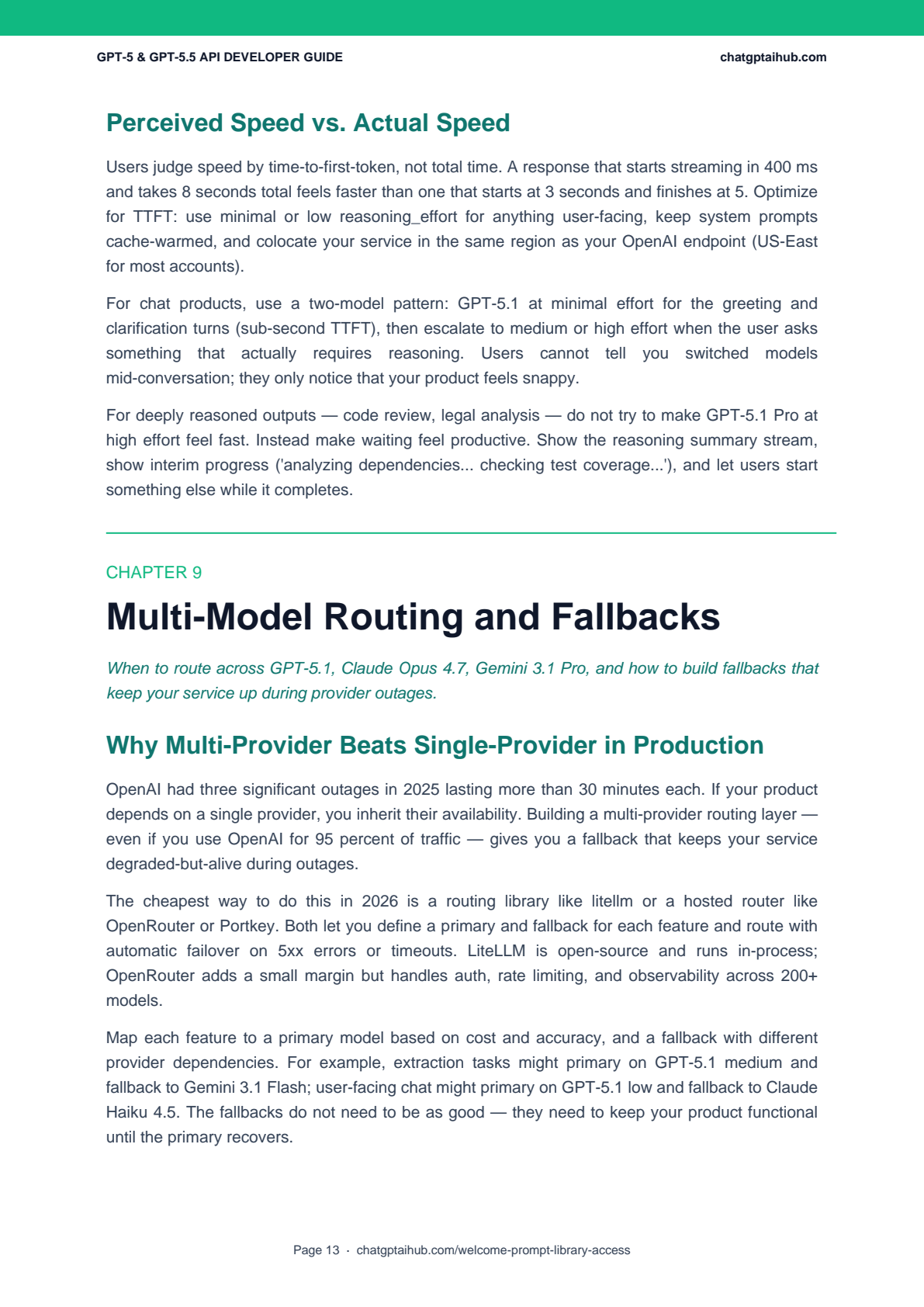
Multi-Model Routing and Fallbacks When to route across GPT-5.1, Claude Opus 4.7, Gemini 3.1 Pro, and how to build fallbacks that keep your service up during provider outages. |
3 |
| 10 |
Evals, Observability, and Continuous Improvement The eval infrastructure and monitoring stack you need to keep quality high as you iterate on prompts, models, and features. |
3 |
| 11 |
Safety, Compliance, and Governance The controls you need to ship AI features in regulated industries and enterprises — moderation, PII handling, audit trails, and prompt injection defense. |
3 |
| 12 |
Migration, Deprecation, and Future-Proofing How to write code today that will still work when GPT-5.5, GPT-6, and their successors ship — and how to migrate cleanly when models are retired. |
3 |
Chapter Preview: The Reasoning Effort Dial That Controls Your Bill
The reasoning_effort parameter on GPT-5.1 is a powerful lever controlling both cost and latency. It accepts four values: minimal, low, medium, and high.
- Minimal: Skips extended reasoning, behaves like a fast chat model with 400-800 ms latency, and incurs no reasoning token costs.
- Low: Adds short deliberation, typically 200-800 reasoning tokens per call.
- Medium (default): Uses 800-3,000 reasoning tokens, balancing cost and quality.
- High: Burns 10,000+ reasoning tokens for deep reasoning tasks.
Many teams leave this setting at medium because it is the default, leading to overspending. The playbook provides an evaluation methodology to optimize this parameter:
- Start new features at medium.
- Run 100 representative requests through an evaluation harness.
- If accuracy remains acceptable, test low to save 40-60% on costs without quality loss.
- Escalate to high or GPT-5.1 Pro only when necessary.
This approach has saved teams tens of thousands of dollars monthly on OpenAI bills. The playbook includes detailed code examples and evaluation scripts to implement this cost-saving strategy effectively.
Chapter Preview: Prompt Caching and the 90 Percent Cost Cut
Prompt caching is an automatic feature in OpenAI’s GPT-5.1 and GPT-5.4 models that significantly reduces input token costs when the prompt prefix is identical to a recent request.
Key points include:
- Cached input tokens are billed at 25% of the normal rate on GPT-5.1 and GPT-5.4, and 10% on GPT-5.4 with extended-cache enabled.
- No explicit API call is required to enable caching; it activates automatically for inputs over 1,024 tokens with byte-identical prefixes.
- To maximize cache hits, place static content like system prompts, tool definitions, and few-shot examples at the beginning of the prompt.
- Dynamic per-request content should be appended at the end to avoid cache misses.
Many teams mistakenly interpolate dynamic content into the system prompt, preventing cache hits and incurring full token costs every time.
The playbook covers advanced topics such as:
- Cache warming strategies for bursty traffic.
- Regional cache hit behavior and implications for multi-region deployments.
- Instrumentation of the
cache_hit_ratemetric with targets: 60% achievable, 80% excellent, >90% likely a bug. - When to use context compression instead of caching, with worked examples.
Who This Playbook Is For
This guide is tailored for backend developers, staff engineers, and technical leads actively shipping production features using OpenAI’s API. It assumes familiarity with asynchronous Python, Kubernetes operational patterns, and AI product tradeoffs.
This is not a beginner’s guide. If you are new to AI or evaluating whether to adopt LLMs, start with our beginner-friendly content.
Ideal Readers
- Developers with existing GPT-4o or GPT-4-turbo integrations who have not audited migration to GPT-5.1 or GPT-5.4.
- Teams with monthly OpenAI bills exceeding $5,000 lacking clear cost accounting per feature or user.
- Builders of agentic workflows involving multi-step tool use, planning, or autonomous loops that sometimes fail to terminate.
- Developers shipping AI features in regulated sectors like healthcare, finance, legal, or education needing compliance-ready architectures.
- Teams exploring multi-model routing with Claude Opus 4.7, Gemini 3.1 Pro, or other providers alongside OpenAI.
Every chapter delivers concrete patterns, real-world numbers, and named tools. There is no filler or vague advice. If you have shipped production AI features, you will recognize the common pitfalls and benefit immediately.
How to Get the Playbook
The playbook is free with a signup at chatgptaihub.com. We request your email to send a biweekly newsletter featuring deep dives, cost benchmarks, and production patterns.
Upon signup, you receive an immediate download link for the 35-page PDF—no drip campaigns, upsells, or waiting.
The PDF is designed for flexible use: read cover-to-cover on a long flight or dip into chapters as needed. Most chapters stand alone, and the final chapter offers a recommended sequence for applying the material to your projects.
Already a subscriber? The 2026 edition is available in your account’s resources section alongside previous playbooks on Claude Code, agent architectures, and eval design.
We welcome your feedback. Every reader reply is read, and future editions incorporate questions and challenges from the community to stay relevant and practical.
⚡ PREMIUM DROP · FREE WITH SIGNUP
Download the full GPT-5 & GPT-5.5 API Developer Guide — FREE
12 chapters · 42+ pages of actionable playbook for AI professionals. Plus full access to our 40,000+ prompt library. Instant email delivery.
No spam. Instant PDF delivery. Unsubscribe anytime.
Frequently Asked Questions
What OpenAI models does the 2026 edition cover?
The playbook covers the full 2026 lineup callable from the official OpenAI API: GPT-5.1 (the recommended default), GPT-5.1 Pro for higher-reasoning workloads, GPT-5 Pro for long-running deep-reasoning jobs, and the newer GPT-5.4 and GPT-5.4-pro checkpoints with 400K context and extended cached inputs. Chapter 1 also covers GPT-5.5 as a preview surface via OpenRouter, including a safe shadow-routing pattern for evaluating it before it lands on the official API. Every chapter uses real model identifiers and current pricing.
Is this for beginners or experienced developers?
Experienced developers. The playbook assumes you have shipped at least one feature that calls the OpenAI API in production, that you are comfortable reading async Python and Kubernetes-flavored operational concerns, and that you can evaluate tradeoffs like cost versus latency versus accuracy for your own product. If you are still learning what an embedding is, start with our beginner content. If you have a GPT-4o integration in production and you have not thought hard about caching, evals, or multi-model routing, this playbook is written for you.
How is this different from OpenAI’s own documentation?
OpenAI’s docs describe the API surface. This playbook describes how to build reliable products on top of it. We cover the operational decisions the docs do not: how to choose reasoning_effort per feature, how to structure prompts for maximum cache hit rate, how to design agent loops that actually terminate, how to build eval harnesses that catch regressions in CI, and how to route across providers when OpenAI has a bad afternoon. It is the accumulated production experience of teams shipping at scale, not a reference for individual endpoints.
Do the code patterns work in languages other than Python?
Most code snippets are Python because that is what most readers use, but the patterns translate. The OpenAI SDKs for Node.js, Go, and Ruby all support the Responses API, structured outputs, background mode, and prompt caching. Architectural chapters (client hardening, multi-model routing, evals, observability) are language-agnostic. A backend developer working in TypeScript or Go will get equal value from every chapter — you just port the specific Python snippets to your language.
How do I actually get the PDF?
Sign up at chatgptaihub.com with your work email. You get an immediate download link for the 35-page PDF, plus access to our resource library which includes earlier playbooks on Claude Code, agent architectures, and eval design. We send a short newsletter every two weeks with new deep-dives and cost benchmarks — you can unsubscribe with one click if it is not useful. There is no paid tier, no drip campaign, and no upsell sequence.
Will the playbook stay accurate as new models ship?
The specific model names discussed — GPT-5.1, GPT-5.4, GPT-5.4-pro — will eventually be superseded, likely later in 2026 or in 2027. That is why Chapter 12 covers migration and future-proofing, and why every architectural pattern in the book (Responses API, structured outputs, prompt caching, multi-model routing, eval-driven development) is designed to survive model turnover. We also publish updated editions each year — subscribers automatically get the new edition in their resource library when it drops.