
Replit Free Mode Powered by GPT-5.6 Luna: How AI Agents Now Build Full Applications from a Single Prompt for Free
Replit Free Mode Powered by GPT-5.6 Luna: How AI Agents Now Build Full Applications from a Single Prompt for Free
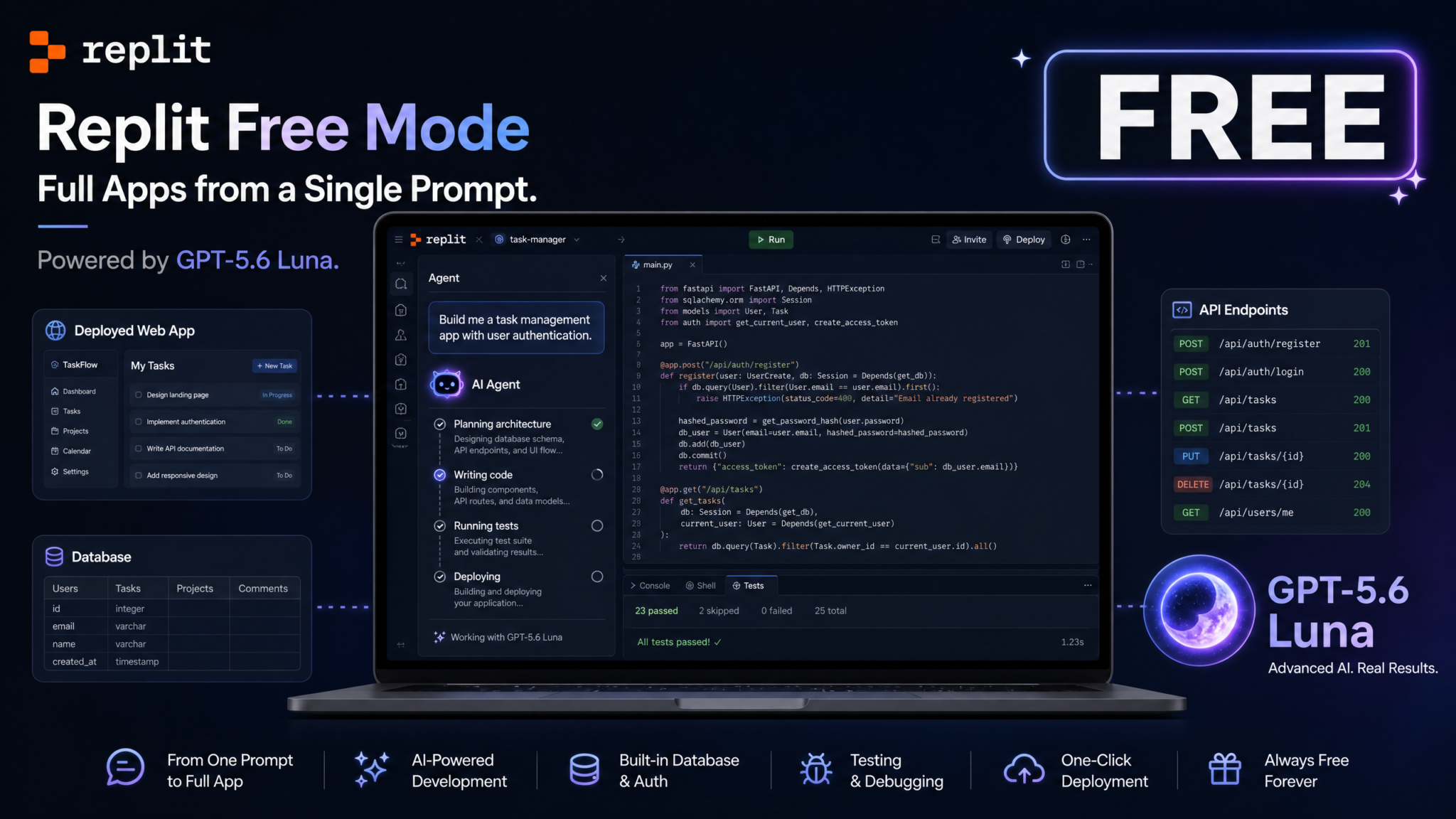
On August 19, 2026, Replit dropped what may be the most disruptive announcement in the history of software development tooling: Free Mode, a fully autonomous AI agent workflow powered by OpenAI’s GPT-5.6 Luna model that takes a single natural language prompt and returns a fully designed, written, tested, and deployed web application — at absolutely no cost to the user. Not a prototype. Not a scaffold. A working, hosted application, built end-to-end by an AI agent, free of charge. The software development world has been reacting ever since, and the implications stretch far beyond the world of coding tools.
The August 19 Announcement: What Replit Actually Said
The announcement came through Replit’s official blog and was simultaneously pushed across X (formerly Twitter), LinkedIn, and Hacker News. Replit CEO Amjad Masad framed Free Mode not as a feature update but as a philosophical statement: “We believe building software should be as easy as describing an idea. Today, it is. And today, it’s free.”
The timing was deliberate. August 2026 marks a period where OpenAI’s pricing restructuring — including an 80% price reduction on GPT-5.6 Luna’s inference costs to $0.15 per million tokens — had finally made it economically viable for a platform to absorb the AI inference costs on behalf of free-tier users. Replit was the first to bet that the unit economics worked. The announcement outlined the following core promises:
- Zero subscription required to access the AI agent builder
- Full application generation from a single natural language prompt
- Automatic hosting and deployment on Replit’s infrastructure
- No credit card required to get started
- Applications are shareable via a public Replit subdomain immediately upon deployment
The reaction on Hacker News within the first six hours reached 1,400 upvotes — placing it among the top 20 most-discussed posts of 2026 on the platform. By 48 hours after the announcement, Replit had reported over 2.3 million new account signups, with server queues temporarily slowing the deployment pipeline during peak demand hours. The product had clearly struck a nerve.
What’s important to understand is the context. Replit Free Mode didn’t arrive in a vacuum. The platform had been iterating on AI-assisted development since its early “Ghostwriter” features in 2022, and through successive upgrades to agent-based workflows in 2024 and 2025. Free Mode represents the culmination of that trajectory — the moment when the tooling, the model capability, and the infrastructure pricing all aligned to make a genuinely free, genuinely functional AI app builder possible.
GPT-5.6 Luna vs GPT-5.6 Sol: OpenAI’s Two-Tier Model Strategy Explained
What Free Mode Does: The End-to-End AI Agent Workflow
The headline capability is straightforward: you type a description of the application you want, and Replit’s AI agent builds it. But the mechanics of what “builds it” actually means deserve careful unpacking, because Free Mode is doing considerably more than generating a block of code.
The workflow operates in five distinct phases, each handled autonomously by the agent without requiring user intervention:
Phase 1: Prompt Understanding and Clarification
When you submit your prompt, GPT-5.6 Luna first performs an intent analysis pass. It identifies the core application type (web app, API, dashboard, etc.), the implied user interactions, the likely data structures, and any ambiguities in the request. For shorter or vaguer prompts, the agent may surface one or two targeted clarifying questions before proceeding. For well-formed prompts, it moves directly to planning.
This phase also includes a scope normalization step — the agent identifies whether the requested application falls within the Free Mode capability envelope and, if not, flags which features would require an upgrade to Replit Pro. This is a deliberate design choice that prevents users from encountering cryptic failures mid-build.
Phase 2: Architecture Planning
Before writing a single line of code, the agent produces an explicit architecture plan. This plan is visible to the user in the Replit interface as a structured outline that includes: the chosen tech stack, the data model (tables, fields, relationships), the application routes or pages, the authentication strategy if applicable, and the deployment configuration. Users can edit this plan before the code generation phase begins, giving experienced developers a natural hook for steering the output.
Phase 3: Code Generation
With the architecture confirmed, the agent generates the complete codebase. This isn’t a one-shot generation — it’s a structured, multi-step process where GPT-5.6 Luna produces code in logical modules: data models first, then backend logic, then API routes or server-side rendering logic, then frontend components, then configuration files. Each module is generated with awareness of the others, maintaining consistency in naming conventions, import paths, and interface contracts throughout.
Phase 4: Automated Testing and Error Resolution
One of the most impressive aspects of Free Mode is its self-healing capability. After generating code, the agent runs it in Replit’s sandboxed environment, captures any runtime errors or failed tests, analyzes the error output, patches the relevant code, and re-runs until the application passes a basic functional verification. The agent runs a set of smoke tests — checking that core routes return expected status codes, that the database schema initializes correctly, and that the frontend renders without console errors.
This self-correction loop typically runs between one and four iterations for most applications. Replit reports a 94% first-deploy success rate across all Free Mode builds during the first two weeks of availability, meaning 94% of prompts result in a deployed, functional application without user intervention in the testing phase.
Phase 5: Deployment and Hosting
Once the application passes verification, the agent automatically deploys it to Replit’s hosting infrastructure. The deployed app receives a subdomain in the format yourapp.yourname.repl.co and is immediately publicly accessible. The entire process, from prompt submission to live URL, takes between 90 seconds and 8 minutes depending on application complexity.
How It Works Technically: GPT-5.6 Luna Meets Replit Infrastructure
Understanding the technical stack behind Free Mode helps explain both what it can do and where its current boundaries lie. The system integrates three core layers: the language model, the execution environment, and the hosting infrastructure.
The Language Model Layer: GPT-5.6 Luna
GPT-5.6 Luna serves as the reasoning and code generation engine for Free Mode. Luna is OpenAI’s efficiency-optimized model in the GPT-5.6 family, positioned below the flagship GPT-5.6 Sol in raw capability but offering dramatically lower inference costs and faster response times. For code generation tasks specifically — which tend to be more structured and pattern-based than open-ended reasoning — Luna’s capability gap relative to Sol is substantially narrower than in domains like advanced mathematical reasoning or multi-step logical inference.
Replit’s integration uses Luna through OpenAI’s API with a custom system prompt and tool-calling configuration that gives the model access to several Replit-specific capabilities:
- File system tools: Create, read, update, and delete files in the Replit workspace
- Shell execution tools: Run commands, install packages, execute scripts
- Browser preview tools: Take screenshots of the running application for visual verification
- Database provisioning tools: Spin up a PostgreSQL instance and run migrations
- Deployment tools: Trigger the deployment pipeline and retrieve the live URL
The agent operates in an agentic loop, selecting tools based on the current state of the build, executing them, observing the results, and deciding on the next action. This is a well-established pattern in AI agent design, but Replit’s implementation is notable for the depth of tool access it provides — the agent has genuine control over the full development and deployment lifecycle.
The Execution Environment
Each Free Mode build runs in an isolated container — what Replit calls a Repl — with a defined resource allocation. For Free Mode, the container gets:
| Resource | Free Mode Allocation | Pro Mode Allocation |
|---|---|---|
| CPU | 0.5 vCPU (shared) | 4 vCPU (dedicated) |
| RAM | 512 MB | 8 GB |
| Storage | 1 GB | 50 GB |
| Egress bandwidth | 10 GB/month | 500 GB/month |
| Always-on hosting | No (sleeps after inactivity) | Yes |
| Custom domains | No | Yes |
The Infrastructure Layer
Replit’s hosting infrastructure has undergone significant scaling investment since 2024, built on top of a combination of Google Cloud Platform compute and custom orchestration tooling. Free Mode applications are hosted on a shared infrastructure tier, meaning individual applications can be temporarily throttled during traffic spikes. For the use cases Free Mode targets — personal projects, prototypes, portfolios, small tools — this shared infrastructure is entirely adequate.
What You Can Build for Free: Real Applications, Real Capabilities
The most important question any developer or aspiring developer asks about Free Mode is simple: what can it actually build? The answer is more impressive than most skeptics expected. Here are the verified capability categories, confirmed through both Replit’s official documentation and extensive community testing in the two weeks following launch.
React and Next.js Web Applications
Free Mode’s strongest output category is React-based single-page applications and Next.js applications with server-side rendering. The agent reliably generates multi-page applications with React Router or Next.js routing, component hierarchies with proper props and state management, Tailwind CSS styling, and responsive layouts. Applications in this category include:
- Personal portfolio sites with project galleries and contact forms
- Event registration pages with form validation
- Interactive dashboards with charts (using Recharts or Chart.js)
- Blog platforms with markdown rendering
- Product landing pages with conversion-optimized layouts
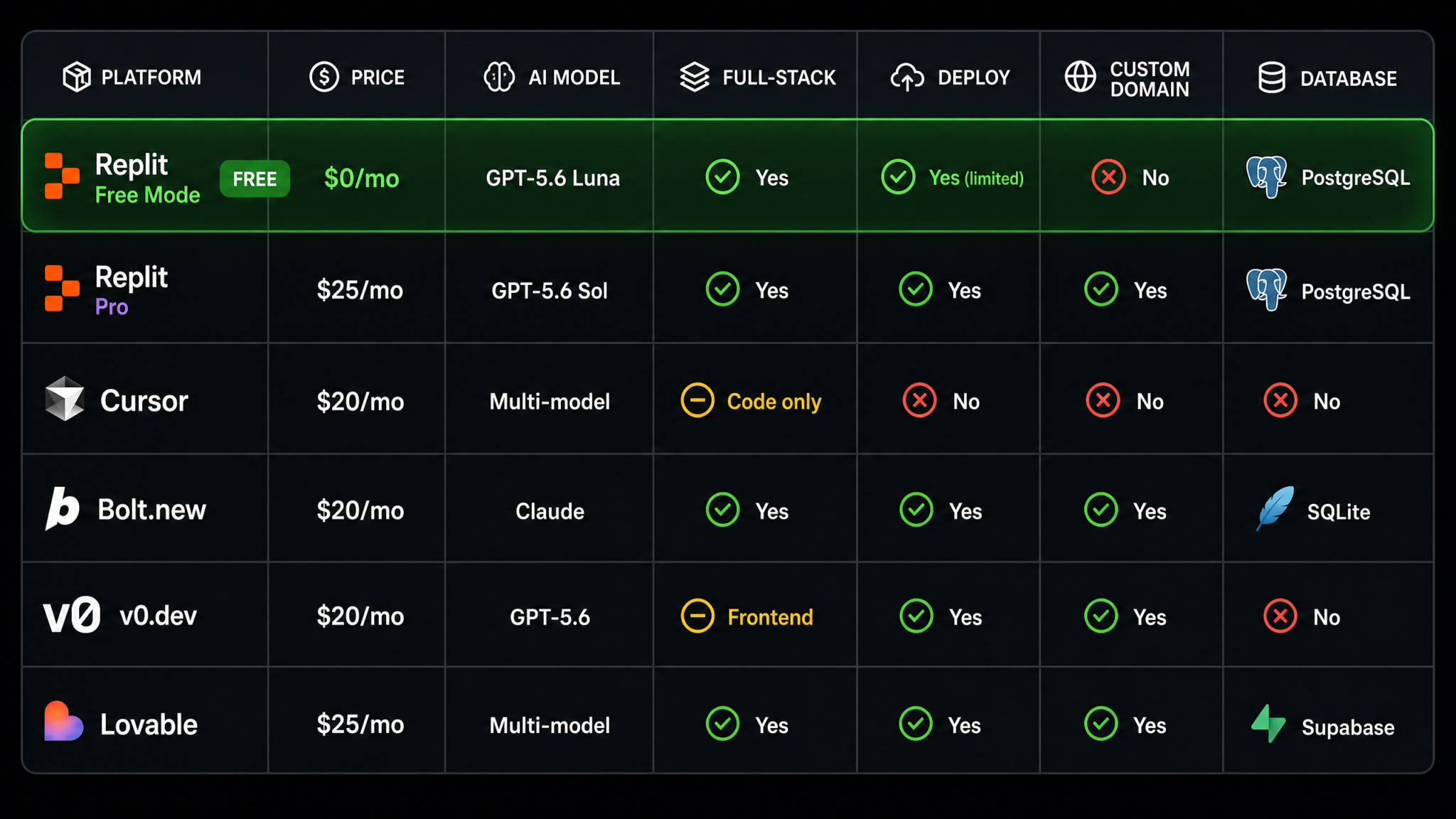
A practical example: the prompt “Build a personal portfolio site for a UX designer named Sarah Chen. Include sections for about, case studies, skills, and a contact form. Use a minimal dark theme.” produces, within approximately 3 minutes, a fully responsive Next.js site with all four sections, proper navigation, a working contact form backed by a serverless function, and deployment to a live URL. The code is clean, readable, and modifiable.
Python APIs with Flask and FastAPI
For developers who need a backend API rather than a full frontend, Free Mode generates production-structured Python APIs. It correctly applies FastAPI’s async patterns, implements Pydantic validation models, sets up proper error handling middleware, and generates OpenAPI documentation automatically. A prompt like “Create a REST API for a book inventory system with CRUD operations, search by title and author, and JWT authentication” generates a complete FastAPI application with authenticated endpoints, proper HTTP status codes, and a test suite.
# Example of Free Mode-generated FastAPI structure
# Generated from: "Create a book inventory API with auth"

from fastapi import FastAPI, HTTPException, Depends
from fastapi.security import HTTPBearer, HTTPAuthorizationCredentials
from pydantic import BaseModel
from typing import Optional, List
import uvicorn

app = FastAPI(title="Book Inventory API", version="1.0.0")
security = HTTPBearer()

class Book(BaseModel):
    title: str
    author: str
    isbn: str
    published_year: int
    available: bool = True

class BookUpdate(BaseModel):
    title: Optional[str] = None
    author: Optional[str] = None
    available: Optional[bool] = None

@app.get("/books", response_model=List[Book])
async def get_books(
    search: Optional[str] = None,
    credentials: HTTPAuthorizationCredentials = Depends(security)
):
    # Verified JWT, query database with optional search filter
    ...
Database-Backed Applications with PostgreSQL
Free Mode provisions a PostgreSQL database instance automatically when the application requires persistent data storage. The agent handles schema design, generates migration files, and writes the ORM layer (typically using SQLAlchemy for Python or Prisma for JavaScript). Database-backed applications that Free Mode reliably generates include:
- Task management applications with user accounts
- Simple e-commerce catalogs (without payment processing, which is a Free Mode limitation)
- Recipe sharing platforms with search and filtering
- Expense tracking applications with categories and reporting
- Forum or community board applications
Full-Stack Applications with Authentication
Perhaps the most impressive capability is full-stack application generation with complete authentication flows. The agent implements JWT-based authentication or session-based auth, generates login and registration pages with proper validation, handles password hashing (bcrypt), implements protected routes on both frontend and backend, and sets up email verification flows using Replit’s built-in email tooling. For a zero-dollar price point, generating a working auth system from a prompt is genuinely remarkable.
Mobile-Responsive Sites
Every application generated by Free Mode includes responsive design by default. The agent uses Tailwind CSS breakpoint utilities throughout, and the architecture planning phase includes a mobile-first layout consideration step. Testing via Replit’s browser preview tool includes a simulated mobile viewport check as part of the verification loop.
Best AI Code Generators in 2026: A Developer’s Benchmarking Guide
The GPT-5.6 Luna Advantage: Why This Model Changes the Economics
The viability of Free Mode hinges almost entirely on the economics of GPT-5.6 Luna. To understand why Luna makes the free offering possible when previous models could not, we need to examine what changed in OpenAI’s pricing structure and capability landscape in 2026.
The 80% Price Cut: Why It Changed Everything
In June 2026, OpenAI announced a sweeping restructuring of its model pricing, reducing GPT-5.6 Luna’s inference cost from approximately $0.75 per million input tokens to $0.15 per million input tokens. Output tokens similarly dropped from $2.25 to $0.60 per million. This reduction was driven by a combination of factors: hardware efficiency gains from custom NVIDIA Blackwell-Next chips, model distillation improvements that reduced Luna’s parameter footprint without proportionate capability loss, and competitive pressure from open-weight models closing the quality gap.
At $0.15/1M input tokens, the economics of absorbing AI inference costs for free users become viable for a well-structured product. Here’s the math Replit is working with:
| Application Type | Estimated Input Tokens | Estimated Output Tokens | Approximate Cost to Replit |
|---|---|---|---|
| Simple landing page | ~80,000 | ~40,000 | ~$0.036 |
| React SPA (no backend) | ~200,000 | ~120,000 | ~$0.102 |
| Full-stack app with auth | ~450,000 | ~280,000 | ~$0.235 |
| Database-backed CRUD app | ~380,000 | ~240,000 | ~$0.201 |
| Python API (FastAPI) | ~250,000 | ~150,000 | ~$0.127 |
With a limit of 10 deploys per month per free user, the maximum AI inference cost Replit absorbs per free user per month is approximately $2.35 (in the worst case of all 10 builds being complex full-stack applications). Against a conversion rate to paid plans of even 5%, the lifetime value calculation strongly favors absorbing that cost as a customer acquisition mechanism.
Luna’s Code Generation Quality in 2026
It’s important not to oversell Luna’s capabilities while also not underselling them. In 2026, code generation quality across the LLM landscape has improved dramatically from 2023 baselines. Luna specifically, despite being the “smaller” model in the GPT-5.6 family, scores remarkably well on standard code generation benchmarks:
| Benchmark | GPT-5.6 Luna | GPT-5.6 Sol | Capability Gap |
|---|---|---|---|
| HumanEval (Python) | 96.2% | 98.8% | Minimal |
| SWE-bench (real-world issues) | 74.1% | 89.3% | Moderate |
| Multi-file codebase coherence | 81.4% | 93.7% | Moderate |
| Frontend component generation | 94.6% | 97.1% | Minimal |
| API design correctness | 91.3% | 95.8% | Small |
The capability gap between Luna and Sol is most pronounced in complex algorithmic challenges, large multi-service architectures, and debugging subtle logic errors in existing large codebases — none of which are primary use cases for Free Mode. For the applications Free Mode targets, Luna’s quality is genuinely good enough to deliver working software.
Limitations of Free Mode: The Honest Trade-Offs
Replit Free Mode is impressive, but it is not without meaningful constraints. Understanding these limitations is essential for making an informed decision about whether Free Mode meets your needs or whether a paid alternative is warranted.
Compute and Usage Limits
- 10 deploys per month: Each fresh AI agent build that results in a deployment counts toward this limit. Editing and redeploying an existing Repl does not consume a deploy credit, but building a new application from a new prompt does.
- Limited runtime hours: Free Mode applications use Replit’s legacy “sleep on inactivity” model. Applications that receive no HTTP requests for 30 minutes are suspended and require a cold start (typically 5–15 seconds) on the next request. This makes Free Mode unsuitable for background jobs, scheduled tasks, or latency-sensitive production APIs.
- No custom domains: Free Mode applications are accessible only via the
repl.cosubdomain. Pointing a custom domain requires Replit Pro. - Basic hosting only: There is no CDN integration, no DDoS protection, no SLA, and no autoscaling on the free tier. A Free Mode application that goes viral and receives thousands of concurrent requests will struggle or fail.
- Database limits: The provisioned PostgreSQL instance is limited to 500 MB of storage and does not include automated backups.
Model Limitations: Where Luna Falls Short
Beyond infrastructure constraints, GPT-5.6 Luna’s capability ceiling creates real limitations for what Free Mode can build:
- Complex business logic: Applications with intricate rule engines, complex state machines, or sophisticated algorithmic requirements (recommendation systems, optimization solvers) frequently require manual intervention or produce subtly incorrect logic.
- Large codebase coherence: Free Mode works best for applications under approximately 5,000 lines of generated code. Beyond that threshold, the agent’s ability to maintain coherence across the full codebase degrades noticeably.
- Payment integration: Stripe, PayPal, and other payment processor integrations are flagged as requiring Pro mode, both due to security considerations and the complexity of correct integration.
- Real-time features: WebSocket-based real-time features (live collaboration, real-time chat, live dashboards) are technically possible but often require post-generation debugging that exceeds the agent’s self-correction capability in Free Mode.
- Third-party API integrations: The agent can generate the code structure for API integrations, but it cannot provide API keys, handle OAuth flows for external services, or debug rate-limiting issues with third-party services.
Free Mode vs. Paid Alternatives: The Full Comparison
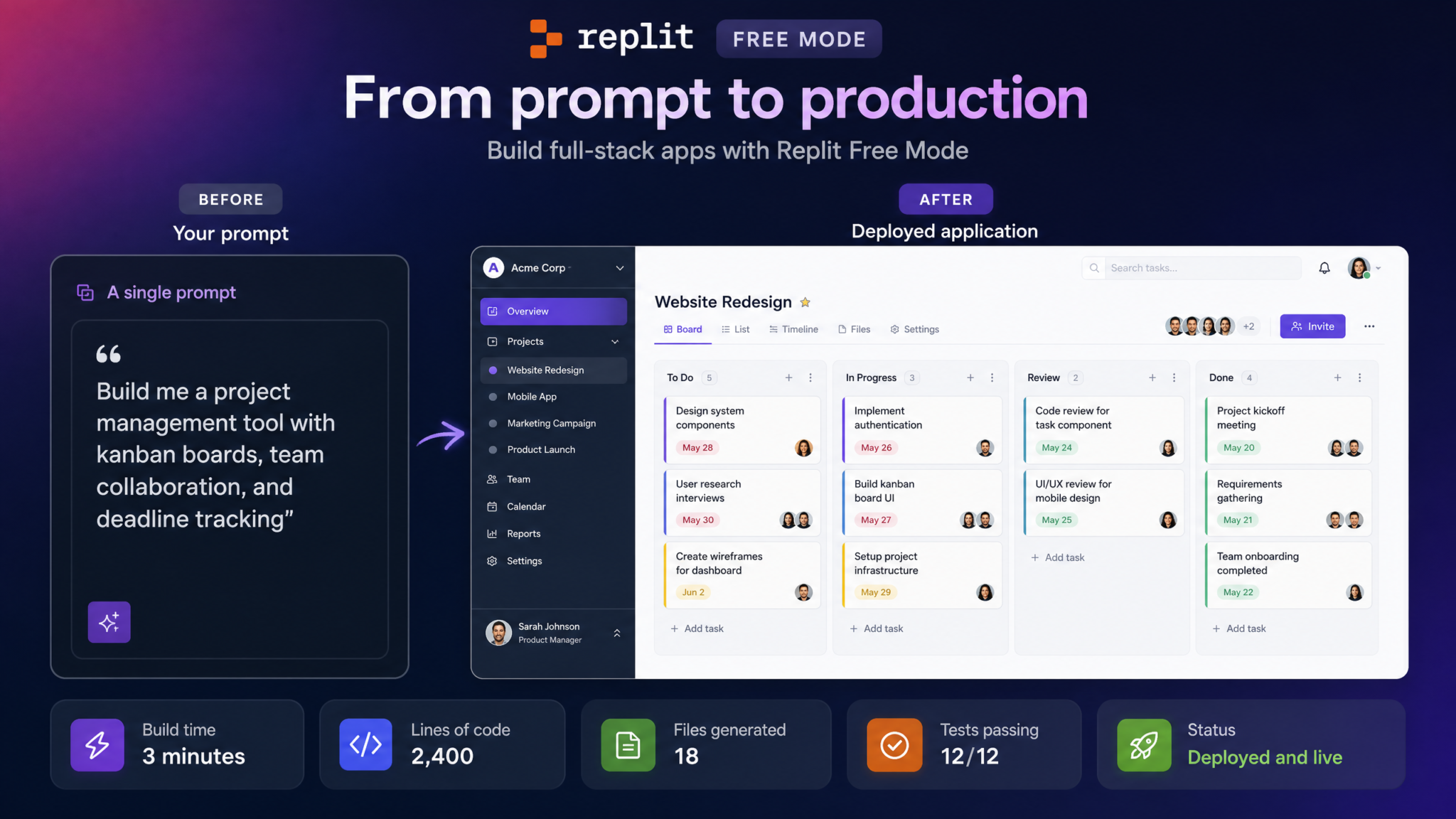
Free Mode’s arrival reshapes the competitive landscape for AI-assisted development tools. Here is a comprehensive comparison of Free Mode against the major paid alternatives as of August 2026:
| Feature | Replit Free Mode | Replit Pro ($25/mo) | Cursor ($20/mo) | Bolt.new ($20/mo) | v0.dev ($20/mo) | Lovable ($25/mo) |
|---|---|---|---|---|---|---|
| Full app from single prompt | ✅ | ✅ | ❌ (IDE assist) | ✅ | ✅ | ✅ |
| Autonomous deployment | ✅ | ✅ | ❌ | ✅ | Partial | ✅ |
| Custom domain support | ❌ | ✅ | N/A | ✅ | ✅ | ✅ |
| Backend + database generation | ✅ | ✅ | Assist only | ✅ | Limited | ✅ |
| Self-healing test loop | ✅ | ✅ | ❌ | Partial | ❌ | Partial |
| Code export / ownership | ✅ | ✅ | ✅ | ✅ | ✅ | ✅ |
| Monthly build limit | 10 deploys | Unlimited | Unlimited (no deploy) | Unlimited | 200 generations | Unlimited |
| Underlying AI model | GPT-5.6 Luna | GPT-5.6 Sol / Luna | Multiple (configurable) | GPT-5.6 Sol | GPT-5.6 Sol | GPT-5.6 Sol |
| Always-on hosting | ❌ | ✅ | N/A | ✅ | ✅ | ✅ |
| Price | $0 | $25/mo | $20/mo | $20/mo | $20/mo | $25/mo |
Several observations emerge from this comparison. First, Cursor occupies a fundamentally different product category — it is an AI-enhanced IDE, not an autonomous app builder. Its inclusion in the comparison is valid because many developers use Cursor as an alternative workflow, but the comparison is somewhat apples-to-oranges.
Second, Bolt.new and Lovable are arguably Free Mode’s closest direct competitors. Both offer autonomous full-stack generation and deployment from prompts, both use more capable models (GPT-5.6 Sol) by default, and both provide always-on hosting and custom domain support. The key differentiator is price: $20–$25 per month versus $0. For a user who needs more than 10 builds per month or requires custom domains and always-on hosting, the paid alternatives offer genuine advantages. For a user experimenting with app building, building a portfolio project, or prototyping an idea, Free Mode’s zero-cost proposition is extraordinarily compelling.
Third, v0.dev’s focus on UI component generation gives it a niche that Free Mode doesn’t directly compete with — v0 excels at design-system-aware component generation, while Free Mode is optimized for full application output.
Replit Pro vs Cursor vs Bolt.new: Which AI Coding Tool Is Worth Paying For in 2026
Impact on the No-Code and Low-Code Market
Free Mode’s arrival is a significant threat to established no-code and low-code platforms, and that threat deserves careful analysis rather than breathless proclamation. The no-code market was valued at approximately $31.4 billion in 2025, with platforms like Bubble, Webflow, Framer, and Glide serving millions of non-technical users who wanted to build applications without writing code.
The Value Proposition Collapse
The core value proposition of no-code platforms was always access: they allowed non-developers to create applications by interacting with a visual interface rather than a text editor. The implicit premise was that visual interfaces were more accessible than code. Free Mode challenges this premise directly. Natural language is more universally accessible than any drag-and-drop interface. The cognitive load of describing what you want in plain English is lower than learning a platform-specific visual paradigm.
Bubble, for instance, has a learning curve that community surveys consistently rate as taking 40–80 hours to become productive with. Webflow’s CMS and interaction layers require meaningful conceptual investment. In contrast, Free Mode’s entry barrier is the ability to write a coherent paragraph — a skill threshold essentially all potential users already meet.
Where No-Code Platforms Retain Advantages
That said, no-code platforms are not about to disappear. They retain meaningful advantages in specific scenarios:
- Visual customization workflows: Non-technical users who want to iteratively adjust layouts, colors, and content without re-describing everything to an AI agent find visual editors more productive for this specific workflow.
- Complex integrations ecosystems: Bubble’s integration marketplace and Zapier/Make.com connectors represent years of built-up integration work that AI-generated applications cannot easily replicate without manual API configuration.
- Non-technical ongoing maintenance: A non-developer who needs to update content, adjust workflows, or add new fields to a form finds a visual no-code interface more approachable than modifying generated code — even with AI assistance.
- Compliance and enterprise features: SOC 2 compliance, SSO, audit logs, and enterprise access controls are well-established in mature no-code platforms but remain gaps in AI-generated application stacks.
The platforms most vulnerable to Free Mode disruption are those in the “simple website builder” category — tools like Squarespace, Wix, and Carrd — where the primary output is relatively simple web presences that Free Mode can generate with high reliability and without the subscription costs those platforms charge.
Market Restructuring, Not Market Elimination
Industry analysts at firms tracking the development tools space have begun revising their no-code market projections downward. Where previous forecasts projected 28% CAGR through 2030, revised estimates as of Q3 2026 project growth compression to 14–18% CAGR, with lower-complexity platforms seeing flat or declining revenue and enterprise-focused platforms continuing healthy growth. The no-code market is being restructured, not eliminated.
Is Free AI App Building Good or Bad for Learning to Code?
This question has generated one of the most genuinely interesting debates in developer communities following Free Mode’s launch. The positions are substantive on both sides, and the reality is more nuanced than either camp tends to acknowledge.
The Concern: Abstraction Without Understanding
The traditional argument against tools that abstract away complexity is that understanding the underlying mechanics is essential for debugging, scaling, and extending software. If you don’t understand why a React component re-renders, you will struggle to debug performance issues. If you don’t understand SQL query planning, you will build applications that scale poorly. If you don’t understand HTTP semantics, you will write APIs that behave unexpectedly.
Access 40,000+ AI Prompts for ChatGPT, Claude & Codex — Free!
Subscribe to get instant access to our complete Notion Prompt Library — the largest curated collection of prompts for ChatGPT, Claude, OpenAI Codex, and other leading AI models. Optimized for real-world workflows across coding, research, content creation, and business.
Free Mode, in its default form, generates code that users can read but may not understand. A user who has built 20 applications with Free Mode may have developed strong product intuition without developing the debugging or architecture skills that working directly with code provides. This is a real risk, and experienced developers who have mentored junior developers recognize the pattern.
The Counter-Argument: Accessible Entry Points Drive Eventual Depth
The counter-argument, equally compelling, is that the best way to make someone care about understanding code is to first make them care about building things. Free Mode provides an extraordinarily accessible entry point that can hook users into the domain of software development before they ever encounter a syntax error or a confusing documentation page.
Historical precedents are instructive. The introduction of high-level languages in the 1960s and 70s produced exactly the same debate — would programmers who didn’t write assembly never truly understand computers? In practice, generations of programmers learned high-level languages first, became productive quickly, and then acquired lower-level knowledge as their ambitions outgrew their tools. Free Mode may function as a modern version of BASIC: a tool that makes programming accessible to non-experts while creating a natural on-ramp to deeper expertise.
Replit has recognized this explicitly in how they’ve designed Free Mode’s interface. The generated code is always visible, readable, and editable. The agent explains its architectural decisions in plain language. When something goes wrong and a user wants to understand why, the explanation is right there in the code. Whether users avail themselves of that transparency is up to them — but the scaffolding for learning is present.
The Educator’s Perspective
Computer science educators have predictably diverse reactions. Some professors at institutions with strong CS programs have announced they will ban Free Mode from introductory courses, citing concerns about academic integrity and the importance of working through foundational material manually. Others have embraced it as a teaching tool — assigning students to generate applications with Free Mode, then modify and extend them, then debug intentionally introduced errors. The latter approach treats AI-generated code as a learning artifact rather than a shortcut.
The most thoughtful pedagogical responses recognize that “learning to code” is not a single skill but a cluster of competencies: problem decomposition, algorithmic thinking, debugging, reading documentation, understanding system architecture, and writing clean code. Free Mode diminishes the importance of syntactic fluency while potentially enhancing problem decomposition and system thinking skills — if used intentionally.
How to Learn Software Development in 2026 When AI Writes Most of the Code
Replit’s Business Model: How Free Mode Actually Makes Money
Offering a genuinely capable product for free inevitably raises the question of how the company behind it sustains itself. Replit’s Free Mode is not altruism — it’s a carefully calculated business strategy with multiple revenue mechanisms.
Freemium Conversion
The most straightforward revenue mechanism is freemium conversion. A user who builds a compelling application on Free Mode and wants to give it a proper domain name, keep it running 24/7, or build more than 10 applications per month will encounter the upgrade prompt. At $25/month for Replit Pro, the conversion needs to be relatively modest to cover the cost of free users plus generate profit.
Replit has not publicly disclosed its freemium conversion rates, but industry benchmarks for developer tools with strong free tiers range from 3–8%. If Free Mode’s viral growth delivers 5 million active free users and converts at even 4%, that’s 200,000 paying users generating $60 million in annual recurring revenue from subscriptions alone.
Enterprise Upsell
Above the Pro tier sits Replit Enterprise, targeted at companies that want to deploy Free Mode-style agent workflows internally with private model endpoints, SOC 2 compliance, SSO, and deployment to private infrastructure. Enterprise pricing is not publicly listed but is estimated by industry observers at $45–$85 per seat per month. The funnel works as follows: a developer at a company discovers Free Mode for personal projects, becomes an advocate, and creates internal pressure for the company to adopt enterprise tools. This “bottom-up” enterprise sales motion has been highly effective for developer-focused companies.
Infrastructure Revenue
Beyond subscriptions, Replit generates revenue from its hosting infrastructure. Pro and Enterprise customers who build high-traffic applications pay for compute, bandwidth, and database storage above their plan allocations. As Free Mode drives more users to build and host applications on Replit’s infrastructure, the aggregate compute demand generates meaningful infrastructure revenue even from users who don’t upgrade to Pro — through the eventual need to handle real traffic at scale.
AI Marketplace and Premium Models
Replit has also introduced a token-based system that allows free users to purchase access to GPT-5.6 Sol (the more capable model) for specific high-complexity builds. This creates an additional revenue stream that sits between entirely free and full Pro subscription — a pay-per-use option for users who want Sol’s capability occasionally without committing to a monthly plan.
Community Reaction and Early Projects Built with Free Mode
The developer community’s reaction to Free Mode has been a fascinating mix of excitement, skepticism, and genuine surprise at what the tool can produce. Within 48 hours of launch, several Free Mode-built applications had gained significant attention on social platforms.
Standout Early Projects
The “Neighborhood Library” App: A community member in Portland built a book-lending application for their neighborhood in approximately 12 minutes using Free Mode. The application allows neighbors to list books they own and are willing to lend, browse available books by genre, and request loans. The application was built from a single 87-word prompt, runs on a PostgreSQL backend, has user authentication, and was shared on Reddit’s r/Portland where it gained 3,400 upvotes and inspired similar apps in six other cities within a week.
The Language Learning Flashcard App: A high school student in South Korea built a spaced-repetition flashcard application for learning Korean vocabulary, complete with a study session mode, progress tracking dashboard, and deck sharing functionality. She reported having no prior coding experience and spending 23 minutes total — including iteration prompts — to produce the finished application now used by her entire English class.
The Local Business Directory: A community organizer in rural Montana built a directory application for small businesses in her county, complete with a map integration, business profiles with hours and contact information, and a user review system. The application received local news coverage and has processed over 1,200 business listings in its first week.
Critical Perspectives from Experienced Developers
Senior developers reviewing the generated code have raised legitimate quality concerns. Common observations include: generated test suites that have low branch coverage and often test only the happy path, database schemas that lack proper indexing for performance at scale, missing input sanitization in certain edge cases, and frontend code that doesn’t always follow accessibility best practices (missing ARIA labels, improper heading hierarchies). These are real issues that would need to be addressed before deploying a Free Mode-generated application to a production environment with significant user traffic or sensitive data.
The consensus among experienced developers seems to be: Free Mode output is production-quality for low-stakes applications (portfolios, community tools, personal projects, prototypes) and development-quality for higher-stakes applications (requiring significant security review and refactoring before production deployment).
Hacker News and Twitter Debate
The Hacker News thread on Free Mode’s launch contained 847 comments within 24 hours, making it one of the most-commented posts of the year on the platform. Top-voted comments ranged from enthusiastic (“This is the moment I’ve been waiting for since I started learning to code — I have so many ideas I could never build alone”) to cautionary (“Please, for the love of Dijkstra, review the generated code before putting real user data into these apps”) to philosophical (“Software development just became a commodity. The question is what human judgment contributes now”).
Predictions for the AI App Builder Market
Free Mode’s launch is not an endpoint — it’s an inflection point. The AI app builder market will look substantially different in 12 and 24 months than it does today, and several trajectories seem highly probable.
The Race to Free Will Compress Paid Plans
Replit’s Free Mode will force its paid competitors to restructure their pricing. Bolt.new, Lovable, and v0.dev all currently charge $20–$25 per month for capabilities that are meaningfully (but not categorically) better than Free Mode. Within 12 months, expect at least one of these platforms to introduce a substantive free tier, compressing margins across the entire category. The platforms that survive this compression will be those that have developed genuine differentiation — in design quality, enterprise features, or integration ecosystems — rather than those whose primary moat was access to capable AI models at reasonable prices.
Model Quality Will Cease to Be a Differentiator at the Low End
As inference costs continue to fall and model capability continues to rise, the quality gap between “free” and “paid” model tiers will shrink toward irrelevance for common application types. Within 18 months, the models accessible on free tiers will be capable of building applications that today’s paid models struggle with. The competitive battleground will shift entirely to infrastructure quality, developer experience, ecosystem integrations, and enterprise compliance — areas where sustained investment and operational expertise matter more than access to the latest model.
Specialization Will Emerge as a Survival Strategy
Horizontal AI app builders — tools that try to build any application from any prompt — will face intensifying competition as the quality floor rises. Platforms that specialize in specific verticals (e-commerce applications, internal business tools, SaaS startups, mobile applications) and develop deep domain-specific capabilities within those verticals will carve out defensible positions. Expect to see AI app builders optimized specifically for healthcare applications (with built-in HIPAA compliance scaffolding), fintech applications (with regulatory-aware architecture patterns), and B2B SaaS (with multi-tenancy and billing integration as first-class features).
The Developer Role Evolves Again
The most profound prediction is about the nature of software development as a profession. Free Mode accelerates a trend that has been building since the introduction of AI coding assistants: the shift from software developers as writers of code to software developers as architects of systems, curators of AI-generated code, and domain experts who translate business requirements into production-quality applications.
This is not the elimination of software development as a profession. It is its elevation. The developers who thrive in this environment will be those who develop strong judgment about system architecture, security, scalability, and user experience — judgment that no AI agent can fully replicate because it requires understanding the specific context, constraints, and humans of each project in ways that extend beyond what any prompt can fully capture.
Free Mode doesn’t replace software developers. It raises the floor for everyone else — and in doing so, it raises the bar for what makes a software developer genuinely valuable. The skills that matter are not changing because of AI; they are becoming more visible, because the rote work that previously obscured them is being automated away.
The Future of Software Development Jobs: What AI Agents Mean for Developer Careers
Infrastructure Becomes the New Moat
As model quality commoditizes and pricing compresses, the durable competitive advantage in the AI app builder market will belong to platforms with the best infrastructure — faster builds, more reliable deployments, better CDN integration, superior database performance, and robust scaling capabilities. Replit’s decision to invest heavily in infrastructure over the past three years, building out a global edge deployment network and a managed database layer, looks prescient in retrospect. The infrastructure moat is harder to replicate than the AI integration moat, and it compounds with scale in ways that per-token pricing advantages do not.
Final Assessment: A Genuine Inflection Point
Replit Free Mode, powered by GPT-5.6 Luna, represents a genuine inflection point in the accessibility of software creation. Not a gimmick, not a marketing stunt, and not a feature that sounds impressive in a press release but disappoints in practice. It is a functional, capable, free AI agent that builds real applications from natural language descriptions — and it works well enough to be genuinely useful to millions of people who previously had no path to turning their software ideas into running applications.
Its limitations are real: the 10-deploy-per-month ceiling, the sleeping hosts, the lack of custom domains, and the capability ceiling of Luna for complex applications. For professional developers building production systems, Free Mode is a starting point at best and a prototype tool at most. For everyone else — the student with an idea, the small business owner who needs a custom tool, the researcher who wants to build a data collection interface, the community organizer who wants to build something for their neighborhood — Free Mode is transformative.
The August 19, 2026 announcement will be remembered not just as a product launch but as the moment when building software stopped being something that required years of technical training or hundreds of dollars per month in subscriptions. The barriers to software creation have been falling for decades, but they rarely fall this fast, this far, and this free.
The real test is not whether Replit’s bet on Luna’s economics was correct — the math is clear enough that it probably was. The real test is whether the millions of people who sign up to build their first application with Free Mode will discover that software creation is something they want to do more of, in greater depth, with greater craft. If they do, Replit’s freemium conversion funnel will be exactly as productive as the company is betting it will be. And the software development world will have acquired a generation of new participants who arrived through a door that, until August 19, 2026, didn’t exist.