
How to Build a ChatGPT-Powered Study System for Students: Complete Playbook for Quizzes, Flashcards, Essay Feedback, and Exam Preparation
How to Build a ChatGPT-Powered Study System for Students: Complete Playbook for Quizzes, Flashcards, Essay Feedback, and Exam Preparation
Most students use ChatGPT the same way they use Google — they type a question, read an answer, and close the tab. That is the least effective way to learn with AI. The students who are quietly outperforming their peers are doing something fundamentally different: they have built systematic, repeatable study workflows that use ChatGPT as a tutor, quiz master, writing coach, and scheduling engine — all working together. This playbook gives you every piece of that system, built from the ground up, covering everything from your very first custom instruction to the week before finals.
Why a System Beats Ad-Hoc Prompting
A 2023 study from Stanford’s Graduate School of Education found that students who used structured AI-assisted study routines scored an average of 22% higher on retention tests compared to peers who used AI tools sporadically. The difference was not access to better technology — it was consistency of method. When every study session follows a predictable architecture, your brain learns how to learn. AI becomes the scaffolding, not the crutch.
Ad-hoc prompting looks like this: “Explain the French Revolution.” A well-designed system looks like this: “Given my lecture notes from Week 4, generate 10 multiple-choice questions at a medium difficulty level on causes of the French Revolution, then evaluate my answers and give me a score with explanations for each wrong answer.” The second approach creates active recall, immediate feedback, and a performance record — three pillars of effective learning science.
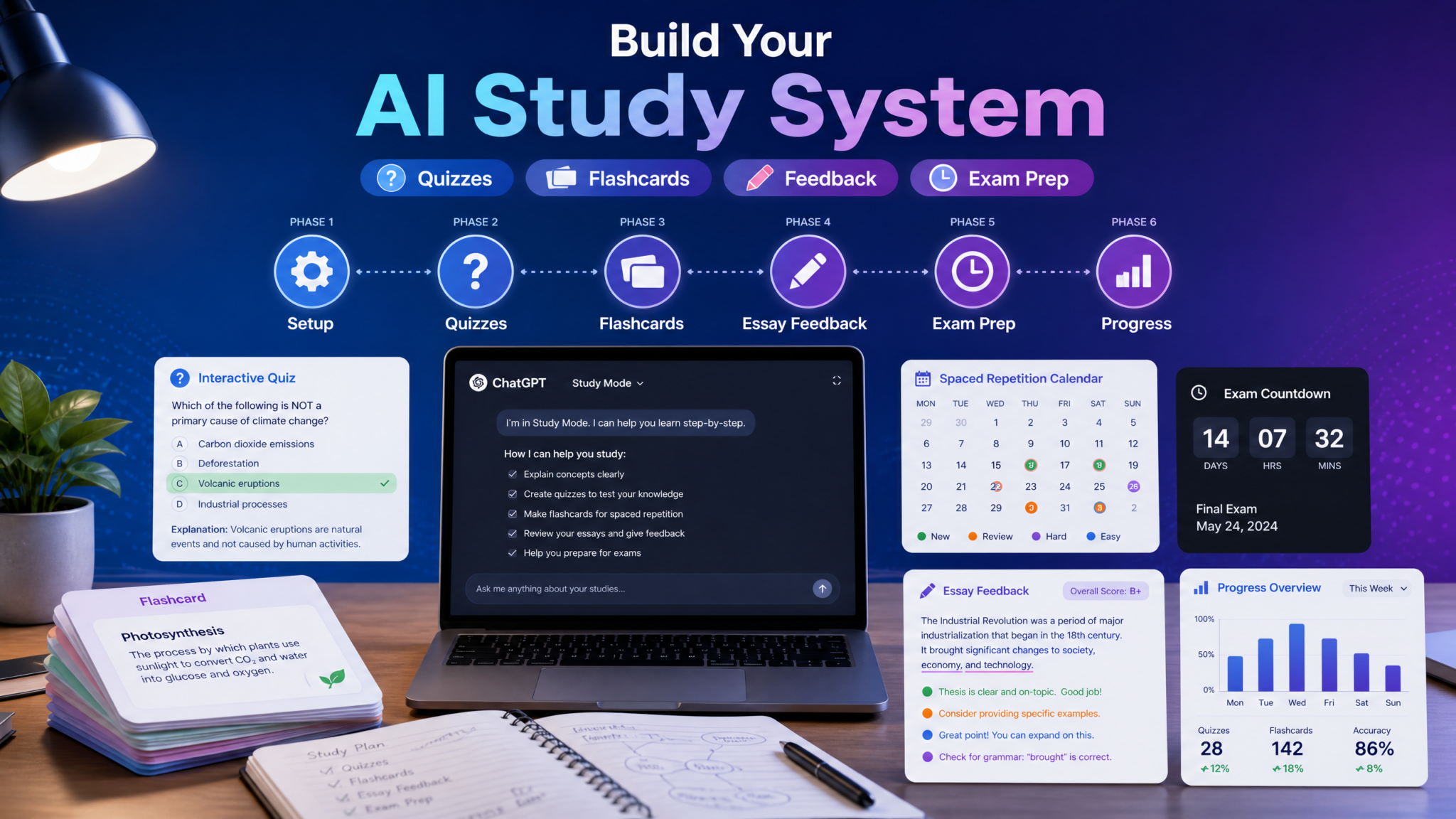
This playbook is organized into six phases that build on each other. You can implement them in sequence over a single weekend, or adopt them phase by phase over a semester. Either way, by the end, you will have a personalized AI-powered study infrastructure that adapts to your courses, your weaknesses, and your exam calendar.
Phase 1: Set Up Your Study Environment
1.1 Configure ChatGPT Custom Instructions for Your Courses
Custom Instructions are the single most underused feature in ChatGPT for students. Accessed through Settings → Personalization → Custom Instructions, this two-field system lets you define who you are and how ChatGPT should respond — once, permanently, across every conversation.
Here is a high-performing student template for the “What would you like ChatGPT to know about you?” field:
I am a third-year undergraduate student majoring in Biochemistry with a minor in Statistics.
My current active courses are: Biochemistry II (BIO 302), Organic Chemistry Lab (CHEM 215),
Biostatistics (STAT 310), and Technical Writing (ENG 201).
My exam schedule runs from December 8–15.
I learn best through questions, not passive explanations.
I want to be pushed on weak areas and praised sparingly.
And for the “How would you like ChatGPT to respond?” field:
When I am studying, default to quiz mode unless I say otherwise.
Ask me questions before giving me answers.
When I get something wrong, explain the correct reasoning, then ask a follow-up question
to confirm I understood. Do not write essays or assignments for me — instead help me improve
my own drafts by identifying weaknesses. Always use my course names when referencing material.
Format flashcards using the structure: FRONT: [concept] / BACK: [definition + one example].
This setup means every conversation starts with context. You do not need to re-explain your situation each time, saving approximately 3–5 minutes per session and ensuring more targeted responses from the very first message.
1.2 Create Subject-Specific Conversation Templates
One of the most powerful organizational habits is to use a dedicated ChatGPT conversation per subject. Do not mix your Organic Chemistry prep with your essay feedback for English Literature. The conversation history becomes a coherent log of your progress, and you can scroll back to see which concepts caused trouble weeks ago.
Create a naming convention and stick to it. Recommended format:
| Conversation Name | Purpose | Frequency of Use |
|---|---|---|
| BIO302 — Quiz Sessions | Active recall quizzes from lecture notes | 3× per week |
| BIO302 — Flashcard Review | Spaced repetition card review | Daily (15 min) |
| CHEM215 — Lab Reports | Draft feedback and rubric evaluation | After each lab |
| ENG201 — Essay Tutor | Argument structure and clarity feedback | Per assignment |
| EXAM PREP — Master Schedule | Countdown calendar and weak-area tracking | Weekly update |
1.3 Organize Study Materials for AI Input
ChatGPT is only as useful as the material you give it. Before each study session, prepare a “material packet” — a clean text block of the content you want to work with. Here is the optimal workflow:
- Digitize your notes: If you handwrite notes, spend 10 minutes after each lecture typing a bullet-point summary. This also doubles as your first review of the material.
- Strip unnecessary formatting: Remove headers, footnotes, and page numbers from PDF textbook passages before pasting. Clean text produces better AI responses.
- Chunk by concept: Do not paste 30 pages at once. Break material into concept clusters of 400–800 words. Label each chunk (e.g., “Week 3 Lecture: Enzyme Kinetics — Michaelis-Menten Model”).
- Create a master reference document: Keep a running document (Google Docs works well) with all your chunked material organized by week. When you need it, copy-paste directly into ChatGPT.
1.4 Setting Up the Interactive Quiz Features (August 14, 2024 Update)
OpenAI’s August 14, 2024 update introduced enhanced interactive quiz capabilities within ChatGPT, including real-time answer evaluation within the same turn, multi-step progressive quizzes, and improved follow-up branching logic based on your responses. To activate these features intentionally in your sessions, use this initialization prompt at the start of each quiz conversation:
We are starting a quiz session for [COURSE NAME].
Here is my source material: [PASTE NOTES].
Run this as an interactive quiz:
- Present one question at a time
- Wait for my answer before proceeding
- Evaluate my answer immediately (correct/partially correct/incorrect)
- If incorrect, explain why, then ask a reinforcing follow-up question
- Track my running score throughout the session
- At the end, give me a performance summary broken down by subtopic
Ready? Begin with question 1.
This prompt structure takes full advantage of the updated session management logic, keeping the model in “quiz master mode” throughout the entire conversation without reverting to passive explanation.
Phase 2: Create Adaptive Quizzes
2.1 Generating Multiple-Choice Quizzes from Lecture Notes
Multiple-choice questions are the most common exam format in STEM and social science courses. Generating high-quality MCQs from your own notes creates questions that are directly calibrated to what your professor emphasized — a massive advantage over generic textbook review questions.
Use this prompt template:
Based on the following lecture notes, generate 10 multiple-choice questions.
Requirements:
- 4 answer choices per question (A, B, C, D)
- One unambiguously correct answer
- Three plausible distractors that represent common misconceptions
- Mix of recall, comprehension, and application questions (3/4/3 ratio)
- Label each question with the subtopic it tests
- Do NOT show answers yet — I will attempt all 10 first

[PASTE NOTES HERE]
After you attempt the quiz, use this follow-up:
Here are my answers: [LIST YOUR ANSWERS]
Now evaluate each one. For every question I got wrong:
1. Explain why my answer was incorrect
2. Explain why the correct answer is right
3. Give me one additional question on that same subtopic to test understanding
This creates a self-reinforcing feedback loop where each wrong answer generates new learning material immediately.
2.2 Fill-in-the-Blank Tests from Textbook Chapters
Fill-in-the-blank exercises are particularly effective for courses with heavy technical vocabulary — biochemistry, law, linguistics, and history. The cognitive process of retrieving a specific term activates deeper encoding than recognition alone.
Convert the following textbook passage into a fill-in-the-blank exercise.
- Remove 12–15 key terms, replacing each with [___]
- Include a word bank at the bottom (add 4 decoy words not from the passage)
- After I complete it, grade my responses and explain any errors in context

[PASTE TEXTBOOK PASSAGE]
2.3 Scenario-Based Questions for Applied Learning
For professional programs — nursing, engineering, business, law — scenario-based questions are essential because real exams (NCLEX, PE, CPA, bar) test application, not memorization. Tell ChatGPT explicitly to generate case-based questions:
I am studying for my Nursing Pharmacology exam. Using my notes on beta-blockers,
create 5 clinical scenario questions. Each scenario should:
- Describe a realistic patient situation
- Include relevant vitals or lab values
- Ask what the nurse should do or assess first
- Require application of pharmacological principles, not just recall

[PASTE NOTES]
2.4 Progressive Difficulty Scaling
One of the most powerful techniques in the updated ChatGPT quiz system is dynamic difficulty adjustment. You can ask ChatGPT to calibrate question difficulty based on your live performance:
I am doing an adaptive quiz on Organic Chemistry Mechanisms.
Start at difficulty level 2 out of 5.
- If I answer 3 questions correctly in a row, increase difficulty by 1 level
- If I answer 2 questions incorrectly in a row, decrease difficulty by 1 level
- Tell me the current difficulty level before each question
- At level 5, include multi-step synthesis problems
Begin.
This mirrors how commercially built adaptive learning platforms like Knewton and McGraw-Hill’s ALEKS function — but personalized to your exact course material at no additional cost.
2.5 Timed Exam Simulations
Exam anxiety is partly a timing problem. Students who have never practiced under time pressure experience significant cognitive interference on exam day. Use ChatGPT to run timed simulations:
Run a 25-question timed exam simulation for BIO302.
- Present all 25 questions at once (numbered)
- Tell me I have 45 minutes (I will track my own time)
- Mix question types: 15 MCQ, 5 short answer, 5 fill-in-the-blank
- After I submit all answers, grade them and give me:
  1. A percentage score
  2. A breakdown by question type
  3. A list of concepts to review based on my errors
  4. A comparison to my previous simulation score if I provide it

[PASTE COURSE MATERIAL]
Phase 3: Build a Spaced Repetition Flashcard System
3.1 Converting Course Material into Flashcard Format
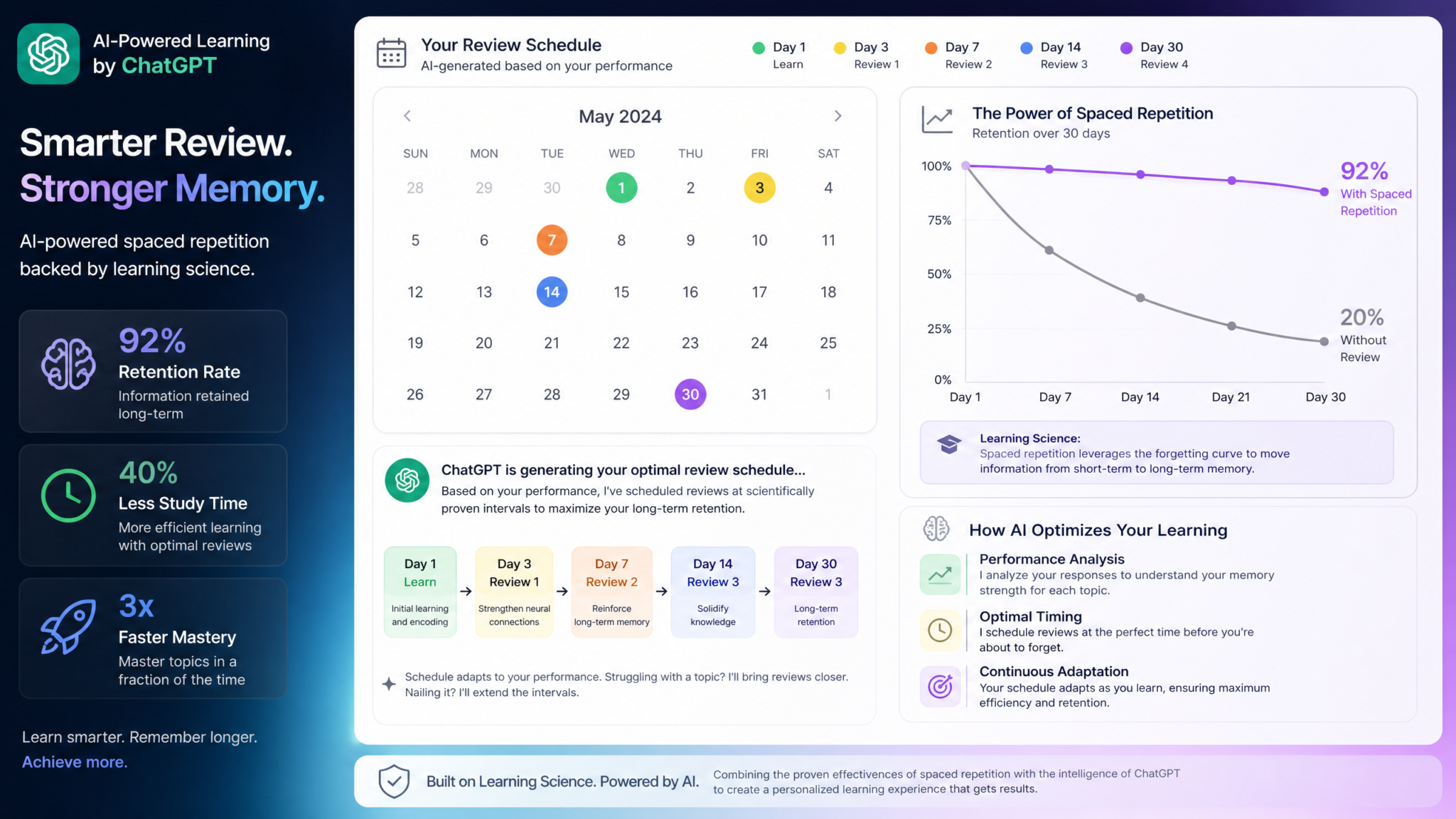
Spaced repetition is the most research-supported study technique in cognitive science. Hermann Ebbinghaus’s forgetting curve, first published in 1885 and replicated dozens of times since, shows that without review, humans forget approximately 70% of new information within 24 hours. Spaced repetition counteracts this by scheduling reviews just before the point of forgetting.
Apps like Anki implement the SM-2 algorithm for automatic scheduling. With ChatGPT, you can replicate this system manually — especially useful for students who do not want to maintain a separate app but still want the cognitive benefits of spaced review.
First, generate your flashcard deck:
Convert the following course material into flashcards.
Format each card exactly as:
CARD [NUMBER]
FRONT: [Concept, term, or question — maximum 15 words]
BACK: [Definition or answer — 2–4 sentences maximum, include one concrete example]
DIFFICULTY: [Rate 1–5 based on typical student performance, where 5 = hardest]

Generate 20 cards from this material. Prioritize terms and concepts that are
testable on exams, not peripheral details.

[PASTE NOTES OR TEXTBOOK PASSAGE]
3.2 Implementing SM-2 Algorithm Scheduling with ChatGPT
The SM-2 algorithm assigns each flashcard a review interval based on how well you recalled it. The core logic is straightforward:
| Your Rating | Description | Next Review |
|---|---|---|
| 0 — Blackout | Complete fail, no recall | Same day |
| 1 — Wrong | Incorrect but familiar | Next day |
| 2 — Partial | Correct with difficulty | 2 days |
| 3 — Correct (hard) | Right but slow | 4 days |
| 4 — Correct (good) | Right with minor hesitation | 8 days |
| 5 — Correct (easy) | Instant, confident recall | 16+ days |
To implement this in ChatGPT, create a Card Tracker document (a simple spreadsheet works perfectly) with columns: Card ID, Front, Back, Last Review Date, Rating, Next Review Date. After each session, paste your results into ChatGPT and ask it to calculate your next review schedule:
Here is my flashcard performance from today's review session (Date: [DATE]):
Card 1: Rating 4
Card 2: Rating 2
Card 3: Rating 5
Card 4: Rating 1
Card 5: Rating 3
[Continue for all cards]

Using the SM-2 algorithm, calculate the next review date for each card.
Today is [DATE]. Output in a table format I can paste into my tracker.
3.3 Creating Two-Sided Cards with Explanations
Basic definition cards work for vocabulary. But for conceptual material — theories, processes, causal relationships — you need enriched cards that include the why, not just the what. Request enriched cards with this template:
Create 10 enhanced flashcards on the topic of [TOPIC].
Each card should have:
FRONT: A question that requires reasoning, not just recall
  (e.g., "Why does enzyme activity decrease above optimal temperature?"
  not "What is enzyme optimal temperature?")
BACK:
  - Direct answer (1–2 sentences)
  - Mechanistic explanation (2–3 sentences)
  - Memory hook or analogy
  - One common exam trap related to this concept
This format produces cards that build genuine understanding, not just surface-level pattern matching. Students who review enriched cards consistently report significantly higher confidence on application questions compared to students reviewing simple definition cards.
3.4 Tracking Cards That Need More Review
At the end of each week, bring your tracker data into ChatGPT for a priority analysis:
Here is my flashcard performance data from the past week:
[PASTE YOUR TRACKER DATA]

Analyze this data and:
1. Identify the 5 cards with the lowest average ratings
2. Identify any cards I have rated below 3 more than twice
3. Suggest whether these cards need to be:
   a) Rewritten with a different explanation
   b) Broken into smaller sub-cards
   c) Linked to related concepts I may be missing
4. Generate 3 new questions specifically targeting the weak concepts behind my worst-rated cards
3.5 Weekly Review Session Generation
Every Sunday (or whichever day precedes your heaviest study week), run a weekly deck generation session. Provide ChatGPT with your due cards and ask for a structured 20-minute review session:
Generate my weekly flashcard review session.
Cards due for review: [LIST CARD IDs OR PASTE CARD CONTENT]
Total session time: 20 minutes
Format:
- Present cards in batches of 5
- After each batch, ask me to rate my performance (0–5 per card)
- Between batches, give me a 30-second motivational insight about my progress
- End with a 3-question mini-quiz on the hardest cards from this session
How to Use ChatGPT Custom Instructions for Productivity and Learning
Phase 4: Get Essay and Assignment Feedback
4.1 Using ChatGPT as a Writing Tutor, Not a Ghostwriter
This distinction is both ethical and practical. When ChatGPT writes your essay, you learn nothing and risk academic integrity violations. When ChatGPT coaches your essay, you develop skills that compound over time and perform better on in-class writing exams. The key is structuring your prompts so that ChatGPT responds to your work, not produces it.
The foundational writing tutor prompt:
You are acting as my writing tutor, not my ghostwriter.
Do NOT rewrite my essay. Instead, analyze my draft and provide:
1. Specific passages that are unclear or weakly argued (quote them exactly)
2. Questions that reveal gaps in my reasoning
3. Suggestions in the form of "consider addressing..." or "your argument would strengthen if..."
4. Things I am doing well that I should preserve

Here is my draft: [PASTE DRAFT]
Here is the assignment prompt: [PASTE PROMPT]
Here is the grading rubric: [PASTE RUBRIC OR DESCRIBE REQUIREMENTS]
4.2 Rubric-Based Essay Evaluation
Most students never re-read the rubric after first glancing at it. A rubric-based ChatGPT evaluation forces alignment between your writing and what is actually being graded. Use this structured evaluation prompt:
Evaluate my essay using the following rubric.
For each criterion, provide:
- A score out of the maximum points available
- Specific evidence from my essay supporting that score (quote relevant sentences)
- One concrete suggestion to improve that criterion

Rubric:
- Thesis clarity and specificity (20 points)
- Quality of evidence and analysis (30 points)
- Argument structure and flow (20 points)
- Use of sources and citation accuracy (15 points)
- Grammar, style, and clarity (15 points)

Essay: [PASTE YOUR ESSAY]
This technique has a reported GPA-lifting effect when used consistently. When students see their own work scored against specific criteria, they internalize rubric thinking — they start writing to the rubric from the first draft, which is exactly what high-achieving students naturally do.
4.3 Structural Feedback on Arguments
Beyond rubric scoring, argument architecture matters enormously in humanities courses. A well-structured argument has a clear claim, supporting premises, acknowledged counterarguments, and a synthesis. Request architectural feedback separately:
Analyze the logical structure of my essay argument only (ignore grammar and style).
Map out:
1. My central thesis (state it in one sentence as I have written it)
2. Each supporting argument and the evidence I provide for it
3. Any logical gaps between my claims and my evidence
4. Counterarguments I have addressed vs. counterarguments I have ignored
5. Whether my conclusion restates, synthesizes, or extends my thesis (and which it should do)

Essay: [PASTE ESSAY]
4.4 Citation Checking
While ChatGPT cannot verify live database access to confirm a source exists, it can check for formatting accuracy and citation consistency — which is where most students lose easy points. Use this for citation review:
Access 40,000+ AI Prompts for ChatGPT, Claude & Codex — Free!
Subscribe to get instant access to our complete Notion Prompt Library — the largest curated collection of prompts for ChatGPT, Claude, OpenAI Codex, and other leading AI models. Optimized for real-world workflows across coding, research, content creation, and business.
Review my bibliography and in-text citations for formatting errors in [APA/MLA/Chicago] style.
Check for:
- Correct author name formatting
- Correct date and publication information placement
- Hanging indent formatting (note if it is present or absent)
- Consistency between in-text citations and bibliography entries
- Common errors: missing DOIs, incorrect capitalization of titles, wrong edition formatting

Citations: [PASTE YOUR REFERENCES LIST]
In-text citations from my essay: [PASTE 5–10 IN-TEXT CITATION EXAMPLES]
4.5 Style and Clarity Improvements
After structural revision is complete, request targeted style editing. Note: this is feedback, not rewriting:
Review the following paragraph for style and clarity.
Do NOT rewrite it. Instead:
1. Identify sentences that are overly passive and suggest the active voice subject
2. Flag nominalizations (turning verbs into nouns) and identify the underlying verb
3. Point out any hedge words I have overused (e.g., "somewhat," "rather," "quite")
4. Identify the longest sentence and suggest where it could be split
5. Rate the paragraph's readability (simple/moderate/complex) and whether that matches the assignment's audience

Paragraph: [PASTE PARAGRAPH]
Phase 5: Create Your Exam Preparation Schedule
5.1 Building a Countdown Study Plan from Your Syllabus
Most students wait too long to start exam preparation. A structured countdown plan, built 4–6 weeks before finals, eliminates last-minute cramming and distributes review sessions across enough time for spaced repetition to work. Here is the master syllabus-to-schedule prompt:
I have 4 exams over a 2-week finals period. Build me a detailed study schedule.

Exam details:
- BIO302 Final: December 10, comprehensive, 80 questions MCQ
- CHEM215 Lab Practical: December 11, 3-hour lab setup and procedure
- STAT310 Final: December 13, problem-based, open notes
- ENG201 Portfolio: December 15, submit 3 revised essays

Today's date: November 12
Available study hours per day: 4 hours (I have class until 4pm)

Build a day-by-day schedule from November 12 to December 15.
Include:
- Which subject to study each day
- What type of activity (quiz, flashcard review, practice problems, essay revision)
- Buffer days for re-review of weak areas identified in mid-schedule assessments
- A 2-day pre-exam review phase for each exam
- Rest days (at least 1 per week — I will burn out without them)
5.2 Identifying Weak Areas from Quiz Performance
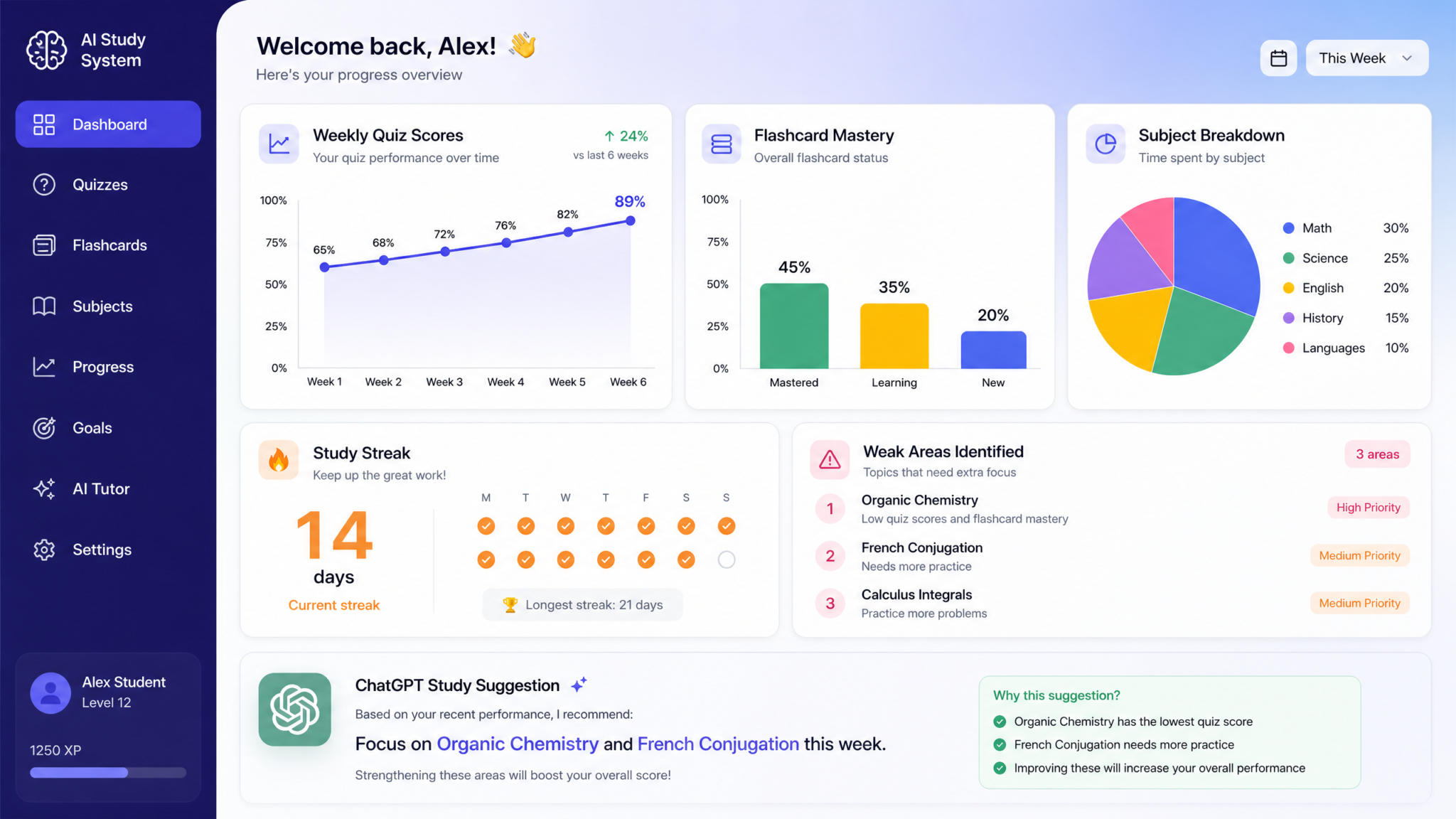
Your quiz history is a diagnostic goldmine. After 3–4 quiz sessions, bring your error log to ChatGPT for a comprehensive weakness analysis:
Here are my quiz results from the past 3 weeks of BIO302 study sessions:

Week 1 errors: Enzyme kinetics (4 wrong), Cell signaling (2 wrong), Membrane transport (1 wrong)
Week 2 errors: Enzyme kinetics (3 wrong), Protein folding (4 wrong), Cell signaling (1 wrong)
Week 3 errors: Protein folding (3 wrong), Gene expression (5 wrong), Enzyme kinetics (2 wrong)

Analyze this pattern and:
1. Rank my weakest areas by cumulative error count
2. Identify which topics are improving vs. plateauing vs. getting worse
3. Suggest the number of additional study hours each weak area needs before exam day
4. Recommend what type of study activity will best address each weak area
5. Flag if any weak area overlaps with topics that typically receive heavy exam weighting in Biochemistry courses
5.3 Allocating Study Time Across Multiple Subjects
Time allocation across subjects is one of the most cognitively difficult tasks students face. Research on optimal study distribution suggests a modified weighted allocation model: assign time proportional to a combination of subject difficulty (your personal rating), exam weight, and current performance gap.
Help me allocate 40 hours of study time across 4 subjects over the next 2 weeks.

Subject data:
- BIO302: Exam weight 35% of grade, my current grade 74%, personal difficulty 4/5
- CHEM215: Exam weight 25%, current grade 81%, personal difficulty 3/5
- STAT310: Exam weight 30%, current grade 88%, personal difficulty 2/5
- ENG201: Exam weight 20%, current grade 79%, personal difficulty 3/5

Allocation priorities:
1. Protect strong subjects (don't let them slip)
2. Maximize grade recovery where it will most impact GPA
3. Account for personal difficulty in realistic effort calculations

Provide a recommended hour split and explain the reasoning behind it.
5.4 Creating Practice Exams from Past Materials
Past quizzes, homework problems, and practice exams are the highest-quality study material available — they are literally calibrated to your professor’s testing style. Use them to build synthesized practice exams:
I am providing materials from 3 previous quizzes and my professor's practice exam.
Create a 30-question comprehensive practice exam that:
- Draws from the highest-frequency concepts across all provided materials
- Maintains the same question style as my professor's materials
- Includes question types that appeared most often in previous assessments
- Adds 5 novel questions that synthesize multiple topics (these are likely on the final)
- Does not repeat questions verbatim from the source materials

Source materials: [PASTE QUIZZES AND PRACTICE EXAM]
5.5 Managing Exam Anxiety with Preparation Confidence
Exam anxiety is a physiological response that preparation directly modulates. Research from the American Psychological Association shows that students who completed at least 3 full practice exams before a test reported 31% lower anxiety levels on exam day compared to students who only reviewed notes. ChatGPT can support this through a structured confidence-building protocol:
I have 5 days until my BIO302 final and I am feeling anxious.
I don't need reassurance — I need a confidence-building plan based on evidence of preparation.

Here is what I have already completed:
- 8 quiz sessions averaging 74% correct
- 3 full spaced repetition review cycles
- 2 practice exams (scores: 68%, 76%)
- Reviewed all flashcards in my deck at least twice

Based on this preparation record:
1. Show me my measurable progress (trend analysis)
2. Identify the 3 most important things to focus on in the remaining 5 days
3. Design a 5-day micro-schedule with specific daily tasks
4. Give me a pre-exam day protocol (what to do the final 24 hours)
How to Use ChatGPT for Time Management and Academic Planning
Phase 6: Track Progress and Adjust
6.1 Weekly Performance Reviews
The difference between students who improve and students who plateau is deliberate reflection. A 10-minute weekly review session at the end of each week transforms scattered study activity into measurable progress. Use this weekly review protocol every Sunday:
Run my weekly academic performance review for the week of [DATES].

Data to analyze:
- Quiz scores this week: [LIST SCORES AND SUBJECTS]
- Flashcard ratings average: [AVERAGE ACROSS ALL DECKS]
- Study hours logged: [HOURS PER SUBJECT]
- Assignments submitted: [LIST]
- One thing that worked well in my study sessions: [YOUR NOTE]
- One thing that did not work: [YOUR NOTE]

Provide:
1. A progress score for the week (out of 10) with justification
2. Three specific observations about my performance patterns
3. One study method I should try next week based on my data
4. An updated priority list for next week's focus areas
5. A one-sentence summary I can use as a weekly anchor statement
6.2 Identifying Knowledge Gaps
Performance data tells you where you are struggling, but it does not always tell you why. A knowledge gap analysis goes deeper, looking at whether errors are conceptual, procedural, or attentional:
Based on my quiz errors this week (listed below), perform a gap analysis.
For each error, categorize it as:
- CONCEPTUAL GAP: I misunderstood the underlying principle
- PROCEDURAL GAP: I knew the concept but made an error in applying it
- RECALL GAP: I knew it once but forgot it
- ATTENTION ERROR: Careless mistake, not a knowledge issue

My errors: [LIST WRONG ANSWERS AND THE CORRECT ANSWERS]

After categorizing, tell me:
- Which gap type is most common for me?
- What study strategy specifically addresses that gap type?
- Which 3 concepts need the most urgent review?
6.3 Adjusting Study Intensity
Study intensity should not be linear. Effective learners modulate their effort based on upcoming deadlines, current mastery levels, and mental fatigue. Use ChatGPT to help calibrate intensity:
I need to adjust my study intensity for the next 3 weeks.
Current context:
- Exam in 3 weeks: BIO302 (my weakest subject)
- Major project due in 10 days: ENG201 paper
- Current average quiz score in BIO302: 71%
- Target score to maintain my grade: 80% on the final
- I have been studying 3 hours per day and feel moderately fatigued

Recommend:
1. Should I increase, maintain, or decrease hours for each subject?
2. How should I shift the ratio of active practice vs. passive review?
3. At what point in the next 3 weeks should I peak my BIO302 intensity?
4. What daily non-study habits should I protect to sustain performance?
6.4 Celebrating Milestones
Behavioral psychology research on study motivation consistently shows that milestone recognition increases follow-through by an average of 40% in self-directed learning contexts. Build this into your system deliberately:
Based on my study log below, identify milestones I have reached this month
that are worth acknowledging:
- Quiz scores improved from X% to Y%
- Number of flashcards mastered (rated 4–5 consistently)
- Study streaks maintained
- Assignments submitted above target quality

Celebrate these concisely — name what I achieved and why it matters for exam performance.
Then set 3 milestone targets for next month.

Study log: [PASTE LOG]
Subject-Specific Templates: STEM, Humanities, and Languages
STEM Template Pack
STEM courses demand problem-solving practice above all else. Passive reading does not build the procedural fluency needed for calculation-heavy exams. These templates prioritize worked examples, error analysis, and multi-step problem generation.
STEM Quiz Generation Prompt:
Generate 8 problem-solving questions for [TOPIC] at three difficulty levels:
- Level 1 (2 questions): Single-step, direct formula application
- Level 2 (4 questions): Multi-step problems requiring concept integration
- Level 3 (2 questions): Non-standard problems where the method is not obvious

For Level 2 and 3 problems, include:
- A hint I can unlock by asking
- The common mistake students make on this problem type
- The expected answer with full worked solution (show after I attempt)

Topic: [TOPIC]
Relevant formulas I have learned: [LIST FORMULAS]
STEM Error Analysis Prompt:
I attempted this problem and got the wrong answer.
Analyze my work step-by-step:
1. Identify the exact step where my reasoning diverged from the correct path
2. Explain the conceptual misunderstanding behind my error
3. Provide the correct solution with each step labeled
4. Generate two similar problems to confirm I now understand the correct method

Problem: [PROBLEM TEXT]
My attempted solution: [YOUR WORK]
Correct answer: [CORRECT ANSWER IF KNOWN]
Humanities Template Pack
Humanities courses test interpretive reasoning, evidence synthesis, and written argumentation. Effective AI-assisted study for humanities focuses on debate practice, source analysis, and essay coaching rather than rote memorization.
Historical Analysis Prompt:
I am studying [HISTORICAL PERIOD/EVENT] for my History exam.
Use Socratic questioning to test my understanding:
1. Start by asking me to explain the main causes of [EVENT]
2. Challenge my explanation with a counter-perspective from the historiography
3. Ask me to evaluate which historical interpretation I find most persuasive and why
4. Identify gaps in my historical reasoning and push back with primary source examples
5. End by asking me to formulate a defensible thesis statement about [EVENT]

Do not lecture me — ask questions and respond to my answers.
Literature Analysis Prompt:
I am analyzing [LITERARY TEXT] for my English Literature course.
Test my analytical reading through this sequence:
1. Ask me to identify the central theme and my evidence
2. Probe whether I am reading literally vs. symbolically
3. Ask me to connect the text to its historical or cultural context
4. Challenge my interpretation with a competing critical reading
5. Ask me to write a 3-sentence analytical claim I could defend in an essay

Stay in Socratic mode throughout — guide my thinking, don't replace it.
Language Learning Template Pack
Language courses require four distinct skill areas: vocabulary, grammar, reading comprehension, and production (speaking/writing). ChatGPT can simulate all four in text-based sessions.
Vocabulary Acquisition Prompt:
I am learning [LANGUAGE] at [BEGINNER/INTERMEDIATE/ADVANCED] level.
Here are 15 vocabulary words I need to master: [LIST WORDS]

Run a vocabulary mastery session:
Round 1: Definition → Target language (I give the word, you confirm or correct)
Round 2: Target language → Definition (reverse recall)
Round 3: Contextual usage — give me a sentence in [LANGUAGE] with the word blanked out; I fill it in
Round 4: Production — give me a concept in English; I write a sentence using the target word naturally

After each round, log which words I missed and repeat them at the end.
Grammar Diagnostic Prompt:
I need to improve my [SPECIFIC GRAMMAR CONCEPT] in [LANGUAGE].
Run a diagnostic:
1. Give me 10 sentences to correct (each contains one error related to this concept)
2. After I submit corrections, identify my error pattern
3. Explain the rule I am misapplying with a clear, concise explanation
4. Generate 10 new sentences at slightly higher complexity for me to correct
5. At the end, predict the most likely exam question format for this grammar rule and show me one example

Concept: [GRAMMAR CONCEPT]
My current level: [LEVEL]
Conversation Simulation for Speaking Exams:
Simulate an oral exam conversation in [LANGUAGE] on the topic of [TOPIC].
Instructions:
- Write your lines in [LANGUAGE] only
- After the conversation ends (8–10 exchanges), switch to English and evaluate:
  1. My grammatical accuracy (rate 1–10 with examples)
  2. My vocabulary range (did I repeat simple words when better options exist?)
  3. My response coherence (did I answer what was asked?)
  4. Three specific phrases I could have used but did not
Start the conversation now.
Common Mistakes Students Make (and How to Avoid Them)
Mistake 1: Using ChatGPT to Read for Them
Asking ChatGPT to summarize your textbook chapter and then reading the summary is not studying — it is passive consumption of pre-digested material. You are skipping the cognitive effort that creates memory traces. The fix: Read the original material first, then use ChatGPT to quiz you on what you read.
Mistake 2: Not Verifying Factual Accuracy
ChatGPT can occasionally generate plausible-sounding but incorrect facts, particularly for highly specific technical content, obscure historical details, or current statistics. The fix: Use ChatGPT-generated quizzes and flashcards as a framework, but always cross-reference key facts against your textbook or lecture slides before committing them to memory.
Mistake 3: Over-relying on One Study Type
Students who only generate MCQs miss the benefits of production tasks. Students who only do flashcards miss the benefits of scenario practice. Research on interleaving — mixing different study types in a single session — shows a 15–30% improvement in long-term retention compared to blocked practice. The fix: Every study session should include at least two different activity types.
Mistake 4: Not Logging Performance Data
Without data, your weekly review is just a vague feeling. With data, it is a diagnostic tool. Students who track even minimal performance metrics — quiz scores, flashcard ratings, hours per subject — make significantly better decisions about where to spend study time. The fix: Spend 2 minutes at the end of every session logging your score and any notes about what felt hard. A Google Sheet with five columns is all you need.
Mistake 5: Treating ChatGPT as an Infallible Tutor
ChatGPT is a powerful study tool, not an oracle. It can misinterpret your notes, generate questions that do not match your professor’s style, or give feedback that diverges from your specific rubric. The fix: Use ChatGPT as a first pass, then confirm with your professor, TA, or textbook on anything that seems inconsistent. Build a habit of skepticism that makes you a better critical thinker.
How ChatGPT Compares to Traditional Tutoring for Academic Support
Putting It All Together: Your First Week Implementation Plan
Reading a playbook and implementing one are different cognitive tasks. Here is a concrete 7-day launch plan to get your full system running without overwhelm:
| Day | Task | Time Required |
|---|---|---|
| Day 1 (Sunday) | Write and activate your Custom Instructions. Create your subject conversation folders. Build your material chunk document for 2 subjects. | 45 minutes |
| Day 2 (Monday) | Run your first interactive quiz session using Phase 2 prompts for your hardest subject. Log the score. | 30 minutes |
| Day 3 (Tuesday) | Generate your first flashcard deck (20 cards) using Phase 3 template. Run your first review session. | 40 minutes |
| Day 4 (Wednesday) | Submit a current draft or assignment for Phase 4 essay feedback. Revise based on feedback. | 60 minutes |
| Day 5 (Thursday) | Run a second quiz session on a different subject. Begin building your exam countdown schedule using Phase 5. | 45 minutes |
| Day 6 (Friday) | Second flashcard review session with SM-2 scheduling. Update your card tracker. | 20 minutes |
| Day 7 (Saturday) | Run your first weekly performance review using Phase 6 template. Set your priority list for next week. | 20 minutes |
Total first-week investment: approximately 4.5 hours — less than a single cramming session, but building infrastructure that will pay dividends across every exam for the rest of your academic career.
What This System Is Not
This system is not a replacement for attending lectures, engaging with your professors, doing assigned readings, or developing your own thinking. ChatGPT-assisted studying is a force multiplier on the inputs you bring to it. Garbage in, garbage out — students who attend class, take genuine notes, and engage with course material will get exponentially more value from this system than students hoping AI will compensate for disengagement.
The most important thing you can build in your academic career is the habit of honest self-assessment: knowing what you know, knowing what you do not know, and taking targeted action on the gap. This system is designed to make that habit frictionless, data-driven, and sustainable.
The best study system is the one you actually use. Start with one phase, run it for two weeks, then add the next. Within a month, you will have a fully operational personalized learning machine built around your courses, your schedule, and your specific academic goals.
A Final Note on Academic Integrity
Every prompt in this playbook is designed to support your learning, not bypass it. Using ChatGPT to quiz yourself, build flashcards, schedule study sessions, and get coaching feedback on your own drafts is equivalent to using a tutoring center, a study group, or a practice workbook. What crosses the line — in terms of both integrity and your own education — is using AI to produce work you submit as your own. The students who will thrive in an AI-augmented world are the ones who develop genuine competence, not the ones who successfully outsource it. This playbook is built on that principle at every stage.